roadwise.Open study app

New Hampshire driving lesson · Signs, Signals, and Markings

Railroad crossings

A 3-minute lesson from the New Hampshire course. Read the rules and examples, follow the handbook page references, and check your understanding before you move on.

Read time
3 minutes
Course unit
Signs, Signals, and Markings
Checkpoint questions
5
Source pages
28, 29

Trains can't stop quickly or swerve. Railroad crossings are marked with signs, lights and signals, and NH sets exact stopping distances for when a train is coming. Some vehicles must stop at every crossing.

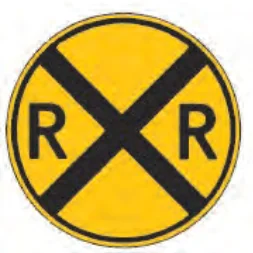
Railroad crossing ahead
Round advance warning sign: RR crossing ahead

Know the rule

A round warning sign with an X and black "RR" letters is placed before a highway-railroad grade crossing: slow down or stop, and look and listen for a train before proceeding.

Handbook p. 29 ↗

Know the rule

A crossbuck (X) marks where the railroad crossing actually is.

Handbook p. 28 ↗

Know the rule

When a train or railroad vehicle is approaching, stop behind the stop line or not less than 15 feet nor more than 50 feet from the nearest rail.

Handbook p. 29 ↗

Stopping for a train

Stopping for a train
RuleDistance
No closer than15 feet from the nearest rail
No farther than50 feet from the nearest rail
Handbook p. 29 ↗

Know the rule

Don't cross until the lights stop flashing or the trains have passed. With more than one track, wait until you have a clear view of the tracks in both directions.

Handbook p. 29 ↗

Know the rule

When the crossing is clear, look both ways and cross the tracks quickly, without stopping.

Handbook p. 29 ↗

Know the rule

Buses carrying passengers and trucks carrying flammable or hazardous material must stop before any railroad crossing, even with no sign of a train. Be ready to stop behind them.

Handbook p. 29 ↗

Put it into practice

A freight train clears the crossing but the lights keep flashing, and there's a second track. Stay stopped until the lights stop and you can clearly see both tracks in both directions; a second train may be coming.

Check your understanding

Read the question, decide on an answer, then open it to check the explanation. These are Roadwise study questions based on the source handbook.

When a train is approaching, how far from the nearest rail must a driver stop?
  1. Not less than 5 feet, nor more than 20 feet
  2. Not less than 15 feet, nor more than 50 feet
  3. Not less than 25 feet, nor more than 75 feet
  4. Not less than 10 feet, nor more than 30 feet

Answer: Not less than 15 feet, nor more than 50 feet

Drivers must stop 15 to 50 feet from the nearest rail when a train is approaching.
Handbook p. 29 ↗
Which vehicles are required to always stop before a railroad crossing, even without a sign of an approaching train?
  1. Any pickup truck towing a trailer
  2. Passenger buses and hazardous-material trucks
  3. Motorcycles traveling in groups
  4. Vehicles with more than four passengers

Answer: Passenger buses and hazardous-material trucks

Passenger buses and hazmat trucks must always stop before railroad crossings.

Handbook p. 29 ↗
What does a crossbuck (X) sign at a railroad crossing indicate?
  1. A weight limit for the crossing
  2. That the tracks have been removed
  3. Where a railroad crossing is located
  4. A detour route is ahead

Answer: Where a railroad crossing is located

The crossbuck (X) marks the exact location of a railroad crossing.

Handbook p. 28 ↗
If there is more than one track at a railroad crossing, a driver should cross as soon as the nearest train passes without checking the other tracks.
  1. True
  2. False

Answer: False

With multiple tracks, drivers should wait for a clear view of the tracks in both directions before crossing.

Handbook p. 29 ↗
Once a railroad crossing is clear, drivers should cross the tracks quickly, without stopping on them.
  1. True
  2. False

Answer: True

Drivers should look both ways and cross the tracks quickly once clear, without stopping.

Handbook p. 29 ↗
Take the lesson checkpoint in the app

More in Signs, Signals, and Markings