roadwise.Open study app

New Hampshire driving lesson · Signs, Signals, and Markings

Prohibition and warning signs

A 3-minute lesson from the New Hampshire course. Read the rules and examples, follow the handbook page references, and check your understanding before you move on.

Read time
3 minutes
Course unit
Signs, Signals, and Markings
Checkpoint questions
4
Source pages
28

Prohibition signs are mostly red and tell you what you must do or must not do. Warning signs are yellow diamonds that tell you what's coming, like a curve, an intersection or a crossing, so you can slow down and be ready to stop.

Know the rule

Stop sign: come to a full stop (wheels completely stopped) behind the stop line or crosswalk; if there is neither, stop before entering the intersection.

Handbook p. 28 ↗

Know the rule

After stopping, look for crossing vehicles and pedestrians in all directions and yield the right-of-way before proceeding.

Handbook p. 28 ↗

Know the rule

Yield sign (red and white downward triangle with red letters): slow down and let traffic with the right-of-way cross before entering.

Handbook p. 28 ↗

Other prohibition signs shown:

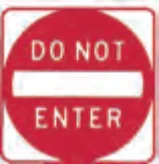
  • Do Not Enter
  • No Trucks
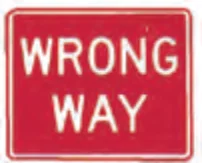
  • Wrong Way
  • No Left Turn
  • No Right Turn
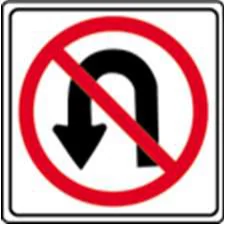
  • No U-Turn
Handbook p. 28 ↗
Do not enter
Do Not Enter
Wrong way
Wrong Way
No U-turn
No U-Turn

Warning signs

Signs that warn of upcoming conditions, like a curve or intersection ahead, a need to be ready to stop, or a hazard or special situation ahead.

Handbook p. 28 ↗

Warning signs shown:

  • Cross Road, Side Road, T-Intersection and Y-Intersection Ahead
  • Curvy Road Ahead, Right Curve, Sharp Curve Ahead, Advisory Speed Around Curve
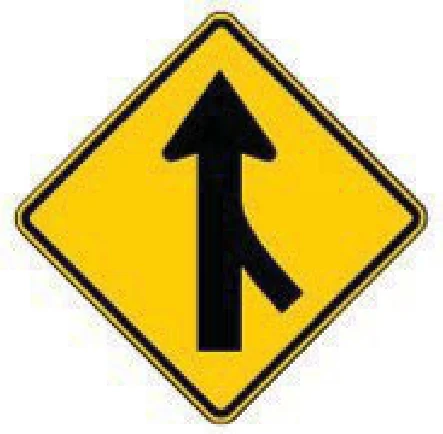
  • Divided Highway Begins / Ends, Lane Ends, Merging Traffic, Added Lane
  • Traffic Signal Ahead, Stop Sign Ahead
  • School Crossing, Pedestrian Crossing, Bicycle Crossing, Share the Road with Bicycles
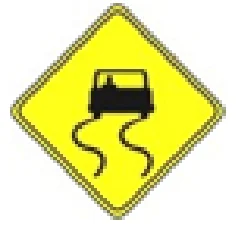
  • Slippery When Wet
Handbook p. 28 ↗
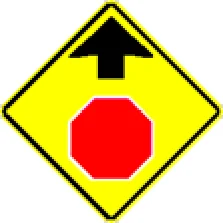
Stop ahead
Stop Sign Ahead
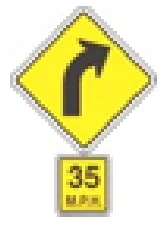
Curve right
Advisory speed around curve (35 MPH plaque)
Merge
Merging traffic
Slippery when wet
Slippery when wet

Put it into practice

You see a yellow diamond with a red octagon and an arrow. It's a Stop Sign Ahead warning: begin slowing now so you can stop fully at the sign that's coming.

Check your understanding

Read the question, decide on an answer, then open it to check the explanation. These are Roadwise study questions based on the source handbook.

A full stop at a stop sign means what, according to the manual?
  1. The wheels must completely stop moving
  2. The vehicle must slow to a crawl
  3. The vehicle coasts through slowly
  4. The driver taps the brake once

Answer: The wheels must completely stop moving

A full stop requires the vehicle's wheels to completely stop moving.
Handbook p. 28 ↗
What does a yield sign require a driver to do?
  1. Stop fully behind the line before every entry
  2. Keep speed and merge into the first gap
  3. Slow down and let right-of-way traffic cross
  4. Stop only when a pedestrian is waiting

Answer: Slow down and let right-of-way traffic cross

A yield sign means slow down and allow traffic that has the right-of-way to cross before entering.

Handbook p. 28 ↗
At a stop sign with no stop line and no crosswalk, where must you stop?
  1. Even with the stop sign post
  2. 15 feet before the stop sign
  3. Before entering the intersection
  4. Just past the edge of the cross street

Answer: Before entering the intersection

With no stop line or crosswalk, a full stop is required before entering the intersection.

Handbook p. 28 ↗
A yellow diamond sign showing a red octagon with an arrow above it warns of what?
  1. A four-way stop at this corner
  2. A traffic signal ahead
  3. A no-entry road ahead
  4. A stop sign ahead

Answer: A stop sign ahead

Stop Sign Ahead is a yellow diamond warning sign that tells you to be prepared to stop at the sign coming up.

Handbook p. 28 ↗
Take the lesson checkpoint in the app

More in Signs, Signals, and Markings