Roadwise States Minnesota Driving lessons Pavement markings and traffic officers Minnesota driving lesson · Signs, Signals & Pavement Markings
Pavement markings and traffic officers A 3-minute lesson from the Minnesota course. Read the rules and examples, follow the handbook page references, and check your understanding before you move on.
Read time 3 minutes
Course unit Signs, Signals & Pavement Markings
Checkpoint questions 6
Source pages 72, 73, 74 Line color tells you traffic direction: white separates lanes going the same way, yellow separates opposite directions. As a rule, solid lines mean don't cross, and dashed lines mean you may.
Know the rule
Solid white lines also mark crosswalks, stop lines, parking stalls and road edges. A bicyclist in a bike lane must travel the same direction as adjacent traffic.
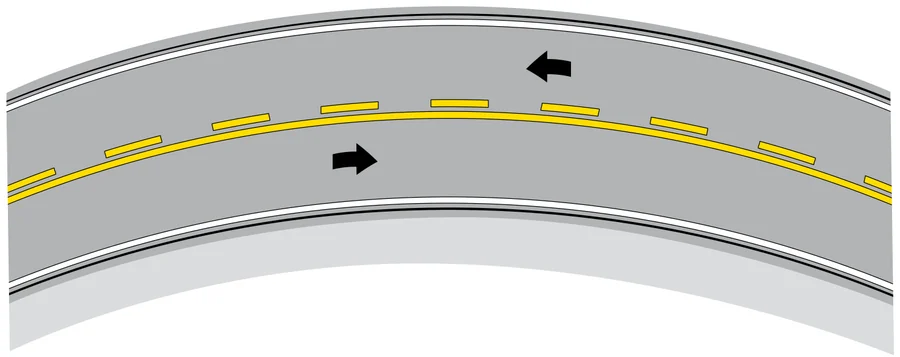
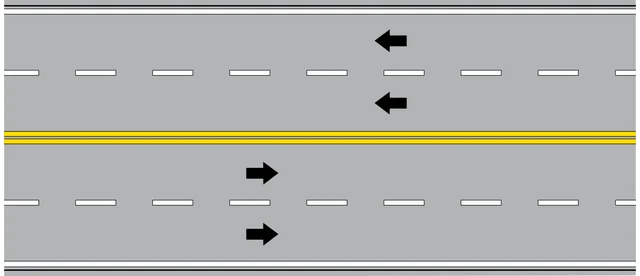
Handbook p. 72 ↗ Two-lane road: no passing from the lane with the solid yellow line Four lanes separated by double solid yellow lines Know the rule
Turn lanes use white arrows, sometimes with the word ONLY: if you're in that lane, you must turn. Some have multiple arrows. Solid white lines separate turn lanes from through lanes to discourage lane changes near intersections.
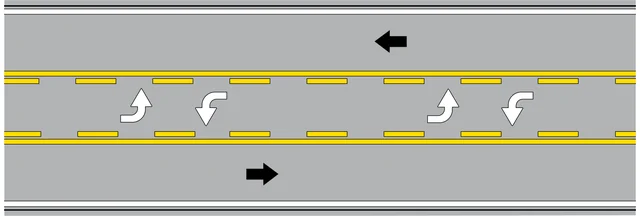
Handbook p. 74 ↗ Center turn lane A lane between opposite directions, marked by parallel solid and dashed yellow lines, used by traffic from either direction only for left turns onto roads or driveways.
Handbook p. 74 ↗ Center left-turn lane shared by both directions Reversible lane A rush-hour lane separated by dashed double yellow lines. Enter only if the overhead signal shows a green arrow or a sign allows it.
Handbook p. 74 ↗ Carpool lane A lane for vehicles with two or more occupants, marked with a diamond or Carpool Only signs, usually on the far left of a freeway.
Handbook p. 74 ↗ Know the rule
Pavement messages such as SCHOOL ZONE AHEAD warn of conditions.
Handbook p. 74 ↗ Know the rule
When an officer directs traffic, obey the officer's hand signals over signals, signs and markings. Stop: one hand up, palm toward you, with a long whistle blast. Go: a hand motion with a series of short blasts. Officers may use a flashlight in low light.
Handbook p. 74 ↗ Put it into practice
The center line has a solid yellow line on your side and dashes on the other. You may not pass, even though the oncoming driver may.
Check your understanding Read the question, decide on an answer, then open it to check the explanation. These are Roadwise study questions based on the source handbook.
What does a solid white line mean for lane changes? You may change lanes freely You should not change lanes You must change lanes soon It marks a carpool lane only Answer: You should not change lanes
A solid white line signals that you should not change lanes.
Handbook p. 72 ↗ The center line has a solid yellow line on your side and a dashed yellow line on the other side. What should you do? Pass; the other side is dashed Don't pass; obey the line on your side No one may pass in either direction Pass only if no oncoming traffic Answer: Don't pass; obey the line on your side
With mixed lines, each driver must obey the marking on their own side of the road.
Handbook p. 72 ↗ What do double solid yellow lines mean? Passing is allowed from the right side only Passing is allowed from the left side only No passing from either side They mark a reversible lane Answer: No passing from either side
Double solid yellow lines prohibit passing from either direction.
Handbook p. 72 ↗ A center turn lane marked with parallel solid and dashed yellow lines is used for: Left turns from either direction of travel Passing slower vehicles Right turns only Emergency vehicle access only Answer: Left turns from either direction of travel
This shared center lane, marked with parallel solid and dashed yellow lines, is reserved for left turns from both directions.
Handbook p. 74 ↗ When may you cross into a reversible lane? Anytime traffic in your lane is slow Only between 6 a.m. and 9 a.m. With a green arrow or a sign allowing it Never, reversible lanes are always off-limits Answer: With a green arrow or a sign allowing it
Reversible lanes may only be entered when the overhead signal or posted sign permits it.
Handbook p. 74 ↗ If a traffic officer's hand signals conflict with a traffic light, which should you obey? The traffic officer's hand signals The traffic light, always The traffic light, unless it is flashing Neither; proceed with caution based on other traffic Answer: The traffic officer's hand signals
You must obey a traffic officer's hand signals over signs, signals, or pavement markings.
Handbook p. 74 ↗ Previous lesson Pedestrian signals, lane-use signals and ramp meters Next lesson SIPDE, following distance and stopping More in Signs, Signals & Pavement Markings About the source Roadwise’s Minnesota course uses the driver handbook edition supplied with this study pack. This lesson cites source pages 72, 73, 74. The linked PDF is a third-party mirror of the handbook, rather than a government-hosted page.
Open the handbook source PDF · View the source edition
For current application requirements, fees, appointments, and the format that applies to your age or license type, check Minnesota’s DVS. Roadwise provides study material and does not issue permits or licenses.