roadwise.Open study app

Minnesota driving lesson · Signs, Signals & Pavement Markings

Railroad crossings

A 4-minute lesson from the Minnesota course. Read the rules and examples, follow the handbook page references, and check your understanding before you move on.

Read time
4 minutes
Course unit
Signs, Signals & Pavement Markings
Checkpoint questions
6
Source pages
56, 57, 62, 63, 88

Because of a train's size and weight, most vehicle-train collisions kill the driver. Trains can't stop quickly and their speed is hard to judge, so every crossing needs your full attention — with or without warning devices.

Know the rule

Warning signs and pavement markers tell you a crossing is ahead; signs near the track show how many tracks there are. Flashing lights, bells and gates mean a train or on-track equipment is coming — don't cross.

Handbook p. 56 ↗
10 ft

Stop at least this far from the nearest rail or gate when signals are active

Handbook p. 56 ↗

Know the rule

It's safe to cross once traffic ahead has moved and you can go without stopping within 10 feet past the rails. Obey a flag person at a crossing as you would a warning device.

Handbook p. 56 ↗

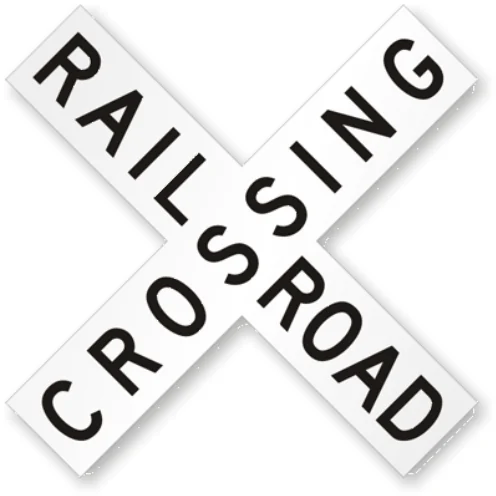
Crossbuck

The X-shaped sign that marks a railroad crossing. A sign below it shows the number of tracks when there's more than one.

Handbook p. 62 ↗
Railroad crossbuck
Railroad crossbuck

Know the rule

Pavement markings before many crossings include a stop line, an X and the letters RR.

Handbook p. 62 ↗
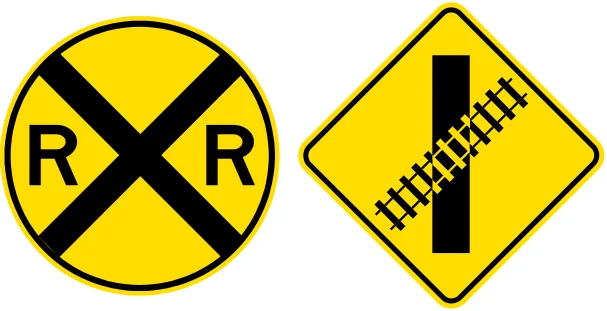
Railroad crossing warning signs (round and advance)
Railroad Crossing Ahead signs

Know the rule

At Railroad Crossing Ahead signs, slow down, look carefully both ways and be prepared to stop.

Handbook p. 63 ↗

Know the rule

An EXEMPT sign lets bus and truck drivers who normally must stop at crossings proceed without stopping — but they still must look both ways for trains.

Handbook p. 62 ↗

Know the rule

Passenger vans, buses and larger trucks must stop at all railroad tracks, train or not. Don't pass them — it's illegal to pass any vehicle within 100 feet of a railroad crossing.

Handbook p. 56 ↗

Crossing safety

  • After a train passes, make sure no second train is coming on another track
  • Look both ways at every crossing, warning devices or not
  • In heavy traffic, wait until you can clear the tracks without stopping on them
  • Never race a train
  • Don't shift gears on the crossing; with a manual, downshift before it
  • Motorcyclists: don't swerve for a better angle — you could enter oncoming traffic
  • If you hesitate with a train in sight, stop and wait for it to pass
  • Never stop on the tracks
Handbook p. 56 ↗

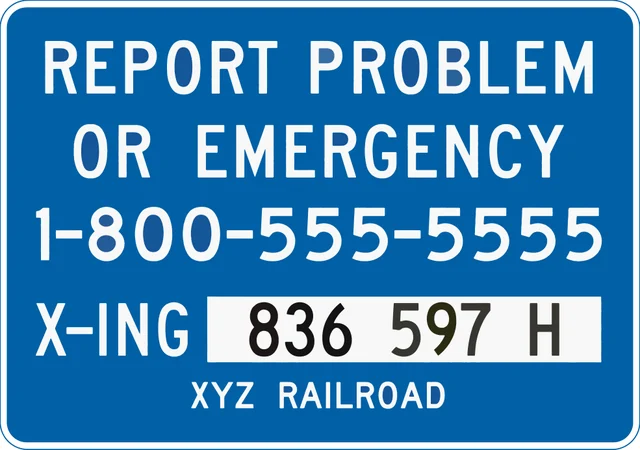
ENS sign

A blue Emergency Notification System sign on every crossing's posts or control box with a 24/7 number to report problems; dispatchers can stop or slow trains.

Handbook p. 57 ↗
Railroad crossing emergency notification sign
Emergency Notification System (ENS) sign

Know the rule

If your vehicle stalls on the tracks with a train coming, get out immediately and walk quickly away at a 45-degree angle, toward the direction the train is coming from, to avoid flying debris.

Handbook p. 88 ↗

Put it into practice

The gates rise after a long freight train passes. Before moving, look for a second train on another track. Then cross only if there's room for your car beyond the tracks — at least 10 feet past the rails.

Check your understanding

Read the question, decide on an answer, then open it to check the explanation. These are Roadwise study questions based on the source handbook.

At a railroad crossing with flashing lights and gates activated, how far from the nearest rail must you stop?
  1. At least 50 feet
  2. At least 5 feet
  3. At least 10 feet
  4. At least 100 feet

Answer: At least 10 feet

You must stop your vehicle at least 10 feet from the nearest rail or gate at an activated railroad crossing.
Handbook p. 56 ↗
Which vehicles are required to stop at all railroad crossings, whether or not a train is present?
  1. Any vehicle towing a trailer
  2. Motorcycles and mopeds
  3. Pickups and SUVs
  4. Buses, passenger vans, and larger trucks

Answer: Buses, passenger vans, and larger trucks

Certain vehicles like vans, buses, and larger trucks must stop at all railroad crossings regardless of a visible train.

Handbook p. 56 ↗
How close to a railroad crossing is it illegal to pass another vehicle?
  1. Within 100 feet
  2. Within 25 feet
  3. Within 500 feet
  4. Within 50 feet

Answer: Within 100 feet

It is illegal to pass any vehicle within 100 feet of a railroad crossing.

Handbook p. 56 ↗
What is the X-shaped railroad crossing sign called?
  1. A chevron
  2. A crossbuck
  3. A pentagon
  4. A diamond

Answer: A crossbuck

The X-shaped railroad crossing sign is called a crossbuck.

Handbook p. 62 ↗
What does an 'exempt' sign at a railroad crossing mean for bus and truck drivers?
  1. They may ignore the crossing entirely
  2. Only cars are required to stop there
  3. It means the crossing is permanently closed
  4. They may proceed but must still look

Answer: They may proceed but must still look

An exempt sign lets normally-required bus and truck drivers skip stopping, but they must still check for trains.

Handbook p. 62 ↗
What is the blue Emergency Notification System (ENS) sign at a railroad crossing for?
  1. Checking when the next train is due
  2. Reporting a crossing problem or emergency
  3. Showing the crossing's speed limit
  4. Showing how many tracks are ahead

Answer: Reporting a crossing problem or emergency

The ENS sign gives a 24/7 number to report problems or emergencies at that crossing so dispatchers can stop or slow trains.

Handbook p. 57 ↗
Take the lesson checkpoint in the app

More in Signs, Signals & Pavement Markings