roadwise.Open study app

Minnesota driving lesson · Traffic Laws & Vehicle Operation

Parking rules

A 3-minute lesson from the Minnesota course. Read the rules and examples, follow the handbook page references, and check your understanding before you move on.

Read time
3 minutes
Course unit
Traffic Laws & Vehicle Operation
Checkpoint questions
6
Source pages
38, 39, 40

Parking rules keep your car from rolling into traffic and keep hydrants, crossings and intersections clear. Most test questions here are about distances, so learn them exactly.

Know the rule

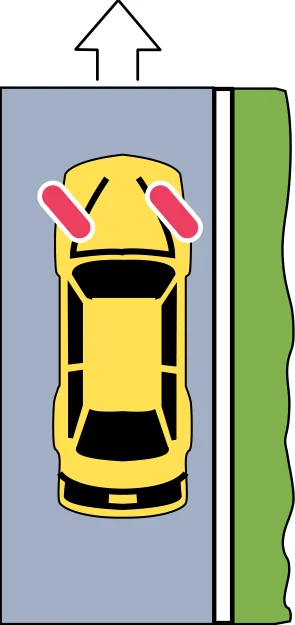
When parallel parking, the wheels nearest the curb must be no more than 12 inches from it. Turn the front wheels toward the curb or shoulder, shift into park and set the parking brake so a rolling car heads off the road, not into traffic.

Handbook p. 38 ↗

No parking within…

No parking within…
DistanceOf
10 feetA fire hydrant
20 feetA crosswalk at an intersection
30 feetFlashing light, stop sign or signal at the roadside
50 feetThe nearest rail of a railroad crossing
Handbook p. 38 ↗

Never park:

  • Within an intersection, or on a crosswalk or sidewalk
  • Beside or across from an excavation or obstacle if you'd block traffic
  • At the street end of a driveway
  • On any bridge or in a highway tunnel
  • On the traffic side of a vehicle parked at the curb (double parking)
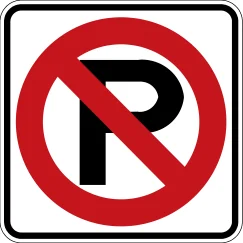
  • Beside a yellow-painted curb or where No Parking signs are posted
  • In front of mailboxes (check city/local ordinances)
Handbook p. 38 ↗
No parking
No Parking sign

Know the rule

Before opening a door on the road side, check for vehicles, motorcycles, bicyclists and pedestrians, and don't leave a traffic-side door open longer than needed to load or unload.

Handbook p. 38 ↗

Parking on a hill — front wheels

Parking on a hill — front wheels
Vehicle facesCurb?Turn wheels
DownhillCurb or shoulderToward the curb or shoulder
UphillCurbAway from the curb
UphillNo curbToward the shoulder
Handbook p. 39 ↗
Parking on a hill (wheel positioning)
Uphill with a curb: wheels turned away from the curb

Parallel parking steps

  • 1. Stop even with the car ahead, about one and a half feet away from it
  • 2. Turn the wheel sharply right and back up slowly
  • 3. When clear of the car ahead, turn sharply left and keep backing slowly
  • 4. Turn sharply right and pull toward the curb in the center of the space
Handbook p. 39 ↗

Know the rule

On state highways or freeways, move your parked vehicle off the main road; if you can't, use visible markers or signals. At night or when lights are needed, show at least one white or amber front light and one red taillight, both visible from 500 feet, and set headlights to low beam.

Handbook p. 40 ↗

Put it into practice

You park facing uphill on a street with a curb. Turn the front wheels away from the curb so that if the car rolls back, the tires catch against it. Then set the parking brake.

Check your understanding

Read the question, decide on an answer, then open it to check the explanation. These are Roadwise study questions based on the source handbook.

When parallel parking, how far may your wheels be from the curb?
  1. No more than 24 inches
  2. No more than 6 inches
  3. No more than 36 inches
  4. No more than 12 inches

Answer: No more than 12 inches

When parallel parked, your wheels should be no more than 12 inches from the curb.
Handbook p. 38 ↗
How close to a crosswalk at an intersection is parking prohibited?
  1. Within 20 feet
  2. Within 5 feet
  3. Within 50 feet
  4. Within 10 feet

Answer: Within 20 feet

Parking is not allowed within 20 feet of a crosswalk at an intersection.

Handbook p. 38 ↗
How close to a flashing light, stop sign, or traffic signal is parking prohibited?
  1. Within 10 feet
  2. Within 30 feet
  3. Within 50 feet
  4. Within 100 feet

Answer: Within 30 feet

Parking is not allowed within 30 feet of a flashing light, stop sign, or traffic control signal.

Handbook p. 38 ↗
How close to a fire hydrant is parking prohibited?
  1. Within 15 feet
  2. Within 20 feet
  3. Within 30 feet
  4. Within 10 feet

Answer: Within 10 feet

Parking is not allowed within 10 feet of a fire hydrant.

Handbook p. 38 ↗
When a parked vehicle's front points downhill, which way should the wheels be turned?
  1. Away from the curb
  2. Toward the curb
  3. Straight ahead
  4. It doesn't matter

Answer: Toward the curb

Pointing downhill, wheels should turn toward the curb or shoulder so the vehicle rolls into it if it moves.

Handbook p. 39 ↗
If you park on a state highway at night, how far must your lights be visible?
  1. At least 500 feet
  2. At least 100 feet
  3. At least 1,000 feet
  4. At least 200 feet

Answer: At least 500 feet

Lights on a vehicle parked on a highway at night must be visible from at least 500 feet.

Handbook p. 40 ↗
Take the lesson checkpoint in the app

More in Traffic Laws & Vehicle Operation