roadwise.Open study app

Minnesota driving lesson · Traffic Laws & Vehicle Operation

Keeping right and speed limits

A 3-minute lesson from the Minnesota course. Read the rules and examples, follow the handbook page references, and check your understanding before you move on.

Read time
3 minutes
Course unit
Traffic Laws & Vehicle Operation
Checkpoint questions
6
Source pages
29, 30, 60

The faster you go, the less time you have to react and the worse a crash gets. Minnesota combines a basic "reasonable for conditions" rule with fixed limits and extra penalties for extreme speed.

On wide roads keep to the right side, except when:

  • Passing a vehicle going in the same direction
  • The right side is closed for construction or repair
  • The road has three marked lanes
  • Signs show the road is one-way
  • Moving over for an authorized vehicle stopped on the road under the Move Over Law
Handbook p. 29 ↗

Basic speed law

Drive at a speed reasonable for current weather, traffic and road conditions. The posted limit is the maximum; driving faster than it is illegal.

Handbook p. 29 ↗

Speed limits under ideal conditions (unless signs say otherwise)

Speed limits under ideal conditions (unless signs say otherwise)
WhereLimit
Alleys10 mph
Urban or town roads30 mph
All other locations not listed55 mph
Handbook p. 29 ↗

Know the rule

On two-lane highways with a limit of 55 mph or higher, you may go 10 mph over the limit while lawfully passing a vehicle going your way.

Handbook p. 29 ↗

Know the rule

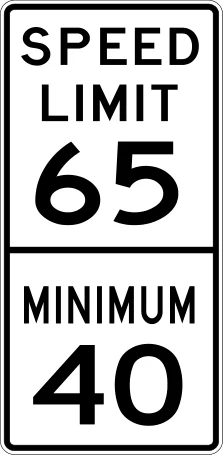
On roads with a posted minimum speed, driving slower than the minimum under normal conditions is illegal; bad weather or poor roads can make slower driving necessary.

Handbook p. 60 ↗
Speed limit with minimum speed
Maximum and minimum speed limit sign

Know the rule

If you approach an intersection at an unlawful speed, you lose the right-of-way you'd have at a lawful speed.

Handbook p. 29 ↗

Know the rule

In school zones, slow down when children are present. In work or construction zones, slow down and drive with care.

Handbook p. 29 ↗

Speeding consequences

Speeding consequences
SituationConsequence
Over the posted limitFine
20 mph or more overAdditional fines
Over 100 mphLicense revoked at least six months
Not slowing for a stopped emergency vehicleSurcharge of at least $25 on the fine
Handbook p. 30 ↗

Slow down for:

  • A stopped emergency vehicle with flashing lights (approaching or passing)
  • Flag persons, pedestrians, barricades, flares or reflectors on the road
  • Bad weather and poor road conditions
  • Narrow or winding roads, curves, hilltops and railroad crossings
  • Gravel or dirt roads — stopping takes longer and skids are easier
Handbook p. 30 ↗

Know the rule

Watch for and obey special speed limits and No Passing signs posted on bridges.

Handbook p. 30 ↗

Put it into practice

You're behind a slow truck on a two-lane highway posted 55 mph. While lawfully passing you may reach 65 mph, then drop back to 55. On a two-lane road posted 50 mph, the extra 10 mph doesn't apply.

Check your understanding

Read the question, decide on an answer, then open it to check the explanation. These are Roadwise study questions based on the source handbook.

What does Minnesota's basic speed law require?
  1. Never more than 5 mph over the limit
  2. You drive as fast as traffic flow allows
  3. A speed reasonable for conditions
  4. You drive at least 10 mph under the limit in the rain

Answer: A speed reasonable for conditions

The basic speed law requires a speed reasonable for weather, traffic, and road conditions, even below the posted limit.
Handbook p. 29 ↗
On a two-lane highway with a 55 mph or higher speed limit, how much can you increase your speed to lawfully pass another vehicle?
  1. 10 mph
  2. 5 mph
  3. 15 mph
  4. 20 mph

Answer: 10 mph

You may increase speed by 10 mph above the posted limit when lawfully passing on a two-lane highway posted 55 mph or higher.

Handbook p. 29 ↗
Under ideal conditions and without signs, what is the speed limit in an alley?
  1. 30 mph
  2. 15 mph
  3. 10 mph
  4. 20 mph

Answer: 10 mph

The default speed limit in alleys, absent signage, is 10 mph.

Handbook p. 29 ↗
Under ideal conditions and without signs, what is the speed limit on urban or town roads?
  1. 25 mph
  2. 35 mph
  3. 55 mph
  4. 30 mph

Answer: 30 mph

Urban or town roads default to a 30 mph speed limit under ideal conditions.

Handbook p. 29 ↗
If you are convicted of driving over 100 mph, what happens to your driving privileges?
  1. They are suspended for 30 days
  2. Nothing beyond a large fine
  3. Revoked for at least six months
  4. They are revoked for at least one month

Answer: Revoked for at least six months

Driving over 100 mph results in a minimum six-month revocation of driving privileges.

Handbook p. 30 ↗
If you fail to slow down for a stopped emergency vehicle with flashing lights, what surcharge is added to your speeding fine?
  1. At least $500
  2. At least $10
  3. No surcharge, just the normal fine
  4. At least $25

Answer: At least $25

A surcharge of at least $25 is added to the speeding fine for failing to slow for a stopped emergency vehicle.

Handbook p. 30 ↗
Take the lesson checkpoint in the app

More in Traffic Laws & Vehicle Operation