roadwise.Open study app

Minnesota driving lesson · Traffic Laws & Vehicle Operation

J-turns, divided highways, U-turns and lane use

A 3-minute lesson from the Minnesota course. Read the rules and examples, follow the handbook page references, and check your understanding before you move on.

Read time
3 minutes
Course unit
Traffic Laws & Vehicle Operation
Checkpoint questions
6
Source pages
35, 36

Divided highways and multi-lane roads have their own turning patterns. J-turns replace risky left turns across four lanes, and U-turns and left-lane driving are tightly limited.

J-turn

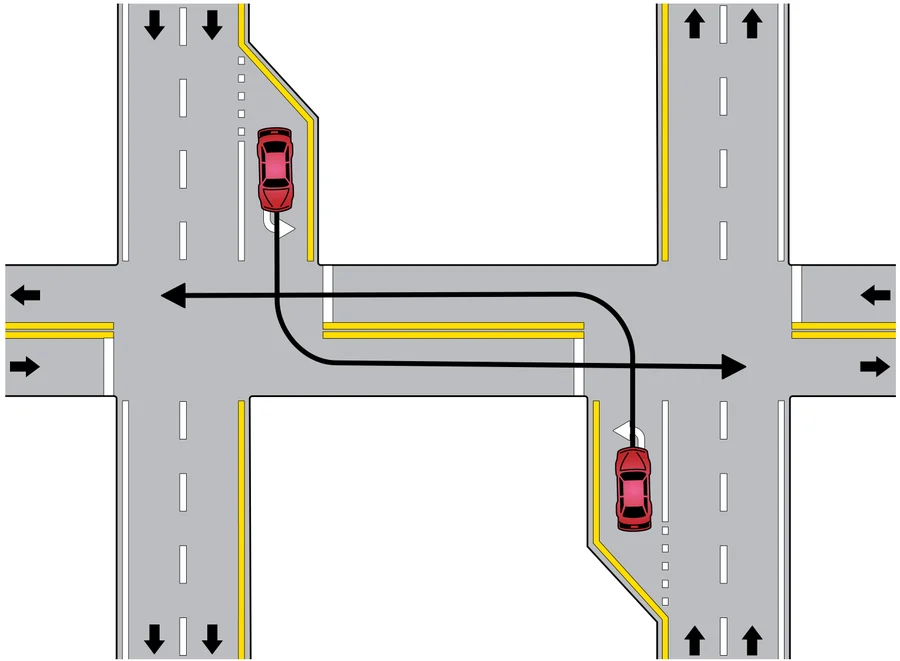
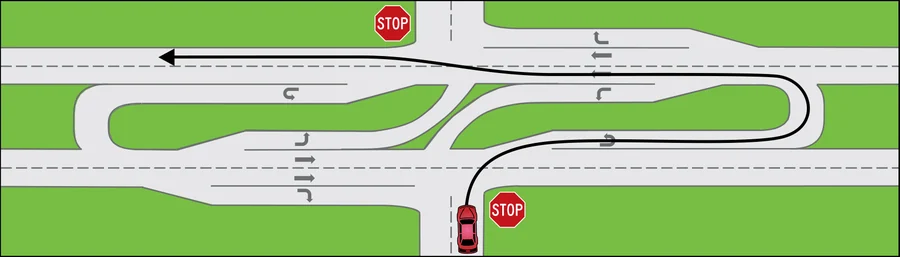
A design on four-lane divided highways that cuts broadside crashes: drivers on the side street always turn right, then make a U-turn at a median opening.

Handbook p. 35 ↗

Crossing or turning left at a J-turn

  • Come to a complete stop
  • Turn right onto the highway
  • Enter the left-turn lane leading to the median opening and make a U-turn
  • When safe, you may cross both lanes to the left-turn lane in one motion
  • Before the U-turn, yield to oncoming traffic, stopping if necessary
Handbook p. 35 ↗
J-turn maneuver on a divided highway
Crossing a divided highway using a J-turn

Know the rule

Crossing a rural divided highway: if the median is wide enough, cross one half and wait in the middle, staying right of center. With no traffic either way, you may cross both roadways if safe. Turn left onto it the same way, leaving room so you don't impede oncoming traffic as you speed up.

Handbook p. 35 ↗
Left turn across a divided highway
Divided highway — left turn across traffic

U-turn

A 180-degree turn that reverses your direction. Make one only if you can do so without disrupting other traffic.

Handbook p. 36 ↗

No U-turns:

  • Where No U-Turn signs are posted
  • On interstate freeways
  • Near hilltops or on curves where other drivers can't see you from 1,000 feet away
Handbook p. 36 ↗

Know the rule

On a road with two or more lanes in the same direction, you may turn into the farthest lane and briefly use the shoulder to complete a U-turn.

Handbook p. 36 ↗

Know the rule

With one lane your way, if you're slow enough to create a hazard, drive as close as possible to the right curb or edge. With more than one lane, drive in the right lane when available, and move out of the left-most lane to let others pass when practical.

Handbook p. 36 ↗

You may use the left lane when:

  • Overtaking and passing a vehicle going your way
  • Preparing to turn left at an intersection, private road or driveway
  • Preparing to exit an expressway, freeway or interstate on the left
  • Driving an authorized emergency vehicle
  • Directed by a traffic control device, a peace officer or in a highway work zone
Handbook p. 36 ↗

Put it into practice

You need to go left from a side road onto a divided highway with a J-turn. Stop, turn right, move into the left-turn lane at the median opening and U-turn — yielding to oncoming through traffic before you merge.

Check your understanding

Read the question, decide on an answer, then open it to check the explanation. These are Roadwise study questions based on the source handbook.

On a J-turn, which direction do you always turn first from the side street?
  1. Left
  2. Right
  3. Either direction, driver's choice
  4. U-turn directly

Answer: Right

At a J-turn, drivers on the side street always make a right turn onto the divided highway first.
Handbook p. 35 ↗
When crossing a rural divided highway with space between the roadways, what can you do?
  1. You must always cross both halves in a single motion
  2. You must wait until both halves are clear
  3. You are never allowed to stop in the median
  4. Cross one half, wait in the median, then finish

Answer: Cross one half, wait in the median, then finish

If there's enough space, you may cross one roadway, wait in the median, then cross the second when safe.

Handbook p. 35 ↗
Where are U-turns always illegal?
  1. On interstate freeways
  2. On any two-lane road
  3. At intersections with stop signs
  4. In residential neighborhoods

Answer: On interstate freeways

U-turns are illegal on interstate freeways.

Handbook p. 36 ↗
U-turns are illegal near hilltops and curves where other drivers cannot see you from how far away?
  1. 500 feet
  2. 1,000 feet
  3. 300 feet
  4. 2,000 feet

Answer: 1,000 feet

U-turns are prohibited near hilltops or curves with less than 1,000 feet of visibility to other drivers.

Handbook p. 36 ↗
Which of these is an exception allowing you to stay in the left lane on a multi-lane highway?
  1. Preparing for a left turn
  2. Driving at the speed limit
  3. Traveling in heavy traffic
  4. Planning to exit on the right

Answer: Preparing for a left turn

Preparing for a left turn is a valid exception to the right-hand lane travel rule.

Handbook p. 36 ↗
If you are driving slowly enough to create a hazard on a one-lane road, what must you do?
  1. Use your hazard lights and stay in the center
  2. Keep as far right as possible
  3. Pull fully off the roadway at all times
  4. Increase your speed to match traffic

Answer: Keep as far right as possible

Slow-moving traffic on a one-lane road must stay as close to the right edge as possible.

Handbook p. 36 ↗
Take the lesson checkpoint in the app

More in Traffic Laws & Vehicle Operation