Roadwise States Maryland Driving lessons Traffic circles & interstate driving Maryland driving lesson · Driving Conditions
Traffic circles & interstate driving A 3-minute lesson from the Maryland course. Read the rules and examples, follow the handbook page references, and check your understanding before you move on.
Read time 3 minutes
Course unit Driving Conditions
Checkpoint questions 6
Source pages 31, 32 Traffic circles keep traffic flowing with yields instead of stops. Interstates and other limited access highways move fast, so entering, exiting and stopping follow strict rules.
Know the rule
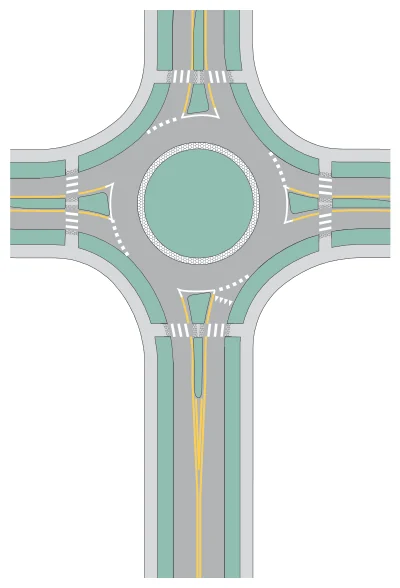
Roads leading to traffic circles have yield signs. Always yield to traffic already in the circle.
Handbook p. 31 ↗ As you come to a traffic circle: Reduce your speed Keep to the right of the island Watch for and yield to pedestrians in the crosswalk Approach the yield line carefully and wait for a gap; watch for vehicles exiting Handbook p. 31 ↗ Know the rule
You do not need to wait to enter if there is no traffic in the circle. In a multi-lane circle, stay in your lane.
Handbook p. 31 ↗ Know the rule
To exit, turn on your right turn signal and move to the outside lane after you pass the exit before the one you plan to take.
Handbook p. 31 ↗ Traffic circle (roundabout) Limited access highway A large road with no intersections or traffic lights and a limited number of places to enter and exit. An interstate is one that crosses from one state to another.
Handbook p. 31 ↗ Know the rule
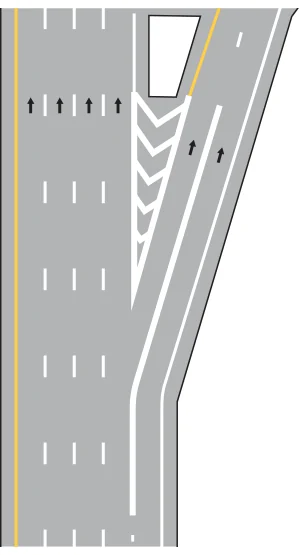
Use the entrance ramp to reach the highway and the acceleration lane to adjust your speed to traffic. Don't cross the solid lines dividing the entrance from the highway.
Handbook p. 32 ↗ Know the rule
If you are driving slower than highway traffic, drive in the right lane whenever possible.
Handbook p. 32 ↗ Know the rule
To exit, move to the right lane well before your exit, start slowing as soon as you enter the deceleration lane, and slow to the exit ramp's posted limit.
Handbook p. 32 ↗ Know the rule
If you exit at the wrong place, continue until you're off the ramp, then find a way to re-enter. Never stop and back up on any part of the highway.
Handbook p. 32 ↗ Know the rule
Never stop in moving lanes. Stop on the shoulder only if your vehicle is disabled or you have another emergency; turn on your flashers and stay inside if you can.
Handbook p. 32 ↗ Lanes leaving the highway at an exit ramp Put it into practice
You realize you just took the wrong exit. Don't stop or back up; drive to the end of the ramp and look for a way to get back on the highway.
Check your understanding Read the question, decide on an answer, then open it to check the explanation. These are Roadwise study questions based on the source handbook.
What must you do when entering a traffic circle (roundabout) with traffic already in it? Merge in without yielding if you signal Only yield if there is a stop sign Always yield to traffic in the circle Proceed if moving faster than circle traffic Answer: Always yield to traffic in the circle
When approaching a traffic circle, you must always yield to traffic already in the circle.
Handbook p. 31 ↗ In a multi-lane traffic circle, what should you do when preparing to exit? Move to the outside lane immediately upon entering Stay in the inside lane the entire time Exit from any lane without signaling Signal right; move out after the prior exit Answer: Signal right; move out after the prior exit
In a multi-lane traffic circle, turn on your right signal and move to the outside lane after passing the exit before the one you want.
Handbook p. 31 ↗ What must you do before entering an interstate from an entrance ramp? Match highway speed in the acceleration lane Stop completely before merging Merge immediately regardless of speed Cross the solid line dividing the ramp from the highway Answer: Match highway speed in the acceleration lane
The acceleration lane lets you adjust your speed to match highway traffic before merging; you should not cross the solid dividing lines.
Handbook p. 32 ↗ If you are driving slower than highway traffic, which lane should you use whenever possible? The left lane The right lane Any lane you prefer The shoulder Answer: The right lane
If driving slower than the flow of traffic, you must drive in the right lane whenever possible.
Handbook p. 32 ↗ If you miss your exit on an interstate, what should you do? Stop and back up to the exit Make a U-turn on the highway Continue until off the ramp, then find a way to re-enter Pull onto the shoulder and wait Answer: Continue until off the ramp, then find a way to re-enter
Never stop and back up on a highway; if you exit at the wrong place, continue until you're off the ramp and find a way back.
Handbook p. 32 ↗ When may you stop your vehicle on the shoulder of an interstate? Anytime you want to check a map To take a phone call To let a passenger out Only when disabled or facing another emergency Answer: Only when disabled or facing another emergency
You may only stop on the shoulder when your vehicle is disabled or you have another emergency; turn on flashers and stay in the vehicle if you can.
Handbook p. 32 ↗ Previous lesson Work zones Next lesson Funeral processions & slow-moving vehicles More in Driving Conditions About the source Roadwise’s Maryland course uses the driver handbook edition supplied with this study pack. This lesson cites source pages 31, 32. The linked PDF is a third-party mirror of the handbook, rather than a government-hosted page.
Open the handbook source PDF · View the source edition
For current application requirements, fees, appointments, and the format that applies to your age or license type, check Maryland’s MVA. Roadwise provides study material and does not issue permits or licenses.