roadwise.Open study app

Maryland driving lesson · Other Important Rules

Rules & equipment for bicyclists

A 3-minute lesson from the Maryland course. Read the rules and examples, follow the handbook page references, and check your understanding before you move on.

Read time
3 minutes
Course unit
Other Important Rules
Checkpoint questions
6
Source pages
53, 54

If you ride a bike, you're a driver too, with the same rights and responsibilities. Maryland spells out how to ride, how to turn left, and what equipment your bike must carry.

Rules of the road for bicyclists:

  • Ride straight and single file in a predictable manner
  • Plan ahead for road hazards, traffic, and opening car doors
  • Yield to pedestrians and obey all traffic signals and signs
  • Always ride on the right side, with traffic; be careful passing on the right
  • At intersections, use the lane for your direction (left, straight, right)
  • Look back before changing lanes or turning, and signal all turns
Handbook p. 53 ↗
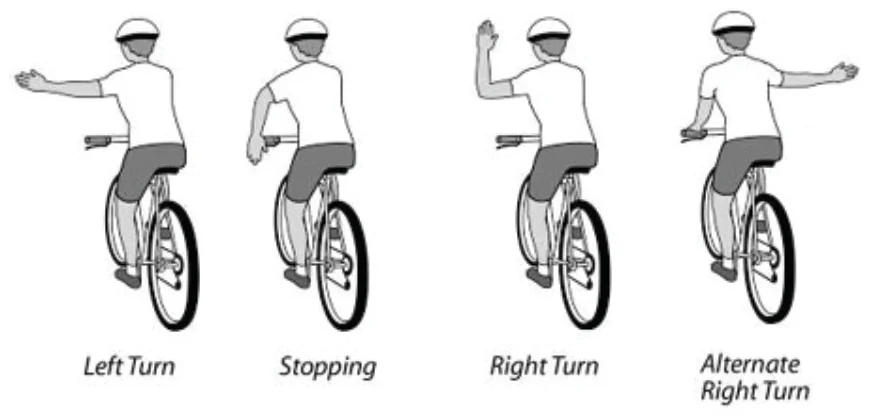
Bicycle hand signals
Bicycle hand signals: left turn, stopping, right turn, alternate right turn

To turn left safely, a bicyclist may:

  • Turn like a motor vehicle, moving to the left side of the travel lane (or left turn lane), or
  • Cross like a pedestrian: stop, get off, and walk across in a crosswalk
Handbook p. 53 ↗

Know the rule

In rain or snow, allow extra distance to stop, and look out for pavement markings and utility covers, which may be slippery.

Handbook p. 54 ↗

Know the rule

Helmets are required for anyone under 16 riding a bike, including passengers who aren't steering, and are strongly recommended for all ages.

Handbook p. 54 ↗

Required bicycle equipment

Required bicycle equipment
ItemStandard
BrakesStop within 15 ft from 10 mph on dry, level, clean pavement
White headlight (night/low light)Visible from 500 feet
Red rear reflector (night/low light)Visible from 600 feet
Small child on boardFirmly attached safety seat or trailer
Carrying small thingsBasket, rack or bag; both hands on handlebars
Handbook p. 54 ↗

Know the rule

The night riding section also says the white headlight and red reflector must be visible from at least 600 feet away. Wearing bright clothing by day and reflective clothing at night is recommended.

Handbook p. 54 ↗

Put it into practice

You're 15 and riding as a passenger on a bike your older brother steers. You must wear a helmet: the rule covers everyone under 16, including passengers who aren't steering.

Check your understanding

Read the question, decide on an answer, then open it to check the explanation. These are Roadwise study questions based on the source handbook.

On which side of the road should bicyclists ride?
  1. The right side, with traffic
  2. The left side, facing traffic
  3. Whichever side has less traffic
  4. The center of the road

Answer: The right side, with traffic

Bicyclists should always ride on the right side of the road, with the flow of traffic.
Handbook p. 53 ↗
How can a bicyclist legally make a left-hand turn like a pedestrian?
  1. By riding on the sidewalk the whole way
  2. By dismounting and walking in a crosswalk
  3. By signaling and riding straight through without stopping
  4. By dismounting only at intersections without signals

Answer: By dismounting and walking in a crosswalk

A bicyclist may cross like a pedestrian by stopping, dismounting, and walking the bike across in a crosswalk.

Handbook p. 53 ↗
What does Maryland law require on the front of a bicycle ridden at night?
  1. A red reflector
  2. A white headlight
  3. An amber flashing light
  4. A white reflector only

Answer: A white headlight

Maryland law requires a white headlight on the front of a bicycle and a red reflector on the back for night riding.

Handbook p. 54 ↗
From how far away must a bicycle's rear reflector be visible at night?
  1. At least 500 feet
  2. At least 300 feet
  3. At least 1,000 feet
  4. At least 600 feet

Answer: At least 600 feet

A bicycle's red rear reflector must be visible from at least 600 feet away.

Handbook p. 54 ↗
Within what distance must a bicycle's brakes be able to stop it when going 10 mph on dry, level pavement?
  1. 15 feet
  2. 25 feet
  3. 5 feet
  4. 50 feet

Answer: 15 feet

By law, a bicycle's brakes must be able to stop it within 15 feet when traveling 10 mph on dry, level, clean pavement.

Handbook p. 54 ↗
Who is required to wear a helmet while riding a bicycle in Maryland?
  1. Only riders over age 18
  2. Anyone under age 16, including passengers
  3. No one; helmets are optional for all ages
  4. Only riders under age 12

Answer: Anyone under age 16, including passengers

Helmets are required for anyone under age 16 riding a bike, including passengers who are not steering.

Handbook p. 54 ↗
Take the lesson checkpoint in the app

More in Other Important Rules