roadwise.Open study app

Kansas driving lesson · Sharing the Road

Public transportation and slow-moving vehicles

A 3-minute lesson from the Kansas course. Read the rules and examples, follow the handbook page references, and check your understanding before you move on.

Read time
3 minutes
Course unit
Sharing the Road
Checkpoint questions
6
Source pages
87, 88

Buses, trolleys and light rail stop often and hide pedestrians. In rural Kansas you'll also meet farm equipment, horse-drawn buggies and riders moving far slower than you. Patience and space prevent most crashes.

Know the rule

Unlike a school bus, you don't have to stop for a transit bus picking up or dropping off passengers unless you're behind it. Watch for passengers crossing and buses pulling into traffic.

Handbook p. 87 ↗

Safety zone

A space set aside for pedestrians boarding, entering or waiting for trolleys and light rail vehicles.

Handbook p. 87 ↗
10 mph

Maximum speed when passing a trolley or light rail safety zone

Handbook p. 87 ↗

Trolleys and light rail:

  • Never drive through or park on tracks or in a safety zone
  • With no safety zone, stop behind the nearest door or platform until riders reach a safe place
  • Don't pass on the left, moving or stopped, except on a one-way street
  • Pass on the left only if the tracks are too close to the right side or an officer directs you
  • Never turn in front of an approaching trolley or light rail vehicle
  • Keep a safe following distance; you may share a lane with them
Handbook p. 87 ↗

Know the rule

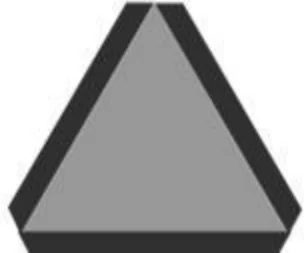
A fluorescent or reflective orange-and-red triangle on the rear of an animal-drawn vehicle, farm equipment or construction equipment means it travels less than 25 mph.

Handbook p. 88 ↗
Slow-moving vehicle emblem

Know the rule

Farm machinery can be wide enough to fill more than one lane, usually lacks turn signals, may swing left before turning right, and usually travels under 25 mph. Its operator can't hear you coming.

Handbook p. 88 ↗
5 to 8 mph

Normal speed range of animal-drawn vehicles

Handbook p. 88 ↗

Know the rule

Animal-drawn vehicles have the same rights and rules as motor vehicles. Pass with caution, never honk or rev your engine, and expect left turns into fields and driveways.

Handbook p. 88 ↗

Know the rule

Horseback riders ride single file near the right edge. Drive at a reasonable speed and distance from the horse; don't honk or rev loudly when approaching or passing.

Handbook p. 88 ↗
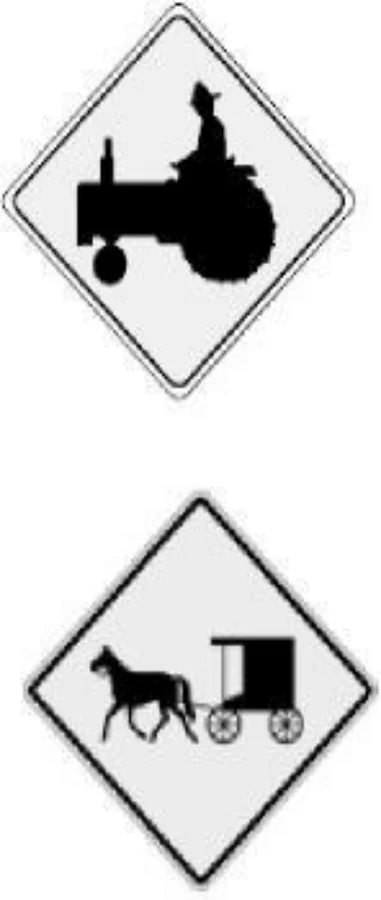
Farm equipment and horse-drawn vehicle warning signs (composite)
Farm machinery and horse-drawn vehicle warning signs

Know the rule

If you're driving a slow vehicle and traffic behind must slow, pull over when safe and let it pass. Use turnouts where provided.

Handbook p. 88 ↗

Put it into practice

On a rural highway you come up behind a combine showing an orange-and-red triangle. It's going under 25 mph and may pull left before turning right. Hang back, and pass only when you're sure it's safe.

Check your understanding

Read the question, decide on an answer, then open it to check the explanation. These are Roadwise study questions based on the source handbook.

A fluorescent or reflective orange-and-red triangle on the back of a vehicle means it is traveling less than what speed?
  1. 15 mph
  2. 45 mph
  3. 35 mph
  4. 25 mph

Answer: 25 mph

This slow-moving vehicle emblem indicates the vehicle is traveling less than 25 mph, such as farm equipment or animal-drawn vehicles.
Handbook p. 88 ↗
Unlike with a school bus, when a transit bus stops to pick up or drop off passengers, you:
  1. Must always stop completely
  2. Must stop until the bus pulls away
  3. Do not have to stop, unless you're directly behind the bus
  4. Must stop when meeting it from the other direction

Answer: Do not have to stop, unless you're directly behind the bus

Transit buses don't require other traffic to stop the way school buses do, though you should watch for pedestrians near the bus.

Handbook p. 87 ↗
What is the maximum speed at which you may pass a safety zone for trolleys or light rail once it's safe to do so?
  1. 5 mph
  2. 10 mph
  3. 25 mph
  4. There is no speed limit for safety zones

Answer: 10 mph

You may pass a safety zone at no faster than 10 mph once it is safe to proceed.

Handbook p. 87 ↗
Normal speeds for animal-drawn vehicles typically range between:
  1. 5 and 8 mph
  2. 25 and 30 mph
  3. 15 and 20 mph
  4. 1 and 2 mph

Answer: 5 and 8 mph

Animal-drawn vehicles typically travel between 5 and 8 mph, sometimes slower with large loads or at intersections.

Handbook p. 88 ↗
Why should you avoid sounding your horn or revving your engine near a horse on the road?
  1. It helps the rider know you are there
  2. It has no effect on horses
  3. It could scare the horse and cause a crash
  4. It is illegal only near livestock

Answer: It could scare the horse and cause a crash

Startling a horse with noise can cause it to bolt unpredictably, creating a dangerous situation for the rider and other traffic.

Handbook p. 88 ↗
Farm machinery on the road often lacks turn signals. To make a right turn, an operator may:
  1. Signal with a hand out the window only
  2. Stop fully before every turn
  3. Always use a designated turn lane
  4. Pull wide to the left first, then turn right

Answer: Pull wide to the left first, then turn right

Because farm equipment can be very wide, operators may pull left before turning right, similar to how large trucks sometimes swing wide.

Handbook p. 88 ↗
Take the lesson checkpoint in the app

More in Sharing the Road