roadwise.Open study app

Kansas driving lesson · Sharing the Road

Motorcycles, scooters and mopeds

A 3-minute lesson from the Kansas course. Read the rules and examples, follow the handbook page references, and check your understanding before you move on.

Read time
3 minutes
Course unit
Sharing the Road
Checkpoint questions
6
Source pages
83, 84

Motorcyclists, scooters and mopeds have the same rights and responsibilities as other drivers, but they're harder to see and their intentions are harder to read. Most crashes with them involve a car driver who didn't notice them.

Know the rule

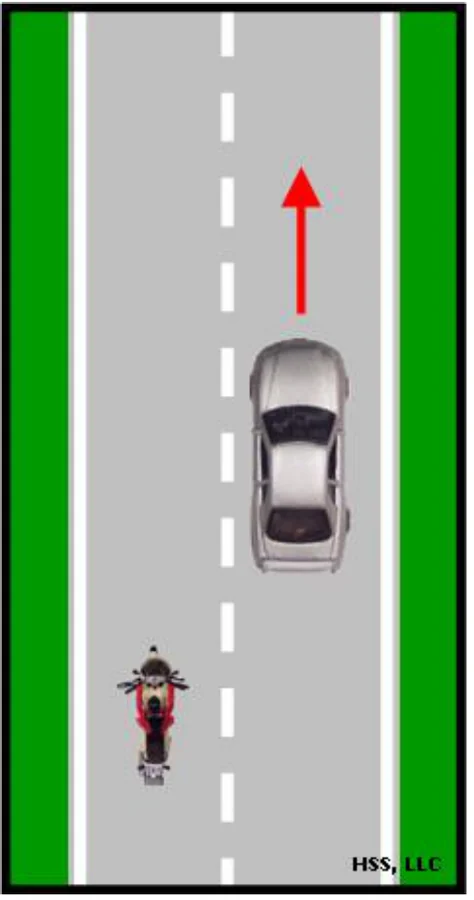
A motorcycle, scooter or moped has the right to use a complete lane, and two of them may share a lane. Never pass one in the same lane.

Handbook p. 83 ↗

Know the rule

Their small size lets them slip into your blind spot. Check mirrors and turn your head before entering or leaving a lane and at intersections.

Handbook p. 83 ↗

A motorized bicycle or moped has two tandem wheels or three wheels and:

  • A motor producing not more than 3.5 brake horsepower
  • A cylinder capacity of not more than 130 cubic centimeters
  • An automatic transmission
  • A maximum design speed of no more than 30 mph
Handbook p. 83 ↗

Motorcycle crash facts

Motorcycle crash facts
FactShare
Crashes involving another motor vehicleAbout one-half
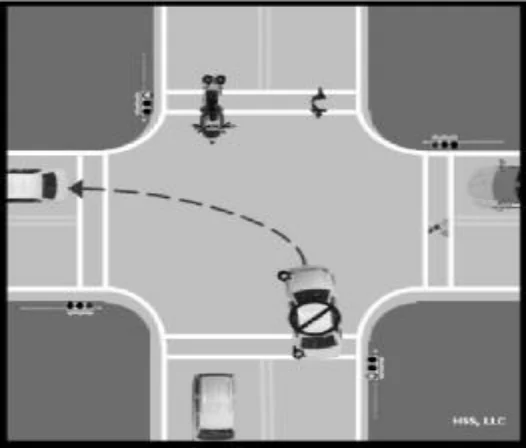
Caused by a vehicle turning left in front of themNearly 40 percent
Handbook p. 83 ↗
Turning movement at intersection (diagram)
Car turning left in front of an oncoming motorcycle

Know the rule

Don't assume a flashing turn signal means they're turning; it may not self-cancel. Wait until the rider begins to turn. Some may have no turn signals at all.

Handbook p. 84 ↗

Know the rule

Potholes, gravel, wet surfaces, pavement seams, railroad crossings and grooved pavement can be deadly to riders. Expect sudden lane or speed changes and leave room.

Handbook p. 84 ↗
3 to 4 seconds

Following distance behind a motorcycle, scooter or moped (more in wet conditions)

Handbook p. 84 ↗
Following distance behind motorcycles
Keeping a following distance behind a motorcycle

Know the rule

Always dim your headlights when approaching a motorcycle, scooter or moped; high beams are more dangerous to them than to car drivers.

Handbook p. 84 ↗

Know the rule

When one passes you, keep your lane position and speed, and never speed up or interfere. Scooters and mopeds travel much slower than motorcycles.

Handbook p. 84 ↗

Put it into practice

You're waiting to turn left and see an oncoming motorcycle with its right signal blinking. Don't turn yet. Its signal may not have cancelled; wait until the rider actually starts to turn or passes.

Check your understanding

Read the question, decide on an answer, then open it to check the explanation. These are Roadwise study questions based on the source handbook.

Do motorcycle, scooter, and moped operators have the right to use a complete traffic lane?
  1. Only on highways with posted high speed limits
  2. No, they must share a lane with cars
  3. Yes, and you should not pass them within the same lane
  4. Only during daylight hours

Answer: Yes, and you should not pass them within the same lane

Motorcycle/scooter/moped operators have the right to a full lane, and drivers should never try to pass them within that same lane.
Handbook p. 83 ↗
Of motorcycle/scooter/moped crashes involving another vehicle, nearly what share were caused by the other vehicle turning left in front of the rider?
  1. About 75 percent
  2. About 15 percent
  3. Nearly 40 percent
  4. About 5 percent

Answer: Nearly 40 percent

Nearly 40 percent of motorcycle-involved crashes were caused by another vehicle turning left in front of the rider.

Handbook p. 83 ↗
When following a motorcycle, scooter, or moped, what following distance does the handbook recommend?
  1. 3 to 4 seconds, or more in wet conditions
  2. The same following distance as any other vehicle
  3. 10 seconds
  4. 1 second

Answer: 3 to 4 seconds, or more in wet conditions

Motorcycles can stop quickly, so a 3-to-4 second following distance (or more in wet conditions) helps avoid a rear-end collision.

Handbook p. 84 ↗
If you see a motorcyclist's turn signal flashing, you should:
  1. Assume they are turning and pull out
  2. Flash your own lights to prompt them
  3. Assume the signal is broken and ignore it
  4. Wait until you see them actually begin turning

Answer: Wait until you see them actually begin turning

Motorcycle signals often don't self-cancel, so a flashing signal doesn't guarantee the rider is turning; wait to see the actual turn begin.

Handbook p. 84 ↗
When approaching a motorcyclist at night, you should:
  1. Switch to your fog lights
  2. Always dim your headlights
  3. Use high beams for extra visibility
  4. Flash your lights repeatedly

Answer: Always dim your headlights

High beams can be especially blinding and dangerous to motorcyclists, so you should always dim your lights when approaching them.

Handbook p. 84 ↗
A moped, as defined in the handbook, must have a motor producing no more than how many brake horsepower?
  1. 3.5 brake horsepower
  2. 25 brake horsepower
  3. 1.5 brake horsepower
  4. 10 brake horsepower

Answer: 3.5 brake horsepower

The handbook defines a motorized bicycle/moped as having a motor producing no more than 3.5 brake horsepower.

Handbook p. 83 ↗
Take the lesson checkpoint in the app

More in Sharing the Road