roadwise.Open study app

Illinois driving lesson · Right of Way & Passing

Lane usage

A 4-minute lesson from the Illinois course. Read the rules and examples, follow the handbook page references, and check your understanding before you move on.

Read time
4 minutes
Course unit
Right of Way & Passing
Checkpoint questions
6
Source pages
32, 33

Keep right is the basic rule on Illinois roads. The exceptions cover passing, blocked lanes, left turns and giving room to stopped emergency vehicles. On interstates, the left lane is for passing.

Drive on the right half of the road, except:

  • When passing a vehicle going the same way on a two-lane highway, interstate or controlled freeway
  • When a blockage forces you left of the center line (yield to oncoming traffic first)
  • On a road divided into three marked lanes
  • On a one-way street with two or more lanes
  • When signs or signals direct you to a left lane on a multilane, two-way highway
  • When crossing the center line to turn left into or from an alley, private road or driveway
  • When approaching a stationary emergency vehicle or disabled vehicle on the side of the highway
  • When road construction is in or near the right lane or right shoulder
Handbook p. 32 ↗

Know the rule

On an interstate or full access-controlled freeway, you may not drive in the left lane(s) except when passing another vehicle.

Handbook p. 32 ↗

You may stay in the left lane when:

  • No other vehicle is directly behind you
  • Traffic or congestion makes the right lane impractical
  • Weather makes the left lane necessary
  • There's an obstruction or hazard in the right lane
  • You're changing lanes to yield to emergency or construction vehicles
Handbook p. 32 ↗

More lane rules:

  • Slow vehicles must use the right lane except when passing or turning left
  • Weaving from lane to lane to go faster than traffic is unlawful
  • Follow posted one-way directions (police/emergency vehicles using sirens or lights excepted)
  • Driving across median strips, such as unpaved strips or barriers, is unlawful
  • You may turn left across a paved dividing space unless a sign or signal prohibits it
Handbook p. 32 ↗

On controlled-access roads and when backing:

  • Enter or leave a controlled-access road only at a posted entrance or exit
  • Never back up on the shoulder or roadway of a controlled-access road
  • On other roads, back up only if it's safe and doesn't interfere with traffic
Handbook p. 33 ↗

Know the rule

You and your passengers may not open doors on the traffic side unless it's safe and doesn't interfere with vehicles or bicycles. Leave the door open only long enough to load or unload.

Handbook p. 33 ↗

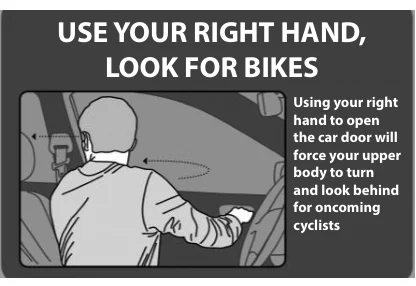
Dutch Reach

Opening your car door with your right hand, which turns your body so you can check for oncoming vehicles and bicyclists.

Handbook p. 33 ↗
Dutch reach - check for bikes before opening door
Use your right hand to open the door and look for bikes

Street sideshow

An event where one or more vehicles block or impede traffic to perform unauthorized stunts, speed contests or exhibitions of speed. It is illegal to take part.

Handbook p. 33 ↗

Put it into practice

A truck is broken down in your lane on a two-lane road. You may drive left of the center line to get around it, but only after yielding to oncoming traffic.

Check your understanding

Read the question, decide on an answer, then open it to check the explanation. These are Roadwise study questions based on the source handbook.

When may you legally cross the center line into the opposing lane?
  1. When a blockage requires it, after yielding to oncoming traffic
  2. Whenever your lane has a pothole
  3. Only on divided highways
  4. Anytime traffic is light

Answer: When a blockage requires it, after yielding to oncoming traffic

You may cross the center for a blockage, but only after yielding to oncoming traffic.
Handbook p. 32 ↗
Under Illinois law, weaving from lane to lane to move faster than the flow of traffic is:
  1. Legal if you signal each change
  2. Unlawful
  3. Legal on multi-lane highways
  4. Illegal only in construction zones

Answer: Unlawful

Weaving from lane to lane to move faster than the traffic flow is unlawful.

Handbook p. 32 ↗
You may open your vehicle door into moving traffic only if it can be done safely and doesn't interfere with traffic.
  1. True
  2. False

Answer: True

Opening a door into traffic is legal only when it can be done safely.

Handbook p. 33 ↗
Which of these situations allows you to legally drive left of the centerline?
  1. Passing a vehicle on a two-lane highway
  2. Making a right turn into a driveway
  3. Driving around a curve
  4. Approaching the top of a hill

Answer: Passing a vehicle on a two-lane highway

Passing when safe is one of the legal exceptions to staying right of center.

Handbook p. 32 ↗
May you back your vehicle up on the shoulder of a controlled-access roadway?
  1. Yes, for up to 100 feet
  2. No, it is prohibited
  3. Yes, if no traffic is behind you
  4. Only at night with hazards on

Answer: No, it is prohibited

Backing up on any part of a controlled-access roadway, including the shoulder, is illegal.

Handbook p. 33 ↗
What is the 'Dutch Reach' technique used for?
  1. Reaching across to unlock a passenger door
  2. A technique for parallel parking
  3. Opening a door so you look for cyclists
  4. A hand signal for a left turn

Answer: Opening a door so you look for cyclists

The Dutch Reach uses your far hand to naturally turn your body and check behind you.

Handbook p. 33 ↗
Take the lesson checkpoint in the app

More in Right of Way & Passing