Roadwise States Illinois Driving lessons Signaling, turning and lane changes Illinois driving lesson · Turning, Parking & Special Stops
Signaling, turning and lane changes A 4-minute lesson from the Illinois course. Read the rules and examples, follow the handbook page references, and check your understanding before you move on.
Read time 4 minutes
Course unit Turning, Parking & Special Stops
Checkpoint questions 6
Source pages 33, 34, 35, 83 Signals tell other road users what you're about to do before you do it. Illinois sets minimum signaling distances, defines the hand signals, and spells out how to position your car for right and left turns.
100 feet Continuous turn signal before turning in a business or residential area
Handbook p. 33 ↗ 200 feet Minimum signaling distance before turning in other areas
Handbook p. 33 ↗ Know the rule
Use electrical turn signals: the right signal for a right turn, the left signal for a left turn.
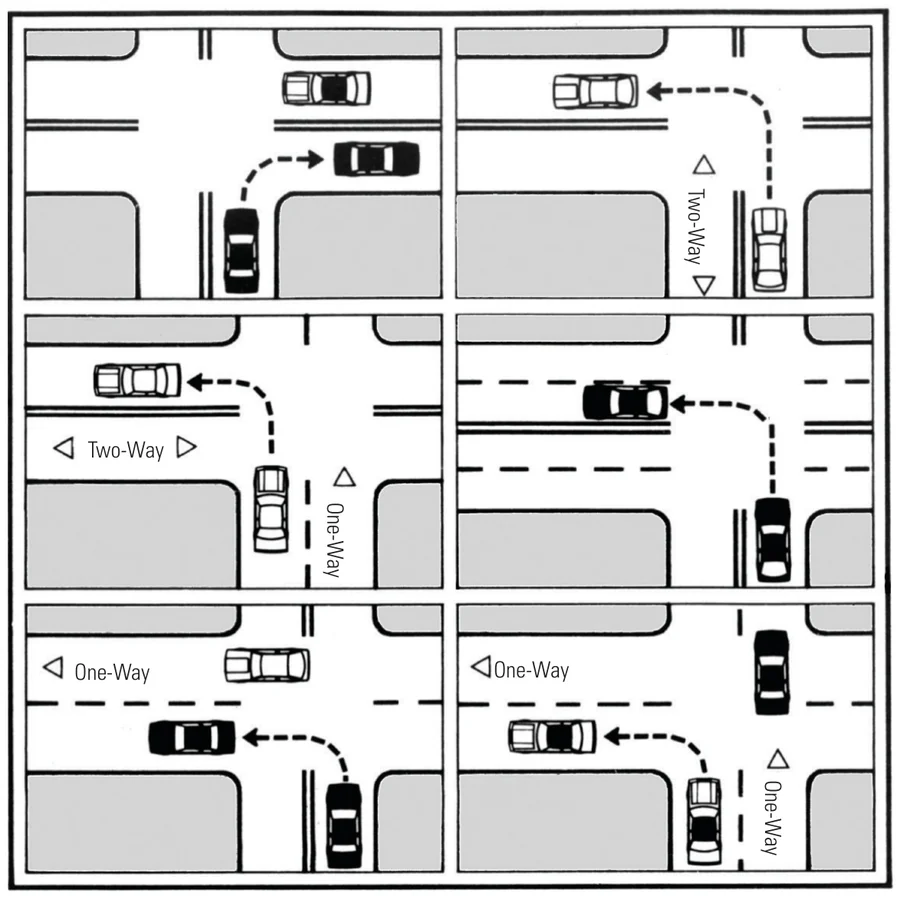
Handbook p. 33 ↗ Right turns: Signal from the proper turning lane and obey signs and signals Yield to pedestrians, emergency vehicles and vehicles in the intersection Check traffic approaching from the left Follow the curve of the curb, staying as close to it as possible Turn into the right-hand lane of the road you're entering Trucks and buses may need more room to turn right Watch bike lanes for bicyclists approaching the intersection Handbook p. 34 ↗ Left turns: Signal from the proper turning lane and obey signs and signals Yield to pedestrians, emergency vehicles and vehicles in the intersection Check all approaching traffic Keep your wheels pointed straight ahead until you start the turn Finish the turn in the lane closest to your intended direction Handbook p. 34 ↗ Correct turning paths for two-way and one-way streets Know the rule
To change lanes, turn your head to check traffic behind you and to that side. If it's clear, signal and move over carefully.
Handbook p. 35 ↗ 500 feet Don't make a U-turn on a curve or hill unless you can see at least this far in all directions
Handbook p. 35 ↗ Know the rule
Municipalities may prohibit U-turns on some roadways.
Handbook p. 35 ↗ Know the rule
Hazard signal: flashing both turn signals at once indicates a disabled or parked vehicle.
Handbook p. 35 ↗ Two-way left turn lane A center lane, marked with yellow lines and white arrows, for left turns at intersections or into and out of mid-block driveways.
Handbook p. 35 ↗ Know the rule
When a two-way left turn lane is provided, don't turn left from any other lane. Drive in it only to prepare for or make a left turn, or a U-turn where permitted.
Handbook p. 83 ↗ Know the rule
When turning or changing lanes in a construction zone, pay special attention to signs, barricades and pavement markings.
Handbook p. 35 ↗ Put it into practice
You're on a residential street and plan to turn right at the next corner. Turn on your right signal at least 100 feet before the turn and keep it on continuously until you turn.
A useful reminder Every hand signal uses the LEFT arm: up = right, straight out = left, down = slow/stop.
Check your understanding Read the question, decide on an answer, then open it to check the explanation. These are Roadwise study questions based on the source handbook.
In a business or residential area, how far before turning must you give a continuous turn signal? 25 feet 100 feet 50 feet 200 feet Answer: 100 feet
Signal at least 100 feet before turning in business/residential areas.
Handbook p. 33 ↗ In areas other than business/residential districts, how far before turning must you signal? 100 feet 200 feet 50 feet 300 feet Answer: 200 feet
Outside business/residential districts, signal at least 200 feet before turning.
Handbook p. 33 ↗ Using hand-and-arm signals, a left arm pointed straight down signals a right turn. True False Answer: False
False. A left arm extended straight up signals a right turn; an arm extended downward means slowing down or stopping.
Handbook p. 33 ↗ Which hand-and-arm signal means slowing down or stopping? Left arm and hand extended straight out Left arm and hand extended downward Left arm and hand extended straight up Right arm waved forward Answer: Left arm and hand extended downward
A downward-extended left arm signals slowing or stopping.
Handbook p. 33 ↗ When making a right turn, where should you position your vehicle? Stay in the center of the lane Keep close to the curb Position toward the left of your lane Swing wide into the oncoming lane Answer: Keep close to the curb
Follow the curve of the curb closely when making a right turn.
Handbook p. 34 ↗ Under what condition can you legally make a U-turn on a curve or hill? Anytime traffic is light Never, even with good visibility If you can see 500 feet in all directions Only during daylight hours Answer: If you can see 500 feet in all directions
A 500-foot sight distance in all directions is required to turn around on a curve or hill.
Handbook p. 35 ↗ Previous lesson Lane usage Next lesson Roundabouts and school buses More in Turning, Parking & Special Stops About the source Roadwise’s Illinois course uses the driver handbook edition supplied with this study pack. This lesson cites source pages 33, 34, 35, 83. The linked PDF is a third-party mirror of the handbook, rather than a government-hosted page.
Open the handbook source PDF · View the source edition
For current application requirements, fees, appointments, and the format that applies to your age or license type, check Illinois’s SOS. Roadwise provides study material and does not issue permits or licenses.