Roadwise States Illinois Driving lessons Railroad crossings Illinois driving lesson · Turning, Parking & Special Stops
Railroad crossings A 3-minute lesson from the Illinois course. Read the rules and examples, follow the handbook page references, and check your understanding before you move on.
Read time 3 minutes
Course unit Turning, Parking & Special Stops
Checkpoint questions 6
Source pages 36, 37, 62 A train can't stop or swerve for you, so the law always gives it the right of way. Know where to stop, when you may go, and what to do if your car stalls on the tracks.
Know the rule
You must yield the right of way to any approaching train or railroad equipment.
Handbook p. 36 ↗ 15-50 feet Stop within this distance of the crossing when required
Handbook p. 36 ↗ You must stop at a railroad crossing when: There's a posted stop sign The electric signal is flashing The crossing gate is lowered A flagger signals you to stop A train is approaching and/or sounds a warning Handbook p. 36 ↗ Know the rule
Go only after the gate is all the way up, the lights stop flashing, or the flagger signals you to proceed. Check every track for more trains or equipment first.
Handbook p. 36 ↗ Know the rule
At a crossing with no warning devices, or only a crossbuck sign, slow down, look both ways and listen for a train. Cross with caution only if it's safe.
Handbook p. 36 ↗ Know the rule
Don't enter a crossing unless there's room for your vehicle on the other side without blocking the tracks.
Handbook p. 36 ↗ Know the rule
Vehicles carrying people for hire, school buses and vehicles carrying hazardous materials must stop at most railroad crossings. Be prepared to stop behind them.
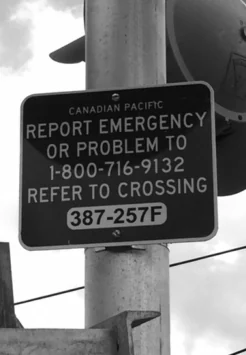
Handbook p. 37 ↗ If your vehicle stalls or gets stuck on the tracks: Everyone gets out immediately Call 911 Move away from the tracks at a 45-degree angle toward the train, to avoid flying debris If possible, call the railroad's Emergency Notification System number on the blue sign on the crossing post Handbook p. 37 ↗ Blue Emergency Notification System sign on a crossing post Railroad crossing safety: Expect a train on any track at any time After a train passes, look for a second train on another track Make sure there's room for your vehicle on the other side Manual transmission: shift down before the tracks, and don't change gears on the tracks Never race a train Handbook p. 37 ↗ Know the rule
A second conviction for failing to obey a railroad-crossing signal can suspend your license.
Handbook p. 62 ↗ Put it into practice
The lights stop flashing and the gate rises after a freight train clears the crossing. Before you go, look down every track for a second train.
A useful reminder Stalled on the tracks? Get out and move toward the train at a 45-degree angle, away from the tracks.
Check your understanding Read the question, decide on an answer, then open it to check the explanation. These are Roadwise study questions based on the source handbook.
How far from railroad tracks must you stop if a signal is flashing or a gate is lowered? 15-50 feet 5-10 feet 100-150 feet 50-100 feet Answer: 15-50 feet
Stop within 15-50 feet of the tracks when a signal or gate requires it.
Handbook p. 36 ↗ A railroad crossing has only a crossbuck sign, no lights or gates. What should you do? Always come to a complete stop regardless of trains Only slow down if you hear a train horn Proceed at normal speed since there's no active signal Slow, look, listen, then cross if safe Answer: Slow, look, listen, then cross if safe
With only a crossbuck, slow down, look, listen, and proceed carefully if it's clear.
Handbook p. 36 ↗ Your vehicle stalls on the tracks and a train is coming. What should you do? Stay in the vehicle with hazards on Get out; move at 45 degrees toward the train Try to push the vehicle off the tracks yourself Run in the same direction the train is traveling Answer: Get out; move at 45 degrees toward the train
Moving away at a 45-degree angle toward the train keeps you clear of flying debris.
Handbook p. 36 ↗ You should always check for a second train on another track before proceeding, even after the first has passed. True False Answer: True
Always check for a second train before crossing, even after one has cleared.
Handbook p. 37 ↗ What should a driver with a manual transmission do when approaching railroad tracks? Accelerate quickly across the tracks Come to a full stop on the tracks to check for trains Downshift before; don't shift on tracks Shift into neutral while crossing Answer: Downshift before; don't shift on tracks
Shift down before the tracks; never change gears mid-crossing.
Handbook p. 37 ↗ Which vehicles does the handbook say are required by law to stop at most railroad crossings? All vehicles, without exception Only school buses Only commercial trucks over 26,000 lbs For-hire, school, and hazmat vehicles Answer: For-hire, school, and hazmat vehicles
These specific vehicle types must stop at most crossings even without an active signal.
Handbook p. 36 ↗ Previous lesson Roundabouts and school buses Next lesson Parking on hills, at curbs and in reserved spaces More in Turning, Parking & Special Stops About the source Roadwise’s Illinois course uses the driver handbook edition supplied with this study pack. This lesson cites source pages 36, 37, 62. The linked PDF is a third-party mirror of the handbook, rather than a government-hosted page.
Open the handbook source PDF · View the source edition
For current application requirements, fees, appointments, and the format that applies to your age or license type, check Illinois’s SOS. Roadwise provides study material and does not issue permits or licenses.