roadwise.Open study app

Illinois driving lesson · Turning, Parking & Special Stops

Roundabouts and school buses

A 3-minute lesson from the Illinois course. Read the rules and examples, follow the handbook page references, and check your understanding before you move on.

Read time
3 minutes
Course unit
Turning, Parking & Special Stops
Checkpoint questions
6
Source pages
35, 36

Roundabouts keep traffic flowing in one direction around a central island. School buses stop often and children cross nearby. The law is strict about stopping for a bus, and passing one is a serious violation.

Rotary or roundabout

An intersection where traffic travels counter-clockwise around a central island. It may have more than one lane.

Handbook p. 35 ↗

Know the rule

Vehicles entering or exiting a roundabout must yield to all traffic, including pedestrians and bicycles.

Handbook p. 35 ↗

Approaching a roundabout:

  • Slow down
  • Look for signs and pavement markings that prohibit certain movements
  • Enter by turning right when it's safe
  • Stay in your lane
  • Use your right turn signal to show you're exiting
Handbook p. 35 ↗

Roundabout tips:

  • Read street and direction signs before entering so you know which exit to take
  • Check for vehicles continuing through before changing lanes or exiting
  • Expect vehicles in blind spots your mirrors can't show
Handbook p. 35 ↗

Know the rule

You don't have to stop for a school bus when you are both on a four-lane roadway and the bus is stopped on the opposite side, facing the other direction.

Handbook p. 35 ↗

Any other time, stop before meeting or passing a stopped school bus that is loading or unloading, including on:

  • Any two-lane roadway, in rural areas and within city limits
  • Any roadway, highway or private road
  • Any parking lot on school property
Handbook p. 36 ↗

School bus warning before a stop

School bus warning before a stop
AreaWarning given at least
Most areas100 feet before the stop
Rural areas200 feet before the stop
Handbook p. 36 ↗

Know the rule

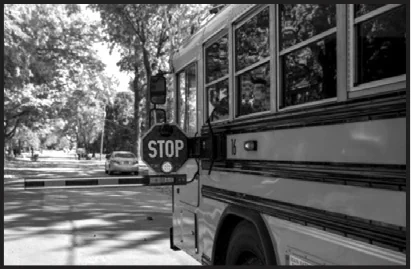
The bus driver flashes lights on the front and rear of the bus. The stop signal arm extends after the bus has come to a complete stop.

Handbook p. 36 ↗
School bus stopped with stop-arm extended
School bus with its stop signal arm extended

Know the rule

Stay stopped until the stop arm is pulled back and the flashing lights are off, or until the bus driver signals you to pass.

Handbook p. 36 ↗

Passing a stopped school bus (lights flashing, stop arm out) brings:

  • Suspension of your driver's license
  • A mandatory $300 fine plus community service set by the court
  • A 3-month registration suspension if the owner wasn't driving and won't name the driver
Handbook p. 36 ↗

Put it into practice

On a two-lane country road, a school bus coming toward you stops and extends its stop arm. You must stop and stay stopped until the arm is pulled back and the lights go off, or the driver waves you on.

Check your understanding

Read the question, decide on an answer, then open it to check the explanation. These are Roadwise study questions based on the source handbook.

Which direction does traffic move around a roundabout's central island?
  1. Counter-clockwise
  2. Either direction depending on lane
  3. Whichever way the exit is closest
  4. Clockwise

Answer: Counter-clockwise

Traffic in a roundabout circulates counter-clockwise around the island.

Handbook p. 35 ↗
A school bus is stopped and loading passengers on a four-lane road, on the opposite side from you. Must you stop?
  1. No, not in that situation
  2. Yes, you must always stop for a loading bus
  3. No, unless children are visible
  4. Yes, but only if it's a school day

Answer: No, not in that situation

On a four-lane roadway with the bus facing the opposite direction, a stop isn't required.

Handbook p. 35 ↗
On a two-lane road, you need not stop for a school bus loading passengers if you are approaching it from the opposite direction.
  1. True
  2. False

Answer: False

False. When approaching a stopped school bus from the opposite direction you must stop and remain stopped until the stop arm is withdrawn and the lights are off, or the driver signals you to pass. Only the four-lane opposite-direction case is exempt.
Handbook p. 36 ↗
Entering a roundabout, when should you yield?
  1. Only to vehicles signaling to exit
  2. Never; entering traffic has the right of way
  3. To all circulating traffic and people
  4. Only if a stop sign is posted

Answer: To all circulating traffic and people

Entering or exiting drivers must yield to all traffic already in the roundabout.

Handbook p. 35 ↗
What signal should you give when exiting a roundabout?
  1. No signal is required
  2. Your hazard lights
  3. Right turn signal
  4. Your left turn signal

Answer: Right turn signal

Use your right turn signal to indicate you are exiting the roundabout.

Handbook p. 35 ↗
A school bus gives its warning signal before stopping. In a rural area, how far in advance is this warning given?
  1. 50 feet
  2. 100 feet
  3. 200 feet
  4. 400 feet

Answer: 200 feet

In rural areas, the bus warning is given at least 200 feet before stopping (100 feet elsewhere).

Handbook p. 36 ↗
Take the lesson checkpoint in the app

More in Turning, Parking & Special Stops