Roadwise States Illinois Driving lessons Passing rules Illinois driving lesson · Right of Way & Passing
Passing rules A 4-minute lesson from the Illinois course. Read the rules and examples, follow the handbook page references, and check your understanding before you move on.
Read time 4 minutes
Course unit Right of Way & Passing
Checkpoint questions 6
Source pages 31, 32 Passing on a two-lane road means borrowing the oncoming lane, which is one of the riskiest things you do while driving. Illinois limits where you may pass and how much room you must give. It also says when passing on the right is allowed.
Know the rule
On a two-lane highway, the left lane must be clearly visible and free of oncoming traffic for a distance long enough to pass.
Handbook p. 31 ↗ Know the rule
Don't return to the right lane until you can see the entire vehicle you passed in your rearview mirror.
Handbook p. 31 ↗ 200 feet You must be back in your lane before getting this close to an oncoming vehicle
Handbook p. 31 ↗ Know the rule
The driver being passed must not speed up until you have finished passing.
Handbook p. 31 ↗ Know the rule
It is against the law to flash your turn signals as a courtesy or "do pass" signal to other drivers.
Handbook p. 31 ↗ Know the rule
You may not drive off the pavement or main traveled part of the road to pass, on the right or the left.
Handbook p. 31 ↗ 3 feet Minimum distance when passing a pedestrian on the road or shoulder, or a bicyclist (even on the shoulder or in a bike lane)
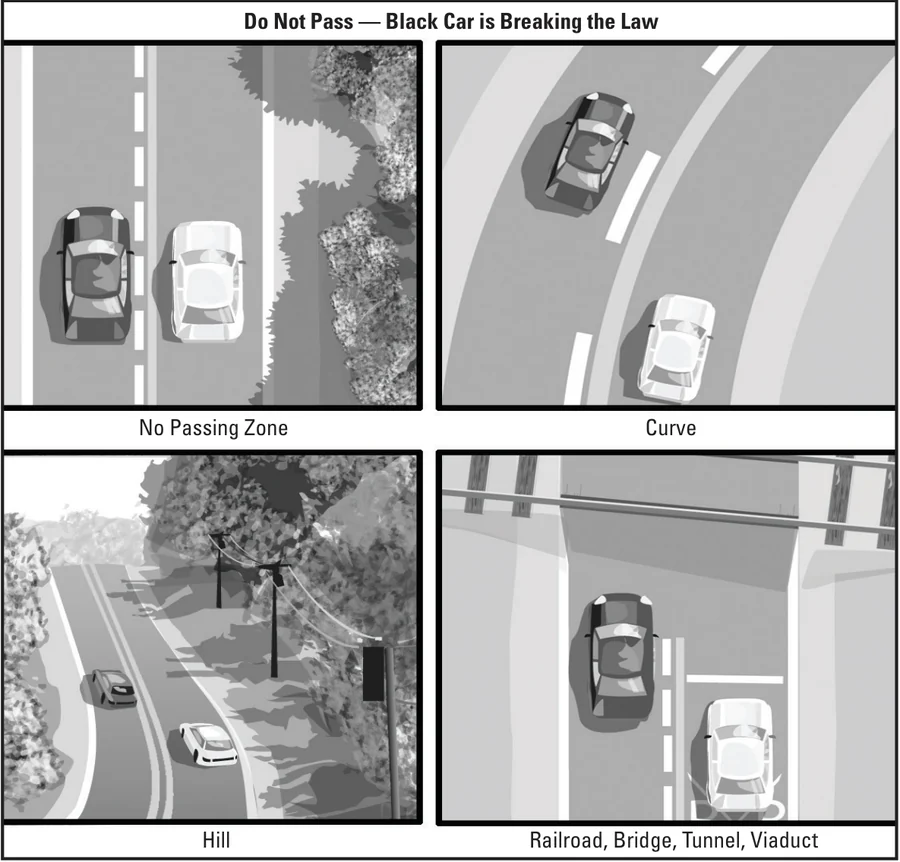
Handbook p. 31 ↗ You may pass on the right (never on the shoulder, except authorized vehicles): On a two-lane road with enough room, when the vehicle ahead is making or about to make a left turn On a one-way street, or a road with two or more clear lanes in each direction At an intersection widened for this purpose Handbook p. 31 ↗ No passing: no-passing zone, curve, hill, and near a railroad, bridge, tunnel or viaduct On a two-lane, two-way road, passing is not allowed: Where a solid yellow line, DO NOT PASS or NO PASSING ZONE sign marks no passing On a hill or curve where you can't see oncoming vehicles Within 100 feet of an intersection or railroad crossing When your view is blocked within 100 feet of a bridge, viaduct or tunnel When a vehicle has stopped at a crosswalk or intersection to let a pedestrian cross In a construction zone (all Illinois construction zones are no passing zones) In any school zone in an unincorporated area, or any posted school zone in an incorporated area When a school bus has stopped to load or unload passengers Handbook p. 32 ↗ 100 feet No passing within this distance of an intersection or railroad crossing on a two-lane road
Handbook p. 32 ↗ Put it into practice
On a two-lane road, the car ahead signals left and slows to turn into a driveway. If there's enough room on the pavement, you may pass on the right. Never use the shoulder.
A useful reminder Back in your lane when the whole car you passed shows in your rearview mirror, and before you're within 200 feet of oncoming traffic.
Check your understanding Read the question, decide on an answer, then open it to check the explanation. These are Roadwise study questions based on the source handbook.
When passing on a two-lane road, you must be back in your lane before getting within how many feet of an oncoming vehicle? 50 feet 100 feet 200 feet 500 feet Answer: 200 feet
You must return to your lane before getting within 200 feet of an oncoming vehicle.
Handbook p. 31 ↗ What is the minimum passing distance from a bicyclist in Illinois? 3 feet 1 foot 2 feet 5 feet Answer: 3 feet
Illinois requires at least 3 feet of clearance when passing a bicyclist.
Handbook p. 31 ↗ Within how many feet of an intersection or railroad crossing is passing prohibited on a two-lane road? 300 feet 50 feet 100 feet 200 feet Answer: 100 feet
Passing is banned within 100 feet of an intersection or railroad crossing.
Handbook p. 32 ↗ It is legal to flash your turn signal as a courtesy signal telling another driver it's okay to pass. True False Answer: False
Using turn signals as a courtesy 'go ahead' signal is against Illinois law.
Handbook p. 31 ↗ Before passing on a two-lane highway, how far ahead must the left lane be clear of oncoming traffic? At least 100 feet At least 300 feet The length of the car being passed Far enough to permit passing safely Answer: Far enough to permit passing safely
The left lane must be clearly visible and free of oncoming traffic for a distance great enough to permit passing.
Handbook p. 31 ↗ When may you legally pass another vehicle on the right? On a one-way street, or past a left-turner Whenever the vehicle ahead signals to let you by Only if you use the shoulder Any time your lane is moving faster Answer: On a one-way street, or past a left-turner
Right-side passing is limited to specific situations like one-way streets or a left-turning vehicle ahead.
Handbook p. 31 ↗ Previous lesson Pedestrian right-of-way Next lesson Lane usage More in Right of Way & Passing About the source Roadwise’s Illinois course uses the driver handbook edition supplied with this study pack. This lesson cites source pages 31, 32. The linked PDF is a third-party mirror of the handbook, rather than a government-hosted page.
Open the handbook source PDF · View the source edition
For current application requirements, fees, appointments, and the format that applies to your age or license type, check Illinois’s SOS. Roadwise provides study material and does not issue permits or licenses.