roadwise.Open study app

Idaho driving lesson · Signs, Signals & Markings

Roundabouts and modern interchanges

A 4-minute lesson from the Idaho course. Read the rules and examples, follow the handbook page references, and check your understanding before you move on.

Read time
4 minutes
Course unit
Signs, Signals & Markings
Checkpoint questions
6
Source pages
62, 63, 64, 65, 66

Idaho uses several intersection designs that move traffic without traditional left turns across oncoming lanes. Each looks strange the first time, but follows simple rules: yield, follow the lane markings, and stop at the stop line.

Roundabout

A one-way circular intersection (aka rotary or traffic circle). You always turn right to enter and exit. Its usual approach sign is a warning sign with arrows in a circle.

Handbook p. 62 ↗

Know the rule

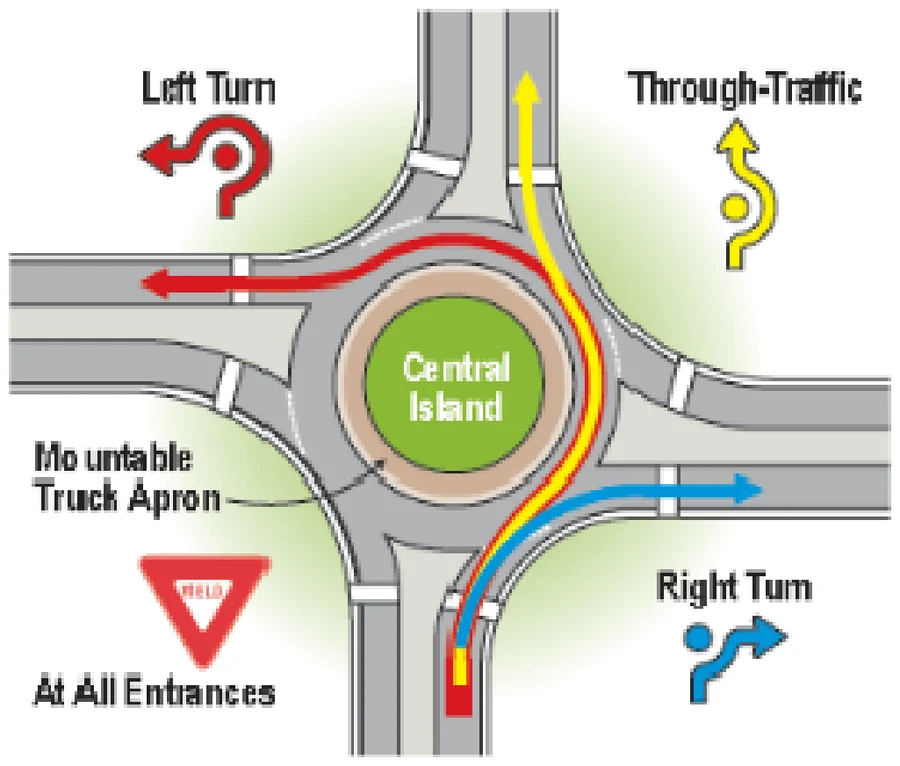
Enter counter-clockwise and merge into the circle whether you're turning right, left, making a U-turn, or going straight. Yield to vehicles already in the circle.

Handbook p. 62 ↗

Driving a roundabout:

  • Slow down and keep your speed low
  • Obey all signs and pavement markings
  • Yield to pedestrians and bicyclists when entering and exiting
  • Yield to traffic on your left already in the roundabout
  • Turn on your right turn signal as you approach your exit
Handbook p. 62 ↗
Roundabout navigation diagram
Paths through a roundabout

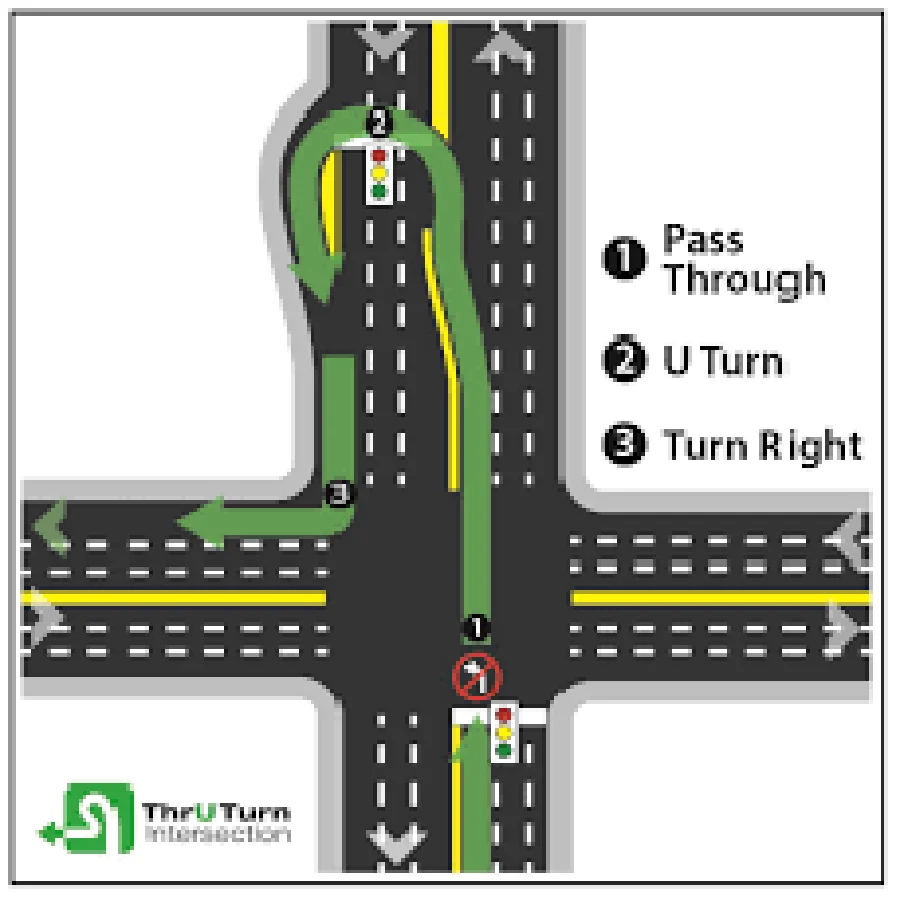
Thru-turn

An intersection design that prohibits direct left turns.

Handbook p. 63 ↗

Know the rule

To turn left at a thru-turn: go straight through, make a U-turn at the next signal downstream as the lane markings direct, come back, and turn right.

Handbook p. 63 ↗
Thru-turn (Michigan left) intersection
Thru-turn: pass through, U-turn, turn right

Single Point Urban Interchange (SPUI)

Pronounced 'spooee': an interchange where signals control all turns from a single point at its center.

Handbook p. 64 ↗

Using a SPUI:

  • Stop at the stop lines so you don't block cross-traffic
  • Going straight: stay in one of the two through lanes
  • Turning left onto the highway: use the lanes marked with a left arrow
  • Exiting right: stay in the right lane, yield, turn right, merge; watch for pedestrians
  • Exiting left: exit in the left lane and merge onto the highway; watch for pedestrians
  • Pedestrians and cyclists cross on signals to a center island
Handbook p. 64 ↗

Know the rule

If you exit the freeway by mistake at a SPUI, you can't go straight across to get back on. Turn left or right, find a safe place to turn around, and return to the correct entrance.

Handbook p. 64 ↗

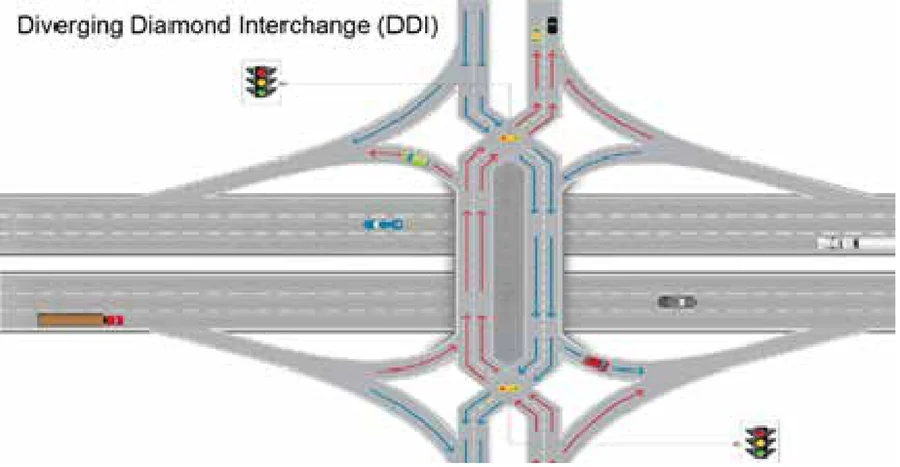
Diverging Diamond Interchange (DDI)

An interchange that temporarily shifts traffic to the left side of the road to give direct access to the interstate. Opposing traffic crosses at signals on each side of the bridge.

Handbook p. 65 ↗

Know the rule

In a DDI, follow signs, signals, raised islands, and markings, and stop at stop lines. Going straight, you cross to the opposite side at the first signal, then back at the second. Turning onto the highway from the left lane, cross over, then turn left.

Handbook p. 66 ↗
Diverging diamond interchange
Diverging Diamond Interchange

Put it into practice

You want to go left at a roundabout. Slow down, yield to traffic on your left already circling, enter to the right and go counter-clockwise around the island, then signal right as you approach your exit.

Check your understanding

Read the question, decide on an answer, then open it to check the explanation. These are Roadwise study questions based on the source handbook.

In a roundabout, drivers must yield to:
  1. vehicles entering from the right only
  2. pedestrians only
  3. no one, since entering traffic has priority
  4. vehicles already in the circle

Answer: vehicles already in the circle

Entering traffic must yield to vehicles already circulating.
Handbook p. 62 ↗
Drivers enter and travel through a roundabout in which direction?
  1. Counter-clockwise
  2. Either direction, depending on the exit
  3. Straight through only
  4. Clockwise

Answer: Counter-clockwise

Roundabouts in Idaho move counter-clockwise.

Handbook p. 62 ↗
In a thru-turn intersection, to complete a left turn you must:
  1. turn left directly as usual
  2. go straight, U-turn, then turn right
  3. wait for a dedicated left arrow
  4. turn right, then loop back left

Answer: go straight, U-turn, then turn right

Thru-turns route left turns through a downstream U-turn and a right turn.

Handbook p. 63 ↗
In a Single Point Urban Interchange (SPUI), traffic signals are controlled from:
  1. multiple independent signals at each ramp
  2. a flagger station
  3. a single point at the center of the interchange
  4. a roundabout in the center

Answer: a single point at the center of the interchange

The SPUI design controls turns from one central signal point.

Handbook p. 64 ↗
In a Diverging Diamond Interchange (DDI), opposing traffic temporarily:
  1. exits onto a frontage road
  2. merges into a single center lane
  3. stops at a four-way stop
  4. crosses to the left side of the highway

Answer: crosses to the left side of the highway

A DDI shifts opposing traffic to the left side across the overpass.

Handbook p. 65 ↗
If you exit a freeway by mistake, you should:
  1. find a safe place to turn around
  2. back up on the exit ramp
  3. cross straight over the highway to re-enter
  4. drive through the median crossover

Answer: find a safe place to turn around

You must not cross the highway directly or use crossovers; find another way back on.

Handbook p. 64 ↗
Take the lesson checkpoint in the app

More in Signs, Signals & Markings