roadwise.Open study app

Idaho driving lesson · Signs, Signals & Markings

Traffic signals and pedestrian beacons

A 3-minute lesson from the Idaho course. Read the rules and examples, follow the handbook page references, and check your understanding before you move on.

Read time
3 minutes
Course unit
Signs, Signals & Markings
Checkpoint questions
6
Source pages
55, 56, 57

Signals control who moves through an intersection and when. The color matters, but so does whether it's a circle or an arrow and whether it's steady or flashing.

Know the rule

Vertical signals: red on top, yellow in the middle, green on the bottom. Horizontal signals: red on the far left, yellow in the middle, green on the far right.

Handbook p. 55 ↗
Traffic signal (red/yellow/green states)
Red, yellow, and green signal indications

Circular lights

Circular lights
LightWhat you do
Steady redStop at the line; may turn unless 'no turn on red' is posted
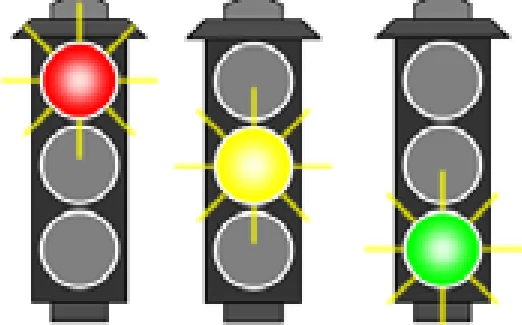
Flashing redFull stop, yield to cross traffic and people, go when clear
Steady yellowAbout to turn red: stop if you safely can
Flashing yellowSlow down, look for hazards, proceed with caution
GreenGo; left turners yield to oncoming traffic and pedestrians
Handbook p. 55 ↗

Arrows

Arrows
ArrowMeaning
Steady red arrowNo turn that way until green or yellow allows it
Solid yellow arrowTurn signal is changing; stop if you safely can
Flashing yellow arrowTurn allowed after yielding to oncoming and pedestrians
Handbook p. 55 ↗

Know the rule

On a yellow light or solid yellow arrow, if you are already in the intersection, keep moving and clear it safely.

Handbook p. 55 ↗

Know the rule

Even on green, don't enter an intersection unless there's room on the other side for your whole vehicle to pass through, so you won't block it.

Handbook p. 56 ↗

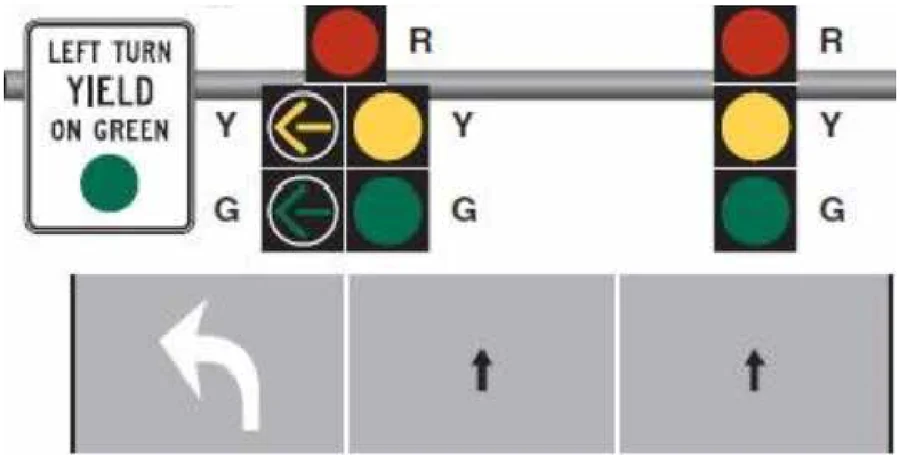
Doghouse signal

A signal most commonly used to indicate protected left turns. Its yellow light means the protected left turn is ending.

Handbook p. 56 ↗
Left turn yield on green (signal arrangement)
Doghouse signal controlling a left-turn lane

Know the rule

Whenever a traffic signal is not working, treat the intersection as a four-way stop.

Handbook p. 56 ↗

Pedestrian Hybrid Beacon (HAWK)

Two red lenses over one yellow lens, on a mast arm and roadside, letting pedestrians cross. Side streets have no signal; a side-street stop sign stays in force.

Handbook p. 56 ↗

How a HAWK beacon works for drivers:

  • 1. Dark (unlit) until a pedestrian pushes the button
  • 2. Flashing yellow: slow down approaching the crosswalk
  • 3. Solid yellow: prepare to stop
  • 4. Two solid reds: stop completely at the stop line
  • 5. Alternating flashing reds: stop, yield to pedestrians, go when the crosswalk is clear
  • 6. Dark again: proceed if the crosswalk is clear
Handbook p. 57 ↗

Put it into practice

A power outage knocks out the signal at a busy intersection. Treat it as a four-way stop: stop, let the first vehicle to arrive go first, and if you arrive together, the driver on the left yields to the driver on the right.

Check your understanding

Read the question, decide on an answer, then open it to check the explanation. These are Roadwise study questions based on the source handbook.

A flashing red light means:
  1. proceed with caution without stopping
  2. stop completely, then go when clear
  3. stop and wait for it to turn green
  4. slow down, but you need not stop

Answer: stop completely, then go when clear

A flashing red means stop: come to a complete stop, yield, then proceed when clear.
Handbook p. 55 ↗
A steady red arrow means:
  1. you must turn immediately
  2. you may turn after stopping and yielding
  3. no turn that way until a green or yellow
  4. you may turn only if there's no oncoming traffic

Answer: no turn that way until a green or yellow

A steady red arrow prohibits any turn in that direction.

Handbook p. 55 ↗
A flashing yellow arrow means:
  1. the signal is malfunctioning
  2. you must stop before turning
  3. no turns are allowed at any time
  4. turns are allowed after yielding

Answer: turns are allowed after yielding

A flashing yellow arrow permits a turn once you've yielded.

Handbook p. 56 ↗
When a traffic signal is not functioning, you should treat the intersection as:
  1. a four-way stop
  2. a do-not-enter zone
  3. a signal showing its last indication
  4. a yield intersection

Answer: a four-way stop

A dead signal is treated the same as a four-way stop.

Handbook p. 56 ↗
What does a 'doghouse' signal most commonly indicate?
  1. Pedestrian crossings
  2. Railroad crossings
  3. Right-turn-only lanes
  4. Protected left turns

Answer: Protected left turns

Doghouse signals are typically used for protected left-turn movements.

Handbook p. 56 ↗
When a HAWK beacon shows alternating flashing red lights, drivers must:
  1. stop completely and wait for a solid green
  2. stop, yield to pedestrians, then go when clear
  3. treat it as a yield sign only
  4. proceed with caution without stopping

Answer: stop, yield to pedestrians, then go when clear

Flashing red on a HAWK beacon means stop, then go once the crosswalk clears.

Handbook p. 57 ↗
Take the lesson checkpoint in the app

More in Signs, Signals & Markings