roadwise.Open study app

Idaho driving lesson · Signs, Signals & Markings

Railroad crossings

A 3-minute lesson from the Idaho course. Read the rules and examples, follow the handbook page references, and check your understanding before you move on.

Read time
3 minutes
Course unit
Signs, Signals & Markings
Checkpoint questions
6
Source pages
53, 60, 61, 106

Always treat railroad crossings as dangerous. A train can't swerve and needs over a mile to stop, so your safety is entirely up to you. Listen and look both ways, and never proceed until you're sure it's safe.

15 to 50 feet

When required to stop, stop within 50 feet but no less than 15 feet from the nearest rail

Handbook p. 60 ↗
40 times

How much greater the chance of death or serious injury is in a train-vehicle crash than other highway crashes

Handbook p. 60 ↗
7,000 feet

Stopping distance (1 1/3 miles) of a 150-car freight train going 50 mph

Handbook p. 60 ↗

Warning devices at crossings:

  • An X and the letters RR painted on the pavement before the crossing
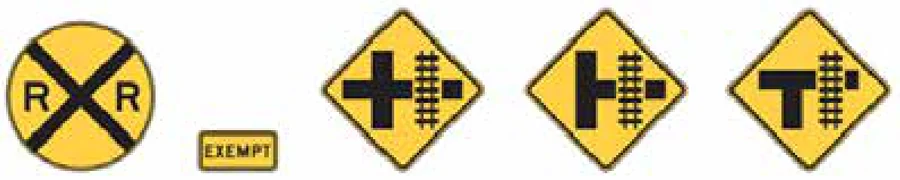
  • Railroad crossbuck signs at most crossings
  • Flashing-light signals: stop while they actively flash; go only when safe
  • Gates: never drive through, under, or around a gate that is lowered or being lowered
Handbook p. 61 ↗
Railroad crossing related signs (composite)
Railroad crossing signs

Crossing safety tips:

  • Expect a train at any time
  • Never stop with any part of your vehicle on the tracks
  • In traffic, don't start across unless there's room for your full vehicle
  • Never drive around lowered gates or ignore a signal, even if you see no train
  • Never shift gears while crossing; you could stall on the tracks
  • Never race a train to a crossing
  • Watch for a second train on another track
  • Look both ways even if the flashing lights aren't working
Handbook p. 61 ↗

Know the rule

Some buses and trucks must stop at all railroad crossings, and all vehicles carrying hazardous materials must. Be ready to stop when following one.

Handbook p. 61 ↗

Know the rule

An Emergency Notification System sign near the crossing gives the railroad's phone number and crossing number to report an emergency or broken signal.

Handbook p. 53 ↗

Put it into practice

Traffic is backed up and the car ahead stops just past the tracks. There's not enough room beyond the rails for your whole car. Wait before the crossing, 15 to 50 feet from the nearest rail if required to stop, until there's room to clear it completely.

Check your understanding

Read the question, decide on an answer, then open it to check the explanation. These are Roadwise study questions based on the source handbook.

Pavement marked with an X and the letters 'RR' in advance of a crossing indicates:
  1. a reduced-speed zone
  2. a school crossing
  3. a roundabout ahead
  4. an upcoming railroad crossing

Answer: an upcoming railroad crossing

This pavement marking warns of a railroad crossing ahead.
Handbook p. 61 ↗
When required to stop at a railroad crossing, you must stop no closer than how many feet from the nearest rail?
  1. 15 feet
  2. 5 feet
  3. 50 feet
  4. 30 feet

Answer: 15 feet

You must stop no less than 15 feet from the nearest rail.

Handbook p. 60 ↗
When required to stop at a railroad crossing, what is the farthest from the nearest rail you may stop?
  1. 15 feet
  2. 50 feet
  3. 25 feet
  4. 100 feet

Answer: 50 feet

The stop must be within 50 feet but no less than 15 feet of the nearest rail.

Handbook p. 60 ↗
A collision between a train and a vehicle is how many times more likely to be fatal than other highway crashes?
  1. 100 times
  2. 4 times
  3. 40 times
  4. 10 times

Answer: 40 times

The handbook cites a 40-times-greater fatality risk at rail crossings.

Handbook p. 60 ↗
You must never drive through, under, or around a lowered or lowering railroad crossing gate.
  1. True
  2. False

Answer: True

Driving around a lowered or lowering gate is always prohibited.

Handbook p. 61 ↗
It's safe to proceed through a railroad crossing without looking both ways if the flashing lights aren't on.
  1. True
  2. False

Answer: False

You should always look both ways, even if the signal isn't flashing.

Handbook p. 61 ↗
Take the lesson checkpoint in the app

More in Signs, Signals & Markings