roadwise.Open study app

Idaho driving lesson · Speed, Stopping & Turning

Speed limits and the basic rule

A 3-minute lesson from the Idaho course. Read the rules and examples, follow the handbook page references, and check your understanding before you move on.

Read time
3 minutes
Course unit
Speed, Stopping & Turning
Checkpoint questions
6
Source pages
68, 69, 71

Idaho's traffic laws are the 'Rules of the Road' for stopping, speed, yielding, passing, and parking. Speed comes first: posted limits are maximums for ideal conditions, and the basic rule can make a slower speed the legal one.

Basic rule

Idaho law requires you to drive at a speed that is 'reasonable and prudent' at all times, on every road, even where maximum and minimum limits are set by law or posted.

Handbook p. 68 ↗

To choose a reasonable and prudent speed, think about:

  • How your speed affects other traffic, including pedestrians and bicycle riders
  • The road surface: ice, snow, rain, or rough pavement
  • Hazards at intersections, and visibility
  • Oncoming traffic, curves, and any other condition affecting safety
Handbook p. 68 ↗

Know the rule

Driving too slowly for conditions and impeding the safe flow of traffic also violates the basic rule, even if you are under the posted limit.

Handbook p. 68 ↗

Maximum speed limits

Maximum speed limits
WhereLimit
Interstates75 mph unless posted (80 may be allowed where posted)
State highways65 mph (70 may be allowed where posted)
Other locations55 mph, up to 70 allowed, unless otherwise posted
Residential, business, or urban districts35 mph unless otherwise posted
Handbook p. 68 ↗

Know the rule

It is illegal to drive so slowly that you disrupt the normal flow of traffic. You may not stay in the extreme left-hand lane long enough to impede traffic moving at a lawful speed.

Handbook p. 69 ↗

Know the rule

Obey posted limits in school zones and in designated work zones. A work zone speeding violation can bring an enhanced, fixed penalty.

Handbook p. 69 ↗

Know the rule

Any vehicle race, speed exhibition, or speed contest on a public road, street, or highway is illegal.

Handbook p. 69 ↗

Know the rule

Your speed determines how much time you have to react and how far it takes to stop. Driving too fast is a major cause of motor vehicle crashes.

Handbook p. 71 ↗
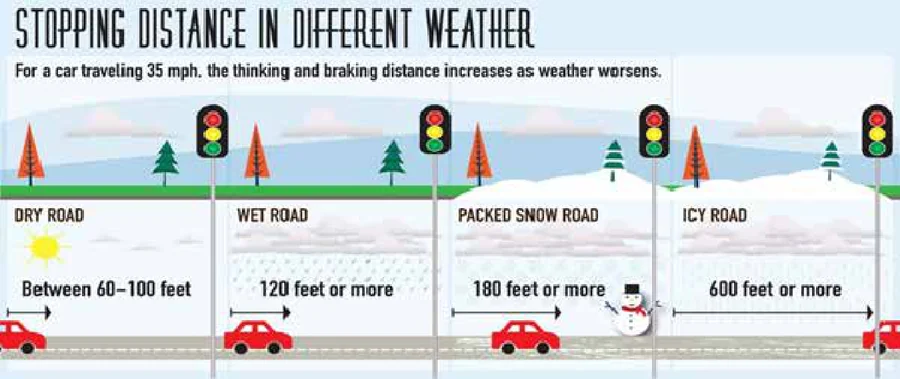
Stopping distance by weather condition
Stopping distance grows as road conditions worsen

Put it into practice

The posted limit is 65 mph but the highway is covered in packed snow and you can barely see. Driving 65 would break the basic rule. Slow to a speed that is reasonable and prudent for the ice and visibility.

Check your understanding

Read the question, decide on an answer, then open it to check the explanation. These are Roadwise study questions based on the source handbook.

Idaho's 'basic rule' requires you to drive at a speed that is:
  1. at least 5 mph under the limit
  2. reasonable and prudent
  3. always the posted limit exactly
  4. never below the posted limit

Answer: reasonable and prudent

The basic rule requires reasonable and prudent speed regardless of the posted limit.
Handbook p. 68 ↗
Maximum speed on Idaho interstates, unless otherwise posted, is:
  1. 65 mph
  2. 70 mph
  3. 75 mph
  4. 80 mph

Answer: 75 mph

Interstates default to a 75 mph maximum.

Handbook p. 68 ↗
Maximum speed on state highways, unless otherwise posted, is:
  1. 65 mph
  2. 55 mph
  3. 75 mph
  4. 70 mph

Answer: 65 mph

State highways default to a 65 mph maximum.

Handbook p. 68 ↗
Maximum speed in a residential, business, or urban district, unless otherwise posted, is:
  1. 45 mph
  2. 35 mph
  3. 25 mph
  4. 30 mph

Answer: 35 mph

Urban/residential/business districts default to 35 mph.

Handbook p. 68 ↗
Driving too slowly for conditions and impeding traffic, even under the posted limit, violates:
  1. only a local ordinance
  2. the minimum speed law only on freeways
  3. the basic rule law
  4. no law, since the limit is a maximum only

Answer: the basic rule law

The basic rule applies to driving too slow as well as too fast.

Handbook p. 68 ↗
When is it illegal to drive in the extreme left-hand lane?
  1. Whenever you are not actively passing
  2. Whenever you are in a work zone
  3. Whenever you are below the speed limit
  4. When it impedes traffic moving at a lawful speed

Answer: When it impedes traffic moving at a lawful speed

Lingering in the far left lane while impeding traffic is prohibited.

Handbook p. 69 ↗
Take the lesson checkpoint in the app

More in Speed, Stopping & Turning