roadwise.Open study app

Idaho driving lesson · Speed, Stopping & Turning

When you must stop

A 4-minute lesson from the Idaho course. Read the rules and examples, follow the handbook page references, and check your understanding before you move on.

Read time
4 minutes
Course unit
Speed, Stopping & Turning
Checkpoint questions
6
Source pages
44, 69, 70, 71

Idaho law lists specific situations where you must stop. Some mean a brief stop, like a stop sign; others, like a school bus with flashing red lights, mean staying stopped until the danger has passed.

Idaho law requires you to STOP:

  • At a stop line, or before the near-side crosswalk, or where you can see the cross road
  • For any flashing red light: it is the same as a stop sign
  • For any steady red arrow: the same as a stop sign; no turn until green or yellow
  • For a steady red light, behind the stop line (or before the crosswalk)
  • Or slow down, to yield to a pedestrian in a marked or unmarked crosswalk
  • At a railway crossing when a train is coming or signals, gates, or a watchman warn
Handbook p. 69 ↗

You must also STOP:

  • Entering a street from an alley, building, driveway, or private road, before the sidewalk
  • When any police officer requests it
  • For emergency or police vehicles with a siren or flashing red or blue lights
  • When you are involved in a crash
  • For a school bus loading or unloading students
Handbook p. 70 ↗

Know the rule

At a steady red, after stopping and yielding to cross-traffic you may turn right, or turn left onto a one-way street, unless posted otherwise. A green arrow with a red light lets you go only in the arrow's direction.

Handbook p. 69 ↗

Know the rule

For an emergency vehicle, pull to the nearest edge or curb on the right side, clear of any intersection, and stay stopped until it passes or an officer signals you to go.

Handbook p. 70 ↗

Know the rule

Stop for a school bus showing flashing red lights near its top and/or its left-side stop arm, and stay stopped until all children are clear of the roadway and the bus.

Handbook p. 70 ↗

Know the rule

Exception: you need not stop if you are going the opposite direction on a highway of four or more lanes with two lanes going each direction.

Handbook p. 70 ↗
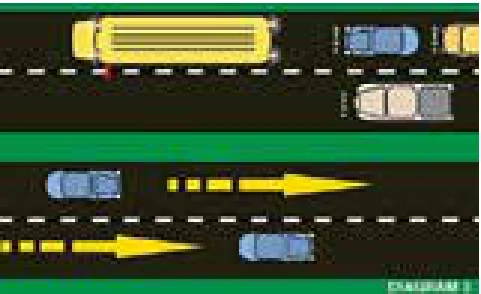
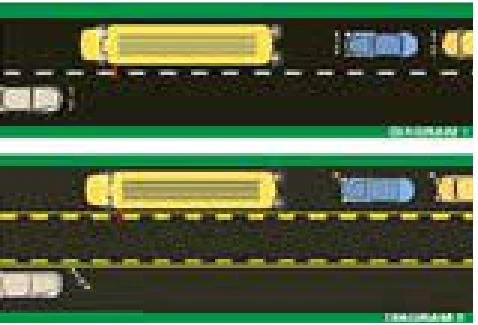
School bus stop scenario (same-direction lanes)
School bus stopped with red lights flashing
School bus stop: divided highway
Four lanes, two each way: opposite-direction traffic may proceed

Know the rule

When slowing or stopping, signal other drivers with your brake lights or an arm signal.

Handbook p. 71 ↗

Know the rule

Stopped behind another vehicle, leave enough room to see its rear tires where they touch the ground. That gives space to avoid being pushed into it and to go around if it stalls.

Handbook p. 71 ↗

Put it into practice

You're on a two-lane road and a school bus coming toward you stops with red lights flashing. You must stop too, and wait until every child is clear of the road and the bus. Only a four-lane road with two lanes each way lets oncoming traffic continue.

Check your understanding

Read the question, decide on an answer, then open it to check the explanation. These are Roadwise study questions based on the source handbook.

When approaching a stop sign with no stop line or crosswalk, you must stop:
  1. where you can see approaching cross traffic
  2. only if cross-traffic is visible
  3. at the edge of the nearest sidewalk or curb line
  4. exactly 10 feet from the intersection

Answer: where you can see approaching cross traffic

Without a stop line or crosswalk, stop where you can view the intersecting traffic.
Handbook p. 44 ↗
At a steady red circular light, after stopping and yielding you may:
  1. turn right only during daylight
  2. turn right
  3. turn left onto any street
  4. never turn until green

Answer: turn right

Right turns are allowed on red after stopping and yielding, unless posted otherwise.

Handbook p. 69 ↗
You must stop for a school bus with flashing red lights unless:
  1. it's after school hours
  2. you're traveling less than 20 mph
  3. the bus is more than 100 feet ahead
  4. you're going the opposite way, 2 lanes each way

Answer: you're going the opposite way, 2 lanes each way

You need not stop if traveling in the opposite direction on a highway with four or more lanes, two going each way.

Handbook p. 70 ↗
You must stop when entering a street from an alley, building, or driveway:
  1. before crossing the sidewalk
  2. after crossing the sidewalk
  3. only during business hours
  4. only if pedestrians are visible

Answer: before crossing the sidewalk

You must stop before crossing the sidewalk, yielding to pedestrians and traffic.

Handbook p. 70 ↗
When stopping behind another vehicle, a safe habit is to leave enough space to see:
  1. the top of the vehicle's trunk
  2. the rear tires of the car ahead
  3. the rear bumper only
  4. the entire rear bumper and license plate

Answer: the rear tires of the car ahead

Seeing the rear tires touch the ground indicates a safe following gap.

Handbook p. 71 ↗
You must stop for emergency vehicles by pulling to:
  1. the left shoulder if it is wider
  2. the lane farthest from the emergency vehicle
  3. the nearest side street or business parking lot
  4. the right curb or edge, clear of intersections

Answer: the right curb or edge, clear of intersections

Pull to the right edge or curb, away from intersections, and stop.

Handbook p. 70 ↗
Take the lesson checkpoint in the app

More in Speed, Stopping & Turning