roadwise.Open study app

Hawaii driving lesson · Signs, Signals & Markings

No-passing rules and slow-moving vehicles

A 3-minute lesson from the Hawaii course. Read the rules and examples, follow the handbook page references, and check your understanding before you move on.

Read time
3 minutes
Course unit
Signs, Signals & Markings
Checkpoint questions
6
Source pages
30, 31

Most passing crashes are head-on crashes, so Hawaii lists exactly where you may never pass. It also marks slow farm and work vehicles with a special triangle so you don't come up on them too fast.

Do NOT pass:

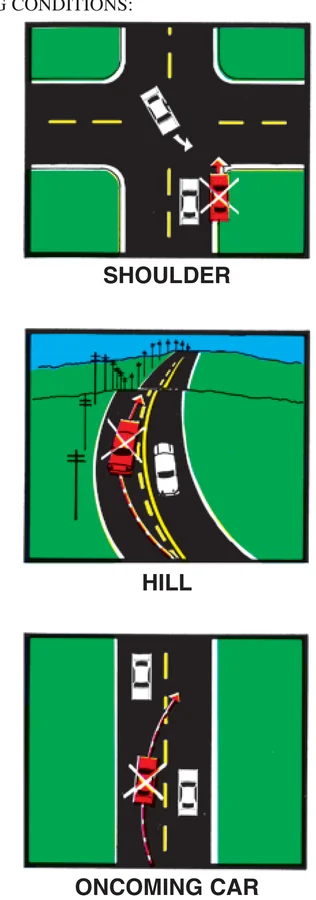
  • On the right shoulder of the highway
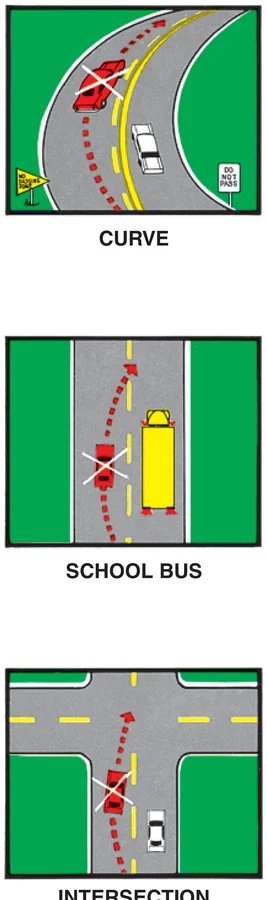
  • Approaching a hill or curve without 700 to 1000 feet of clear distance ahead
  • When you can't finish without endangering oncoming traffic, before a yellow line appears in your lane
  • When there's a solid yellow line in your lane
  • When a school bus on the same roadway has its flashing lights operating
  • Within 100 feet of, or in, an intersection or railroad crossing
  • Within 100 feet of a posted narrow bridge, viaduct or tunnel
Handbook p. 30 ↗
No-passing situations (composite)
No passing: on the shoulder, near a hill, into an oncoming car
No-passing situations (composite)
No passing: on a curve, by a school bus, at an intersection
700–1000 ft

Clear distance you need ahead to pass near a hill or curve

Handbook p. 30 ↗
100 feet

No passing this close to an intersection, railroad crossing, or posted narrow bridge, viaduct or tunnel

Handbook p. 31 ↗

Know the rule

When a solid yellow line is in your lane, look for the yellow NO PASSING ZONE pennant on the left side of the road ahead.

Handbook p. 31 ↗

Know the rule

When you are being passed, it is unlawful to increase your speed.

Handbook p. 30 ↗

Know the rule

The end of a no-passing zone doesn't mean it's safe to pass. It only means visibility ahead is better.

Handbook p. 31 ↗
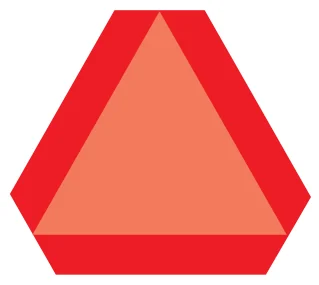
Slow-moving vehicle emblem
Slow moving vehicle emblem

Know the rule

The highly reflective 18-inch triangular slow moving vehicle emblem must be displayed on the rear of vehicles designed to operate at 25 mph or less.

Handbook p. 30 ↗

Know the rule

When you see the slow moving vehicle emblem, reduce speed and approach cautiously.

Handbook p. 30 ↗

Put it into practice

You're passing a car when you realize an intersection is coming up within 100 feet. Don't speed up to finish. Drop back behind the car and pass after the intersection, if it's safe.

Check your understanding

Read the question, decide on an answer, then open it to check the explanation. These are Roadwise study questions based on the source handbook.

You must not pass another vehicle when approaching a hill or curve unless you have a clear view of at least:
  1. 500 to 700 feet
  2. 300 to 500 feet
  3. 700 to 1,000 feet
  4. 1,000 to 1,500 feet

Answer: 700 to 1,000 feet

Passing near a hill or curve requires 700 to 1,000 feet of clear sight distance.
Handbook p. 30 ↗
You may not pass within how many feet of an intersection or railroad crossing?
  1. 500 feet
  2. 100 feet
  3. 50 feet
  4. 200 feet

Answer: 100 feet

Passing is prohibited within 100 feet of an intersection or railroad crossing.

Handbook p. 31 ↗
You must never pass:
  1. a school bus with its red lights flashing, on the same roadway
  2. a slow-moving vehicle on a 4-lane road
  3. a car signaling a right turn
  4. a bicyclist

Answer: a school bus with its red lights flashing, on the same roadway

Passing a school bus with flashing red lights on the same roadway is prohibited.

Handbook p. 31 ↗
The 18-inch reflective triangular slow-moving vehicle emblem is required on vehicles designed to operate at:
  1. 40 mph or less
  2. 25 mph or less
  3. 35 mph or less
  4. 45 mph or less

Answer: 25 mph or less

The emblem is required for vehicles designed to travel 25 mph or less.

Handbook p. 30 ↗
When you are being passed by another vehicle, it is unlawful to:
  1. increase your speed
  2. slow down
  3. sound your horn
  4. move to the right side of your lane

Answer: increase your speed

It is unlawful to speed up while being passed.

Handbook p. 30 ↗
The end of a "no passing zone" sign means:
  1. a school zone begins
  2. more visibility ahead, not that passing is safe
  3. the speed limit increases
  4. it is now safe to pass

Answer: more visibility ahead, not that passing is safe

The end of a no-passing zone only signals more visibility, not guaranteed safety.

Handbook p. 31 ↗
Take the lesson checkpoint in the app

More in Signs, Signals & Markings