roadwise.Open study app

Hawaii driving lesson · Signs, Signals & Markings

Stop lines, crosswalks and special markings

A 3-minute lesson from the Hawaii course. Read the rules and examples, follow the handbook page references, and check your understanding before you move on.

Read time
3 minutes
Course unit
Signs, Signals & Markings
Checkpoint questions
6
Source pages
9, 36, 37, 38

Beyond lane lines, Hawaii uses markings that tell you exactly where to stop, where pedestrians cross, which way you may turn, and how to get around obstacles. Each one has a precise rule.

Know the rule

Stop lines are solid white lines across the lanes at intersections and pedestrian crosswalks, marking the exact place to stop.

Handbook p. 36 ↗

Know the rule

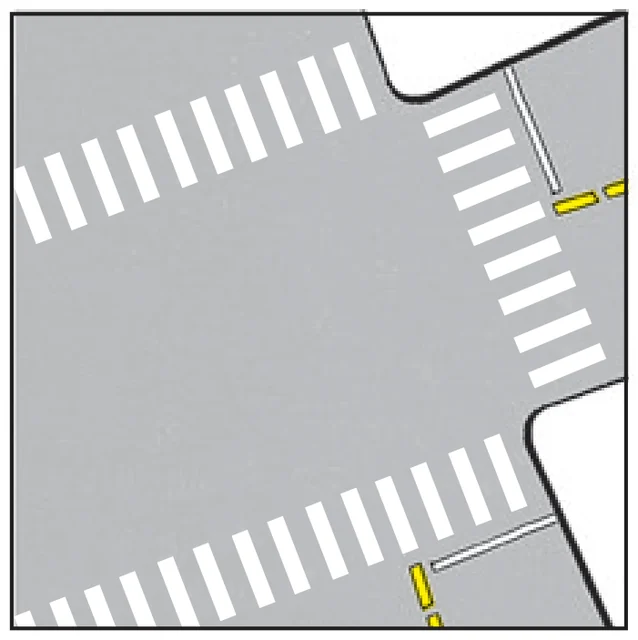
Crosswalk lines show pedestrians where to cross and warn drivers. You must stop for pedestrians in crosswalks.

Handbook p. 36 ↗
Crosswalk
Crosswalk markings at an intersection

Crosswalk

The part of a road at an intersection within the lines of the sidewalks extended across it, or any spot distinctly marked for pedestrian crossing.

Handbook p. 9 ↗

Know the rule

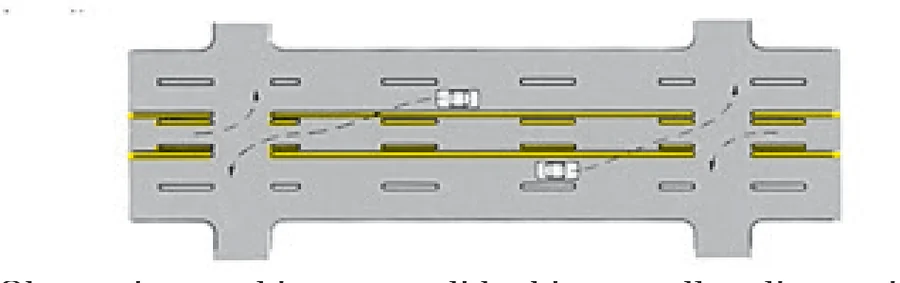
A two-way left-turn lane, marked with solid and dashed yellow lines in the center, is for left turns by traffic in either direction ONLY. Never use it for passing.

Handbook p. 36 ↗
Multi-lane road with double yellow center line diagram
Two-way left-turn lane in the center of the road

Know the rule

Obstruction markings guide you around objects like bridge supports. Pass either side of white obstruction markings, but only to the right of yellow ones.

Handbook p. 37 ↗

Know the rule

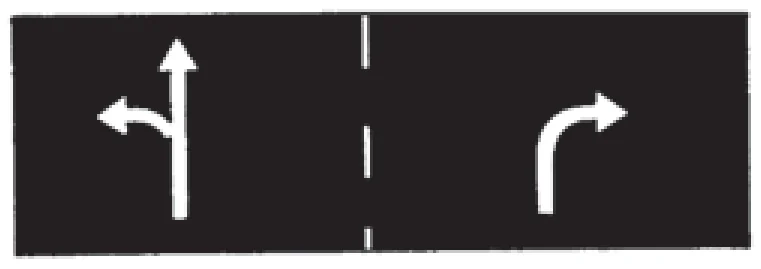
Directional arrows show which way you must go. Where arrows show more than one direction, you may choose any of them.

Handbook p. 37 ↗
Lane use arrows (straight/left and right turn lanes)
Lane arrows: left lane may go straight or turn left; right lane must turn right

Know the rule

Railroad crossing markings: a large 'X' and two 'R's in the lane, a solid yellow centerline the whole distance to prevent passing, and a white stop line.

Handbook p. 38 ↗

Know the rule

Traffic islands direct you into separate lanes; they may be paint only or curbing, paving or landscaping. Never drive into or across a traffic island.

Handbook p. 38 ↗

Safety island (safety zone)

A traffic island used to protect pedestrians who must stand in the roadway; the area is set apart for pedestrians' exclusive use.

Handbook p. 38 ↗

Put it into practice

A concrete bridge pier sits in the middle of your lane, outlined with yellow markings. You must pass it on the right. If the markings were white, you could pass on either side.

Check your understanding

Read the question, decide on an answer, then open it to check the explanation. These are Roadwise study questions based on the source handbook.

Stop lines are:
  1. broken white lines across the lanes
  2. solid yellow lines across the lanes
  3. solid white lines across the lanes
  4. dashed yellow lines along the lanes

Answer: solid white lines across the lanes

Stop lines are solid white lines marking where to stop at intersections and crosswalks.
Handbook p. 36 ↗
When you see crosswalk lines with pedestrians in them, you must:
  1. stop only if a school crossing guard is present
  2. stop and let the pedestrians finish crossing
  3. proceed if your light is green
  4. honk your horn and continue driving

Answer: stop and let the pedestrians finish crossing

Drivers must stop for pedestrians in crosswalks.

Handbook p. 36 ↗
A center lane marked with combined yellow solid and dashed lines, usable by traffic from either direction, is for:
  1. left turns only
  2. passing slower vehicles
  3. emergency vehicles only
  4. buses and taxis only

Answer: left turns only

This two-way left-turn lane is for left turns only, never for passing.

Handbook p. 36 ↗
Yellow obstruction markings around a hazard in the road mean you should:
  1. pass only to the right of it
  2. pass on either side of it, your choice
  3. stop and wait before entering it
  4. pass only to the left of it

Answer: pass only to the right of it

You must pass yellow obstruction markings only to the right.

Handbook p. 37 ↗
White obstruction markings around a hazard mean you may:
  1. pass only on the left side
  2. pass only on the right side
  3. not pass it at all
  4. pass on either side of it

Answer: pass on either side of it

White obstruction markings may be passed on either side.

Handbook p. 37 ↗
A railroad crossing pavement marking includes:
  1. a yellow diamond and the word RAIL
  2. a large "X" inside a circle
  3. two solid yellow lines and a train
  4. a large "X" and two "R's"

Answer: a large "X" and two "R's"

The pavement marking is a large X flanked by two R's.

Handbook p. 38 ↗
Take the lesson checkpoint in the app

More in Signs, Signals & Markings