Hawaii practice test
Hawaii permit practice test.
Get to know the format, try six study questions, and check the explanations before opening a full Roadwise practice test. This course’s simulation is based on the format described below.
- Questions
- 25
- Correct to pass
- 20
- Practice timer
- 60 minutes
- Study question bank
- 617
The format in this course
Hawaii Class 3 Knowledge Test
To pass this Roadwise simulation, answer at least 20 of 25 questions correctly. Answers and explanations appear after you finish. Unanswered questions count as incorrect.
This practice format uses one overall passing threshold, without a separately scored sign section.
The practice simulation uses a 60-minute countdown. The test clock continues while you are away from the session.
The handbook itself does not state the test format. Hawaii's statewide knowledge test is now administered online via KnowToDrive (k2do-hi.iti4dmv.com), confirmed by HIDOT's own site as 25 questions with a 60-minute limit; in-person testing is still offered at county offices on a limited basis. The official pages found did not publish an exact passing percentage, so 80% (20/25) is used per third-party DMV test-prep corroboration (e.g. driving-tests.org, epermittest.com) and is the customary Hawaii standard; treat the minimum correct-answer count as best-corroborated rather than officially confirmed. No sections are scored separately.
Try a few practice questions
Read the question, decide on an answer, then open it to check the explanation. These are Roadwise study questions based on the source handbook.
Where must the supervising licensed driver sit when riding with a permit holder in a car?
- Right front seat
- Left rear seat
- Any rear seat
- Anywhere in the vehicle
Answer: Right front seat
In all vehicles except motorcycles, the licensed supervisor must sit in the right front seat.
Handbook p. 11 ↗If you've just had a serious argument and are angry, the safest choice before driving is to:
- take a few minutes to cool off first
- drive home right away to beat traffic
- play the radio loud to forget about it
- drive, but stay under the speed limit
Answer: take a few minutes to cool off first
Strong emotions require a cooling-off period before it is safe to drive.
Handbook p. 24 ↗If you're involved in a crash, the first thing you should do is:
- Exchange insurance information
- Call your insurance company
- Stop immediately and move off the road if possible
- Move any injured people to your car
Answer: Stop immediately and move off the road if possible
You must stop immediately and move your vehicle off the traveled roadway if possible.
Handbook p. 52 ↗A child under age 4 in a Hawaii vehicle must ride:
- held in an adult's lap
- in a child restraint seat
- belted with a regular seat belt only
- in the front seat
Answer: in a child restraint seat
Children under age 4 must be in a child restraint seat.
Handbook p. 20 ↗You must stop for a blind pedestrian identified by a white cane or guide dog:
- only if the traffic light is red
- only at a marked crosswalk
- regardless of the signal or traffic situation
- only if they signal you
Answer: regardless of the signal or traffic situation
Stopping for a blind pedestrian is required regardless of signal or situation.
Handbook p. 95 ↗What does this sign mean?
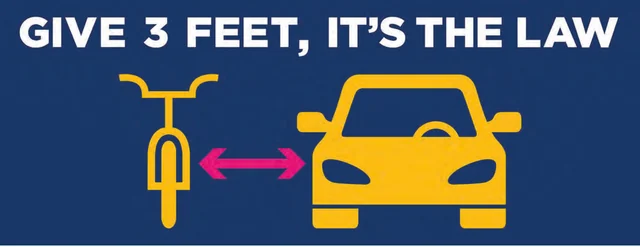
- Drivers must leave at least 3 feet when passing a bicyclist.
- Provides a phone number for road and weather conditions.
- Shows nearby services such as fuel, food and lodging.
- Shows gas, food, and lodging services available at the next right.
Answer: Drivers must leave at least 3 feet when passing a bicyclist.
3-foot passing law (bicycles): Drivers must leave at least 3 feet when passing a bicyclist. Give at least 3 feet of space when passing a cyclist.
Handbook p. 9 ↗What to study next
The practice question pool spans the course. Use the topics below to read the rules behind an answer, then return to practice.
6 lessons
Your License
Permits, GDL, license classes, REAL ID, renewal, road test
Explore4 lessons
Vehicle Equipment & Registration
Required equipment, inspections, registering and titling
Explore7 lessons
Rules of the Road & Right-of-Way
Attitude, lanes, signals, speed, parking, right-of-way, freeways
Explore8 lessons
Signs, Signals & Markings
Pavement markings, signals, signs, no-passing zones, work zones
Explore2 lessons
Crashes & Insurance
What to do after a crash, no-fault insurance basics
Explore2 lessons
Alcohol & Drugs
BAC limits, implied consent, other drugs
Explore8 lessons
Safe Driving Techniques
Habits, seeing, belts, lanes, speed, braking, weather, emergencies
Explore3 lessons
Trucks, Buses & Motorcycles
Sharing the road with large vehicles, trailers and motorcycles
Explore4 lessons
Pedestrians, School Buses & Bicycles
Pedestrian right-of-way, school buses, sharing the road with cyclists
Explore