Roadwise States Hawaii Driving lessons Pedestrian safety: your duties as driver and walker Hawaii driving lesson · Pedestrians, School Buses & Bicycles
Pedestrian safety: your duties as driver and walker A 3-minute lesson from the Hawaii course. Read the rules and examples, follow the handbook page references, and check your understanding before you move on.
Read time 3 minutes
Course unit Pedestrians, School Buses & Bicycles
Checkpoint questions 6
Source pages 95, 96 A pedestrian has no physical protection against a car, so safety depends entirely on the alertness of both the walker and the driver. Hawaii's numbers show children and older people are hit most often.
Know the rule
Children are quick and see well but underestimate a vehicle's danger. Older people often have poor vision, slow reactions and can't move fast, and are more easily hurt.
Handbook p. 95 ↗ Your responsibility as a DRIVER: Slow down and be ready to stop for people on or crossing the road, and children nearby Sound your horn as necessary to warn a pedestrian on the roadway (required by law) Never drive through a pedestrian safety zone (prohibited by law) Watch for children near schools, parks, playgrounds and homes; stop for school crossing guards Watch for pedestrians when turning and entering or leaving driveways (required by law) Look before you or passengers get out; exit on the side away from traffic if possible Handbook p. 95 ↗ Know the rule
Stop for all blind persons in the roadway, identified by a white cane or guide dog, regardless of the traffic signal or traffic situation.
Handbook p. 95 ↗ Know the rule
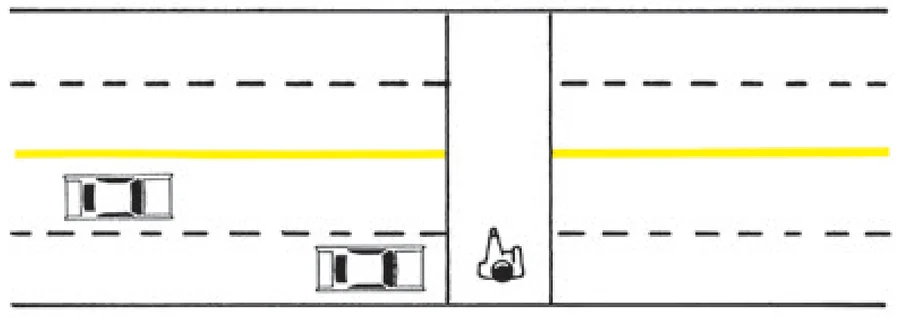
Never pass a vehicle stopped to allow a pedestrian to cross the street. This is prohibited by law.
Handbook p. 95 ↗ A vehicle stopped at a crosswalk – don't pass it Your responsibility as a PEDESTRIAN: Cross only at crosswalks – jaywalking is illegal Obey all traffic laws and signals, and watch for cars at all times Don't start across on a green that's been showing a while; wait for the next cycle Never step out when vehicles are close by (prohibited by law) Look for turning vehicles; never run alongside or across a street Walk on the left side of the street, facing oncoming traffic Don't stand in the road to solicit or to guard a car or parking place (prohibited by law) Wear bright clothing; don't walk on or near the road under the influence Make sure your children don't play in the street Handbook p. 95 ↗ Put it into practice
On a four-lane street, the car in the lane beside you stops at a crosswalk with no signal. You can't see why. Stop too: a pedestrian may be crossing in front of it, and passing a vehicle stopped for a pedestrian is illegal.
A useful reminder White cane or guide dog: stop, no matter what the signal shows.
Check your understanding Read the question, decide on an answer, then open it to check the explanation. These are Roadwise study questions based on the source handbook.
In Hawaii, about what share of all traffic fatalities are pedestrians? 5% 20% 10% 35% Answer: 20%
Roughly 20% of Hawaii's traffic fatalities are pedestrians.
Handbook p. 95 ↗ Of pedestrians fatally injured in Hawaii, almost half are: drivers who got out of their cars bicyclists too under age 15 or over age 65 tourists Answer: under age 15 or over age 65
Nearly half of pedestrian fatalities involve people under 15 or over 65.
Handbook p. 95 ↗ Most fatal pedestrian crashes in Hawaii occur: in parking lots in the roadway off the roadway in driveways Answer: in the roadway
About 90% occur in the roadway, and over half of those happen while crossing.
Handbook p. 95 ↗ By law, when you see a pedestrian on the roadway, especially children, you must: keep your speed and honk slow down and be prepared to stop change lanes without slowing stop only if they are in a crosswalk Answer: slow down and be prepared to stop
Drivers must slow down, be ready to stop, and sound the horn as necessary.
Handbook p. 95 ↗ You must stop for a blind pedestrian identified by a white cane or guide dog: only if the traffic light is red only at a marked crosswalk regardless of the signal or traffic situation only if they signal you Answer: regardless of the signal or traffic situation
Stopping for a blind pedestrian is required regardless of signal or situation.
Handbook p. 95 ↗ Passing a vehicle that has stopped to let a pedestrian cross is: prohibited by law allowed on multi-lane roads only allowed if the pedestrian is not in your lane allowed if you slow down Answer: prohibited by law
It is prohibited to pass a vehicle stopped for a crossing pedestrian.
Handbook p. 95 ↗ Previous lesson Sharing the road with motorcycles Next lesson Stopping for school buses More in Pedestrians, School Buses & Bicycles About the source Roadwise’s Hawaii course uses the driver handbook edition supplied with this study pack. This lesson cites source pages 95, 96. The linked PDF is a third-party mirror of the handbook, rather than a government-hosted page.
Open the handbook source PDF · View the source edition
For current application requirements, fees, appointments, and the format that applies to your age or license type, check Hawaii’s DMV. Roadwise provides study material and does not issue permits or licenses.