Roadwise States Georgia Driving lessons Sign shapes and colors Georgia driving lesson · Signs, Signals and Markings
Sign shapes and colors A 3-minute lesson from the Georgia course. Read the rules and examples, follow the handbook page references, and check your understanding before you move on.
Read time 3 minutes
Course unit Signs, Signals and Markings
Checkpoint questions 6
Source pages 29 Georgia uses seven basic sign shapes. Learn them so you can recognize a sign from a distance, before you can read it, and react in time.
Know the rule
Georgia law requires all drivers, including bicyclists, to obey official highway signs and traffic signals unless a police officer or emergency worker directs otherwise.
Handbook p. 29 ↗ Octagon: STOP Know the rule
At a stop sign, stop at the marked stop line. If there's none, stop before the crosswalk on your side; if there's no crosswalk, where you can best see oncoming traffic.
Handbook p. 29 ↗ Know the rule
Don't start again until pedestrians on your side of the road have finished crossing and you've yielded to closely approaching traffic.
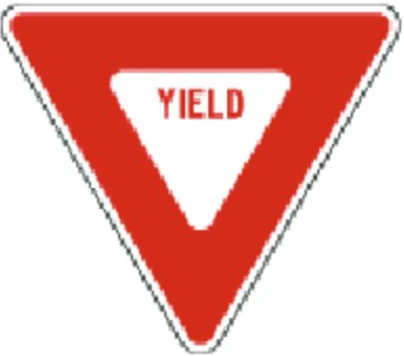
Handbook p. 29 ↗ Triangle: YIELD Know the rule
At a yield sign, slow to a reasonable speed and stop if necessary, at a marked stop line if there is one. Then yield to vehicles in the intersection or approaching closely.
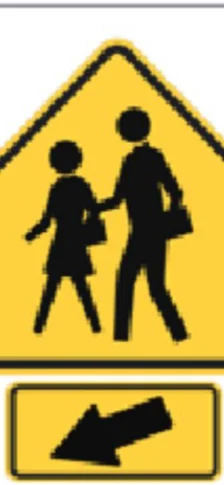
Handbook p. 29 ↗ Pentagon: school zone or school crossing 150 to 700 feet Distance ahead of the school grounds or crossing where pentagon signs are placed
Handbook p. 29 ↗ Know the rule
Pentagon school signs can sometimes be fluorescent green.
Handbook p. 29 ↗ Know the rule
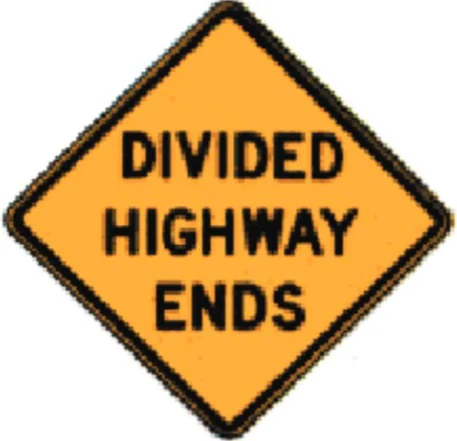
Diamond warning signs are yellow, with black words naming the hazard or black symbols showing it.
Handbook p. 29 ↗ Diamond: warning (Divided Highway Ends) Put it into practice
You reach a stop sign with no stop line and no crosswalk. Stop at the point where you can best see oncoming traffic, and go only after yielding.
Check your understanding Read the question, decide on an answer, then open it to check the explanation. These are Roadwise study questions based on the source handbook.
What does an octagon-shaped sign always mean? School zone ahead Yield Stop Railroad crossing ahead Answer: Stop
An octagon (eight-sided shape) always means stop.
Handbook p. 29 ↗ What does a triangle-shaped sign mean? Yield No passing Stop Railroad crossing Answer: Yield
Triangle signs mean yield; slow down and stop if necessary.
Handbook p. 29 ↗ What does a round-shaped sign warn you about? A construction zone ahead A school zone ahead A railroad crossing ahead A sharp curve ahead Answer: A railroad crossing ahead
A round sign means you are approaching a railroad crossing.
Handbook p. 29 ↗ What does a pentagon-shaped sign indicate? A hazardous materials route A hospital is nearby A weigh station ahead A school zone or crossing Answer: A school zone or crossing
Pentagon shaped signs mean you are approaching a school zone and/or school crossing.
Handbook p. 29 ↗ Diamond-shaped signs are typically used for what purpose? Marking regulatory speed limits Warning of road hazards Directing traffic to services like gas or food Showing distances to the next town Answer: Warning of road hazards
Diamond shaped signs warn of existing or possible hazards on roadways or adjacent areas.
Handbook p. 29 ↗ When you approach an octagon-shaped sign at an intersection with no marked stop line and no crosswalk, where should you stop? Right beside the stop sign post Where you can best see traffic About 4 feet before the sign Exactly 50 feet before the intersection Answer: Where you can best see traffic
If there is no stop line and no crosswalk, stop at a point from which you can best see oncoming traffic.
Handbook p. 29 ↗ Previous lesson Responsible adults, revocation and teens moving to Georgia Next lesson Regulatory signs More in Signs, Signals and Markings About the source Roadwise’s Georgia course uses the driver handbook edition supplied with this study pack. This lesson cites source pages 29. The linked PDF is a third-party mirror of the handbook, rather than a government-hosted page.
Open the handbook source PDF · View the source edition
For current application requirements, fees, appointments, and the format that applies to your age or license type, check Georgia’s DDS. Roadwise provides study material and does not issue permits or licenses.