roadwise.Open study app

Georgia driving lesson · Signs, Signals and Markings

Warning signs

A 3-minute lesson from the Georgia course. Read the rules and examples, follow the handbook page references, and check your understanding before you move on.

Read time
3 minutes
Course unit
Signs, Signals and Markings
Checkpoint questions
3
Source pages
31, 32

Warning signs alert you to conditions immediately ahead: curves, intersections, lane changes and road hazards. They're usually yellow with black markings. Nearly every one asks you to slow down and get ready to act.

Know the rule

Warning signs are usually yellow with black markings, and can also be fluorescent green with black markings.

Handbook p. 31 ↗

Road shape and junctions:

  • Sharp turn to the right; curve to the right
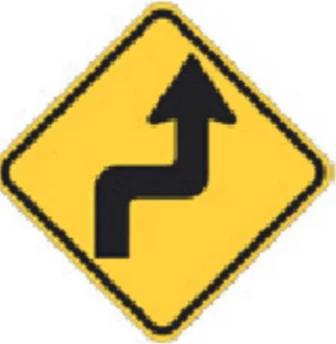
  • Sharp turn to the right and then a sharp turn to the left
  • Winding road ahead
  • Side road enters the highway ahead, or enters at an angle
  • Another road crosses the highway ahead
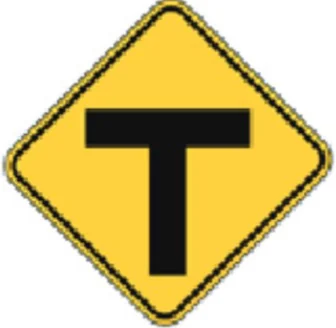
  • Road ends straight ahead (T): slow down and prepare to yield or stop before turning
Handbook p. 31 ↗
Reverse curve
Sharp right, then sharp left
T intersection
Road ends ahead (T intersection)

Road conditions:

  • Narrow bridge: room for only two lanes of traffic; approach with caution
  • Soft shoulder: drive on the shoulder only in emergencies
  • Dip or bump ahead: slow down
  • Steep hill: slow down and be ready to shift to a lower gear to protect your brakes
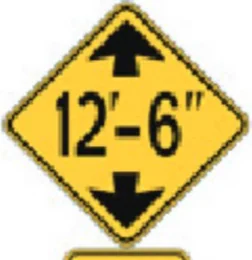
  • Low underpass: don't enter if your vehicle or cargo is taller than the height shown
  • Slippery when wet: the first half-hour of rain is most hazardous
Handbook p. 31 ↗
Low clearance
Low clearance

Traffic changes ahead:

  • Divided highway begins or ends: prepare to change lanes or shift lane position
  • Two-way traffic: leaving a separated one-way highway for a two-way highway
  • Signal ahead: traffic signals at the intersection ahead; slow down
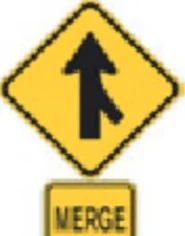
  • Merge: traffic merging from the right; allow it to merge safely
  • Yield ahead or stop ahead: slow down and be prepared to stop
Handbook p. 31 ↗
Merge
Merge

Know the rule

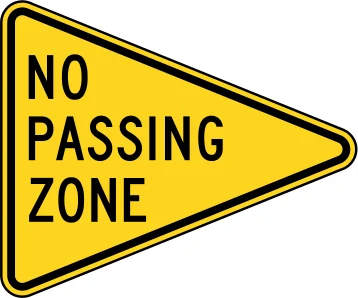
The pennant-shaped NO PASSING ZONE sign is on the left side of the highway and marks the start of a no-passing zone. Finish any pass before you reach it.

Handbook p. 32 ↗
No passing zone
No Passing Zone pennant

Know the rule

Crossing signs warn of places where animals, people and vehicles may cross. At a pedestrian crosswalk sign, stop and stay stopped when pedestrians are in the crosswalk.

Handbook p. 32 ↗

Know the rule

Warning signs may carry speed advisory plaques showing the speed at which you should proceed.

Handbook p. 32 ↗

Put it into practice

A yellow diamond shows a truck on a slope with a HILL plaque. Slow down before the descent and be ready to shift to a lower gear so you don't overwork your brakes.

Check your understanding

Read the question, decide on an answer, then open it to check the explanation. These are Roadwise study questions based on the source handbook.

What do warning signs alert drivers to?
  1. Hazards or traffic changes just ahead
  2. Distances to the next city
  3. Locations of nearby restaurants
  4. Only permanent regulatory changes

Answer: Hazards or traffic changes just ahead

Warning signs alert drivers to conditions immediately ahead, such as road hazards or changes in traffic direction.
Handbook p. 31 ↗
Warning signs in Georgia are always yellow and can never be a different color.
  1. True
  2. False

Answer: False

Warning signs are usually yellow but can also be fluorescent green with black markings.

Handbook p. 31 ↗
A yellow warning sign shows that the road you are on ends straight ahead. What should you do?
  1. Keep your speed; cross traffic must yield
  2. Prepare to change lanes; your lane ends
  3. Slow down and be ready to yield or stop
  4. Stop only if a stop sign is posted

Answer: Slow down and be ready to yield or stop

This sign means the road ends straight ahead; slow down and prepare to yield or stop before turning right or left.

Handbook p. 31 ↗
Take the lesson checkpoint in the app

More in Signs, Signals and Markings