roadwise.Open study app

Georgia driving lesson · Signs, Signals and Markings

Pavement markings

A 3-minute lesson from the Georgia course. Read the rules and examples, follow the handbook page references, and check your understanding before you move on.

Read time
3 minutes
Course unit
Signs, Signals and Markings
Checkpoint questions
6
Source pages
37

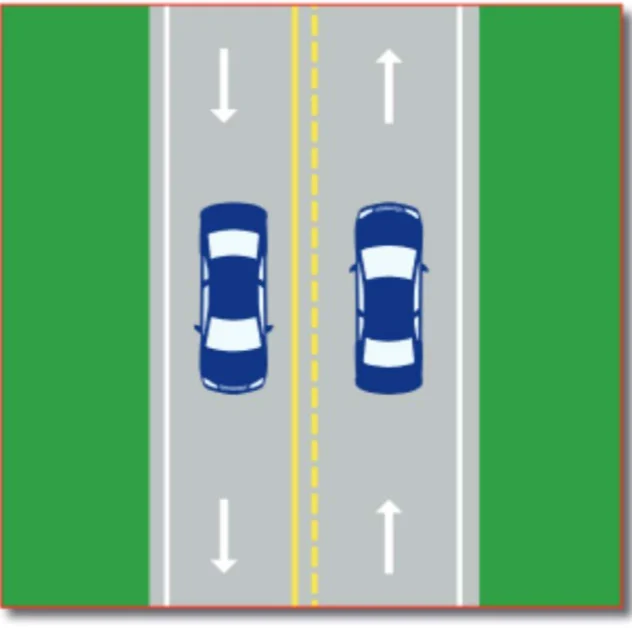
Pavement markings work like signs: they warn, direct and regulate traffic. Yellow lines separate traffic going in opposite directions; white lines separate lanes going the same way and mark the edges. Solid means don't cross; broken means you may.

Know the rule

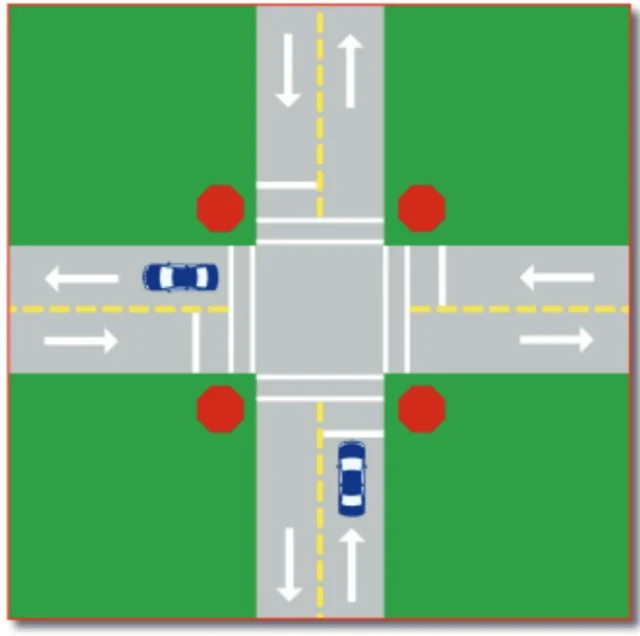
Stop lines are white lines across the pavement at intersections, usually about four feet before the crosswalk in urban areas. Stop at the stop line when there is one, not at the sign or signal.

Handbook p. 37 ↗
Stop line
Stop lines and crosswalks

Know the rule

Crosswalk lines are white, sometimes in a ladder pattern. Pedestrians in crosswalks have the right-of-way. Crosswalks may be mid-block in residential areas.

Handbook p. 37 ↗

Know the rule

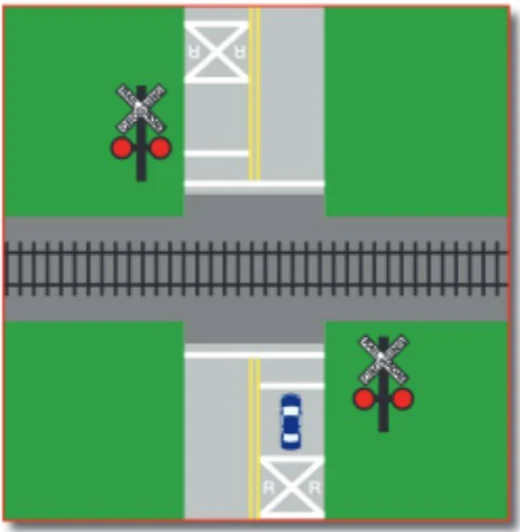
At railroad crossings the pavement is usually marked with a large X and two R's, and a yellow line on the right of the center line prevents passing. Stop if warning signals show a train coming.

Handbook p. 37 ↗
Railroad crossing pavement marking
Railroad crossing pavement markings

Know the rule

Broken yellow center lines separate opposite traffic on two-lane roads where passing is safe in either direction.

Handbook p. 37 ↗
Broken yellow center line

Know the rule

A solid yellow line on your side of the broken line means no passing for you. When both yellow lines are solid, passing is unsafe in either direction.

Handbook p. 37 ↗

Know the rule

Double white lines: when dashed, you may cross to the adjacent lane; when solid, lane changes are prohibited.

Handbook p. 37 ↗

Know the rule

Edge lines are solid white lines along the side of the pavement, a guide especially at night. A yellow edge line on the left warns of narrow or raised medians.

Handbook p. 37 ↗

Know the rule

Lane lines are white dashes separating lanes going the same direction. On a multi-lane road, stay in the right lane except to pass.

Handbook p. 37 ↗

Know the rule

Where four or more lanes carry traffic in opposite directions, two solid yellow lines mark the center. Cross them only to turn left into or from an alley, private road, driveway or street.

Handbook p. 37 ↗

Know the rule

Traffic striping, diagonal yellow lines inside a triangle-like area, warns that the road narrows or there's an obstruction. Always keep to the right of it.
Handbook p. 37 ↗

Put it into practice

On a two-lane road, the center has a broken yellow line with a solid yellow line on your side. You may not pass; drivers coming the other way may.

Check your understanding

Read the question, decide on an answer, then open it to check the explanation. These are Roadwise study questions based on the source handbook.

What does a single solid yellow line on the right of the center line indicate for the lane nearest it?
  1. No passing in that lane
  2. Passing is allowed with caution
  3. The lane is closed to traffic
  4. It marks a bicycle lane

Answer: No passing in that lane

A solid yellow line nearest your lane indicates a zone where passing is prohibited.

Handbook p. 37 ↗
If both center lines on a two-lane road are solid yellow, what does that indicate?
  1. No passing either way
  2. It marks a school zone
  3. The road is one-way only
  4. Passing is allowed in either direction

Answer: No passing either way

When both yellow lines are solid, it means it's not safe to pass in either direction.

Handbook p. 37 ↗
What does a dashed (broken) double white line on a roadway indicate?
  1. It marks the edge of a bike lane
  2. You may cross into the next lane
  3. The lane is for buses only
  4. Lane changes are strictly prohibited

Answer: You may cross into the next lane

When the double white lines are dashed, vehicles are allowed to cross over to the adjacent lane.

Handbook p. 37 ↗
What does a solid double white line on a roadway indicate?
  1. It marks a pedestrian crossing
  2. Lane changes are always allowed
  3. It marks a passing zone
  4. Lane changes are prohibited

Answer: Lane changes are prohibited

When the double white lines are solid, lane changes are prohibited.

Handbook p. 37 ↗
Besides the large X and two R's, what pavement marking is always placed at a railroad crossing?
  1. A blue line marking the crossing boundary
  2. A yellow no-passing line right of the center line
  3. White dashed lines on both sides of the tracks
  4. A white stop line painted between the rails

Answer: A yellow no-passing line right of the center line

At railroad crossings, a yellow line is always placed on the right of the center line to prevent passing.

Handbook p. 37 ↗
Where are stop lines typically located in urban areas relative to the crosswalk?
  1. About 20 feet before the crosswalk
  2. About 4 feet before it
  3. Directly on top of the crosswalk
  4. There is no standard distance

Answer: About 4 feet before it

In urban areas, the stop line is usually located about four feet before the crosswalk.

Handbook p. 37 ↗
Take the lesson checkpoint in the app

More in Signs, Signals and Markings