District of Columbia driving lesson · Driving Rules: Turns, Passing & Lights
Where you must not pass
A 3-minute lesson from the District of Columbia course. Read the rules and examples, follow the handbook page references, and check your understanding before you move on.
Many places make passing illegal because you can't see far enough or other traffic may cross your path. Several of them share the same distance: 100 feet.
You must not pass:
Where the solid yellow line is on your side of the center of the roadway
Where there are two solid yellow lines
When passing would interfere with the safe operation of oncoming vehicles
Approaching the top of a hill or on a curve without a clear view ahead
When crossing or within 100 feet of an intersection
When crossing or within 100 feet of a railroad crossing
Within 100 feet of a bridge, viaduct or tunnel when the view is obstructed
On the shoulder of the highway, either to the right or the left
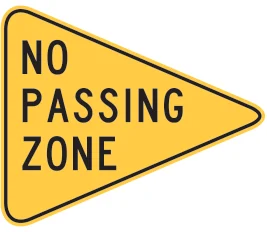
The pennant-shaped no-passing sign supplements the regulatory DO NOT PASS sign. It is on the left side of the roadway and points to the beginning of a no-passing zone.
You're 80 feet from an intersection behind a slow car on a two-lane road with a broken center line. You still may not pass: you're within 100 feet of the intersection. Wait until you've cleared it and the way is clear.
Check your understanding
Read the question, decide on an answer, then open it to check the explanation. These are Roadwise study questions based on the source handbook.
Where is it illegal to pass another vehicle in DC?
More than 500 feet from an intersection
On any road wider than two lanes
On roads without painted center lines
Within 100 feet of an intersection
Answer: Within 100 feet of an intersection
You must not pass when crossing or within 100 feet of an intersection.