roadwise.Open study app

District of Columbia driving lesson · Right-of-Way & Intersections

Pedestrians at crosswalks

A 3-minute lesson from the District of Columbia course. Read the rules and examples, follow the handbook page references, and check your understanding before you move on.

Read time
3 minutes
Course unit
Right-of-Way & Intersections
Checkpoint questions
6
Source pages
35, 36

Pedestrians are among the most vulnerable road users. In DC they usually have the right-of-way at crossings, and even when they don't, you're still responsible for not hitting them.

Know the rule

Pedestrians have the right-of-way at street crossings in towns and cities, except where traffic officers or traffic control devices control traffic.

Handbook p. 35 ↗

Know the rule

Pedestrians in a crosswalk, marked or unmarked, have the right-of-way, except when they enter on a red light or against a traffic officer's direction.

Handbook p. 35 ↗

Know the rule

Where pedestrian signals are used with normal traffic signals, drivers obey the normal traffic signals and pedestrians obey the WALK and DON'T WALK signals.

Handbook p. 35 ↗

You must come to a complete stop when a pedestrian in a crosswalk is:

  • On the half of the roadway your vehicle is traveling on, or
  • Approaching from an adjacent lane on the other half so closely as to be in danger
Handbook p. 35 ↗

Know the rule

When any vehicle is stopped at a marked or unmarked crosswalk at an intersection to let a pedestrian cross, drivers approaching from behind must not overtake and pass it.

Handbook p. 35 ↗

Know the rule

A pedestrian may not suddenly leave a curb or other safe place and walk or run into the path of a vehicle so close that it cannot yield.

Handbook p. 35 ↗

Know the rule

If a pedestrian crosses outside a crosswalk, they don't have the right-of-way, but you must still yield to them.

Handbook p. 35 ↗

Know the rule

Where a pedestrian tunnel or overhead crossing is provided, a pedestrian crossing the road must yield to vehicles. Drivers still must yield to pedestrians in the intersection.

Handbook p. 36 ↗

Know the rule

Between adjacent intersections with traffic signals operating, a pedestrian may cross only in a marked crosswalk or after yielding to approaching vehicles.

Handbook p. 36 ↗

Know the rule

Be especially alert for and yield to pedestrians who are deaf or use canes, crutches, walkers, guide dogs/service animals, wheelchairs or scooters. Take extreme care near children and confused individuals.

Handbook p. 36 ↗

Know the rule

A five-sided sign warns of school crossings. Diamond-shaped signs warn of pedestrian crossings.

Handbook p. 36 ↗
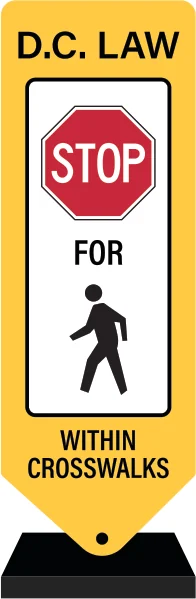
Stop for pedestrians in crosswalk
D.C. LAW: stop for pedestrians within crosswalks

Put it into practice

The car in the lane beside you stops at an unmarked crosswalk at an intersection. You can't see why. Don't pass it: a pedestrian may be crossing in front of it. Stop too, and go only when the crosswalk is clear.

Check your understanding

Read the question, decide on an answer, then open it to check the explanation. These are Roadwise study questions based on the source handbook.

Do pedestrians in a marked or unmarked crosswalk generally have the right-of-way?
  1. No, vehicles always have the right-of-way
  2. Yes, with narrow exceptions on red
  3. Only in marked crosswalks, never unmarked
  4. Only during daylight hours

Answer: Yes, with narrow exceptions on red

Pedestrians in a crosswalk generally have the right-of-way, except entering on red or against an officer's direction.
Handbook p. 35 ↗
If a pedestrian crosses outside of a marked crosswalk, what is the driver's obligation?
  1. No obligation to yield
  2. Slow down, but not stop
  3. Yield the right-of-way
  4. Honk to warn the pedestrian

Answer: Yield the right-of-way

Even though not recommended, a driver must yield to a pedestrian crossing outside a crosswalk.

Handbook p. 35 ↗
If a pedestrian crosses where a pedestrian tunnel or overhead bridge is provided, who technically has the right-of-way?
  1. The pedestrian always has the right-of-way
  2. Whoever arrives first
  3. It depends on the time of day
  4. The vehicle, not the pedestrian

Answer: The vehicle, not the pedestrian

Where a tunnel or overhead crossing is provided, the pedestrian must yield right-of-way to approaching vehicles.

Handbook p. 35 ↗
When a vehicle stops at a marked or unmarked crosswalk to let a pedestrian cross, what must the driver approaching from the rear do?
  1. Not overtake the stopped vehicle
  2. Pass carefully on the right
  3. Pass carefully on the left
  4. Pass once the pedestrian clears your lane

Answer: Not overtake the stopped vehicle

A driver approaching from the rear must not overtake and pass a vehicle stopped for a pedestrian in a crosswalk.

Handbook p. 35 ↗
Between adjacent signalized intersections, where may a pedestrian legally cross the roadway?
  1. Only in a marked crosswalk, or after yielding
  2. Anywhere, as long as they look both ways
  3. Only at the middle of the block
  4. Only if a crossing guard is present

Answer: Only in a marked crosswalk, or after yielding

Between signalized intersections, a pedestrian may cross only in a marked crosswalk or after yielding to traffic.

Handbook p. 36 ↗
What must a driver do if a pedestrian is crossing in the half of the roadway on which the vehicle is traveling?
  1. Slow down but continue if the pedestrian is far away
  2. Come to a complete stop
  3. Honk to alert the pedestrian
  4. Proceed if the pedestrian has not yet reached the center line

Answer: Come to a complete stop

A driver must come to a complete stop for a pedestrian crossing in a crosswalk on their half of the roadway.

Handbook p. 35 ↗
Take the lesson checkpoint in the app

More in Right-of-Way & Intersections