roadwise.Open study app

Alaska driving lesson · Railroads, Night, Weather & Emergencies

Vehicle emergencies

A 3-minute lesson from the Alaska course. Read the rules and examples, follow the handbook page references, and check your understanding before you move on.

Read time
3 minutes
Course unit
Railroads, Night, Weather & Emergencies
Checkpoint questions
5
Source pages
78, 79

When something fails at speed, the right first move matters. The handbook gives short action lists for the most common emergencies. Learn them now so you don't have to think later.

Emergency actions

Emergency actions
EmergencyWhat to do
Tire blows outDon't brake; steer; slow gradually; brake softly
Wet brakesTest lightly; dry in low gear, braking lightly
Accelerator jammedSlap pedal hard; brake; shift to neutral; steer
Brakes failParking brake; lower gear; rub tires on curb
Vehicle coming in your laneSound horn; brake sharply; steer for shoulder/ditch
Handbook p. 78 ↗

Know the rule

After a tire blowout, concentrate on steering and pull completely off the pavement once you've slowed.

Handbook p. 78 ↗

Know the rule

After driving through deep water, test your brakes lightly. They may pull to one side or not hold at all.

Handbook p. 78 ↗

Vehicle fire (if it can be done safely):

  • Use a fire extinguisher, or check a ditch for water
  • Apply mud, dirt, dust, or snow until the fire is out or it's no longer safe
  • Use a hub cap to carry water, or use wet clothing
  • Loosen dirt with a tire tool
Handbook p. 78 ↗

Disabled vehicle:

  • Park with all four wheels off the traveled portion of the highway, if possible
  • Turn on parking lights or 4-way flashers at night
  • Set out flares or warning triangles if you have them
  • If you can't move off the roadway, raise the hood to warn other drivers
Handbook p. 78 ↗
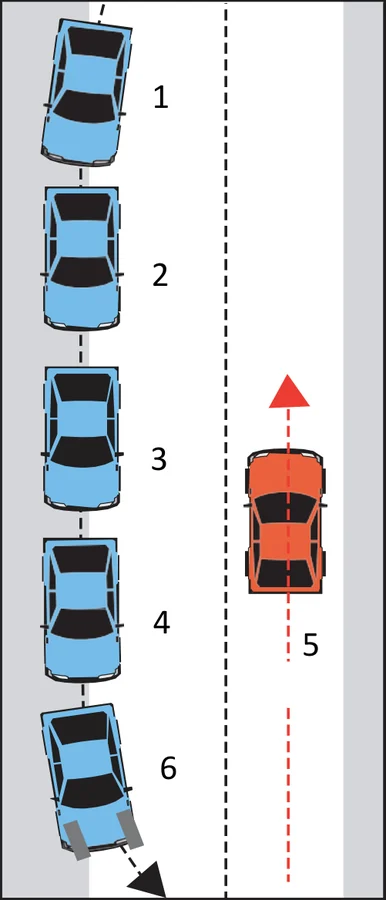
Multiple vehicles yielding to an emergency vehicle
Wheels off the roadway: recovering to the pavement

If your wheels drop off the roadway:

  • Stop feeding gas and keep a firm grip on the wheel
  • Brake lightly and intermittently, and keep control
  • Don't return to the pavement until no cars are nearby
  • Turn back onto the pavement at slow speed
Handbook p. 79 ↗

Know the rule

Coasting is prohibited: on a downgrade you may not coast with the gears in neutral or the clutch disengaged.

Handbook p. 79 ↗

Put it into practice

On the highway your front tire blows and the car pulls hard to one side. Don't hit the brakes. Grip the wheel, steer straight, let the car slow gradually, brake softly, then pull completely off the pavement.

Check your understanding

Read the question, decide on an answer, then open it to check the explanation. These are Roadwise study questions based on the source handbook.

If your accelerator jams, what should you do?
  1. Turn off the engine while at highway speed
  2. Pump the accelerator repeatedly
  3. Slap the pedal hard, use the brakes, and shift to neutral
  4. Steer only, without braking

Answer: Slap the pedal hard, use the brakes, and shift to neutral

For a jammed accelerator, slap the pedal, use the brakes, and shift to neutral.
Handbook p. 78 ↗
If your vehicle catches fire and it's safe to act, what can you use to help extinguish it?
  1. Windshield washer fluid
  2. Nothing; you must wait for help
  3. Air, by opening the hood wide
  4. A fire extinguisher, or mud, dirt, dust, or snow

Answer: A fire extinguisher, or mud, dirt, dust, or snow

Use a fire extinguisher, or mud, dirt, dust, or snow to help extinguish a vehicle fire.

Handbook p. 78 ↗
What should you do if your brakes fail?
  1. Use the parking brake and a lower gear
  2. Turn off the ignition immediately at speed
  3. Shift into neutral and coast
  4. Pump the accelerator

Answer: Use the parking brake and a lower gear

Use the parking brake, shift to a lower gear, and rub tires on the curb if needed.

Handbook p. 78 ↗
Is coasting downhill with the vehicle in neutral or clutch disengaged legal in Alaska?
  1. Yes, as long as you stay under the speed limit
  2. No, coasting is prohibited
  3. Yes, only on highways
  4. Yes, if no other vehicles are nearby

Answer: No, coasting is prohibited

Coasting downhill in neutral or with the clutch disengaged is prohibited.

Handbook p. 79 ↗
Coasting downhill with the transmission in neutral is prohibited under Alaska law.
  1. True
  2. False

Answer: True

Coasting with gears in neutral or the clutch disengaged is prohibited.

Handbook p. 79 ↗
Take the lesson checkpoint in the app

More in Railroads, Night, Weather & Emergencies