roadwise.Open study app

Alaska driving lesson · Railroads, Night, Weather & Emergencies

Emergency vehicles & traffic stops

A 4-minute lesson from the Alaska course. Read the rules and examples, follow the handbook page references, and check your understanding before you move on.

Read time
4 minutes
Course unit
Railroads, Night, Weather & Emergencies
Checkpoint questions
6
Source pages
76, 77

When an emergency vehicle comes with lights flashing, your job is to get out of its way. If police signal you to stop, a few simple habits keep you and the officer safe.

Know the rule

Police, fire and ambulance vehicles have sirens and front red and/or blue lights. It is illegal for any unauthorized vehicle to show a red light to the front or a blue light to the side.

Handbook p. 76 ↗

Know the rule

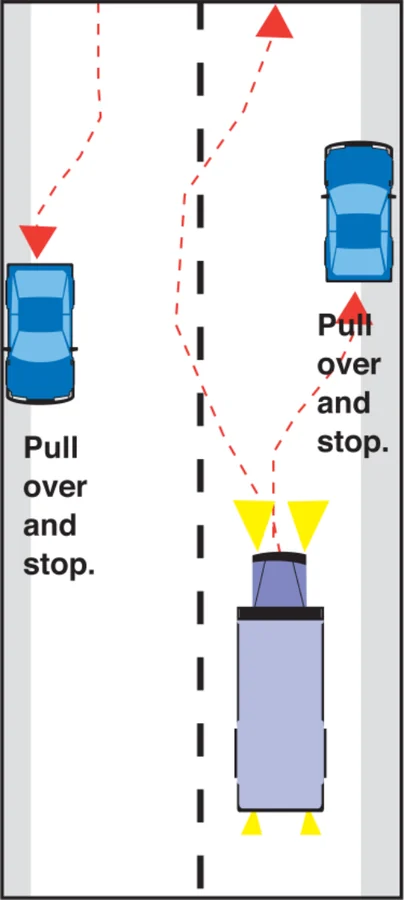
When an emergency vehicle approaches with flashing red and/or blue lights, siren or not, drivers going any direction must slow, pull to the right-hand edge clear of any intersection, and stop until it passes (13 AAC 02.140).

Handbook p. 76 ↗
Yielding to an emergency vehicle
Pull over to the right and stop for an emergency vehicle

Know the rule

For emergency vehicles responding on the road (ambulance, fire truck, law enforcement or tow truck), move to the lane away from them. If you can't, or there's only one lane your way, slow down and drive safely around the scene.

Handbook p. 76 ↗

Know the rule

Stationary emergency vehicles or tow trucks with flashing lights on a four-lane road: move to the lane opposite them if safe. If it isn't safe, or on a two-lane road, slow to a reasonable, prudent speed (AS 28.35.185).

Handbook p. 76 ↗

Emergency vehicle distances

Emergency vehicle distances
RuleDistance
Don't follow a responding emergency vehicle closer than500 feet
Don't park near stopped fire apparatus with lights within500 feet
Handbook p. 76 ↗

Know the rule

Don't drive over a fire department hose without a department official's consent: $100 fine and 2 points (13 AAC 02.520(c)). Your city may have additional ordinances.

Handbook p. 77 ↗

Know the rule

When signaled by police, stop as soon as practical and reasonably safe (AS 28.35.182). If you have a concealed deadly weapon, tell the officer immediately.

Handbook p. 77 ↗

Know the rule

Carry and show on request your driver's license, proof of insurance (a mobile device display is OK), and proof of current registration.

Handbook p. 77 ↗

Best practices when pulled over:

  • Signal right away and pull to the right when safe, even from the left lane of a four-lane road
  • Avoid stopping on a curve, just past a hill crest, next to a guardrail, or other unsafe spots
  • Driver and all passengers stay in the vehicle
  • At night, turn on the interior lights
  • Keep your hands visible, such as on the steering wheel
  • Wait for the officer to ask before reaching into a wallet, purse, console, or glove box
  • Tell the officer if a disability keeps you from complying with orders
  • Afterward, the officer stays put until you signal and safely re-enter traffic
Handbook p. 77 ↗

Put it into practice

You're in the left lane of a four-lane road when a patrol car's lights come on behind you. Signal right immediately, move over and stop on the right in a safe spot, turn on the dome light if it's dark, and keep your hands on the wheel.

Check your understanding

Read the question, decide on an answer, then open it to check the explanation. These are Roadwise study questions based on the source handbook.

When an authorized emergency vehicle approaches with flashing lights, what must you do?
  1. Speed up to clear the intersection first
  2. Stop immediately wherever you are, even in the intersection
  3. Pull to the right edge of the roadway and stop, clear of the intersection
  4. Pull to the left and stop

Answer: Pull to the right edge of the roadway and stop, clear of the intersection

You must pull to the right edge of the roadway and stop, clear of the intersection.
Handbook p. 76 ↗
How closely may you follow an emergency vehicle responding to an emergency?
  1. No closer than 100 feet
  2. No closer than 1,000 feet
  3. There is no minimum distance
  4. No closer than 500 feet

Answer: No closer than 500 feet

A vehicle may not follow an emergency vehicle responding to an emergency closer than 500 feet.

Handbook p. 76 ↗
On a four-lane road, what should you do when you see a stationary emergency vehicle with flashing lights?
  1. Move to the lane opposite it, if safe to do so
  2. Stay in your lane and maintain speed
  3. Always stop completely, even on a four-lane road
  4. Turn on your high beams and proceed

Answer: Move to the lane opposite it, if safe to do so

On a four-lane road, move to the lane opposite the stationary emergency vehicle if safe.

Handbook p. 76 ↗
What must you do if you have a concealed deadly weapon and are contacted by a police officer during a stop?
  1. Say nothing unless asked directly
  2. Notify the officer immediately
  3. Only mention it if asked to exit the vehicle
  4. It does not need to be disclosed if legally owned

Answer: Notify the officer immediately

You must notify the officer immediately if you have a concealed deadly weapon.

Handbook p. 77 ↗
What must a driver have available to show a police officer upon request during a stop?
  1. Only a driver's license
  2. Only proof of insurance
  3. Driver's license, proof of insurance, and registration
  4. Vehicle title only

Answer: Driver's license, proof of insurance, and registration

Drivers must have their license, proof of insurance, and current registration available for the officer.

Handbook p. 77 ↗
What is the fine and point penalty for driving over a fire department hose without consent?
  1. $100 fine and 2 points
  2. $500 fine and 6 points
  3. No fine, only a warning
  4. $50 fine and 1 point

Answer: $100 fine and 2 points

Driving over a fire hose without consent carries a $100 fine and 2 points.

Handbook p. 77 ↗
Take the lesson checkpoint in the app

More in Railroads, Night, Weather & Emergencies