Roadwise States Alaska Driving lessons Railroad crossings Alaska driving lesson · Railroads, Night, Weather & Emergencies
Railroad crossings A 3-minute lesson from the Alaska course. Read the rules and examples, follow the handbook page references, and check your understanding before you move on.
Read time 3 minutes
Course unit Railroads, Night, Weather & Emergencies
Checkpoint questions 6
Source pages 41, 42, 61, 63 Trains can't stop easily or quickly. At every crossing, assume a train could be coming, even one you haven't seen yet on a second track.
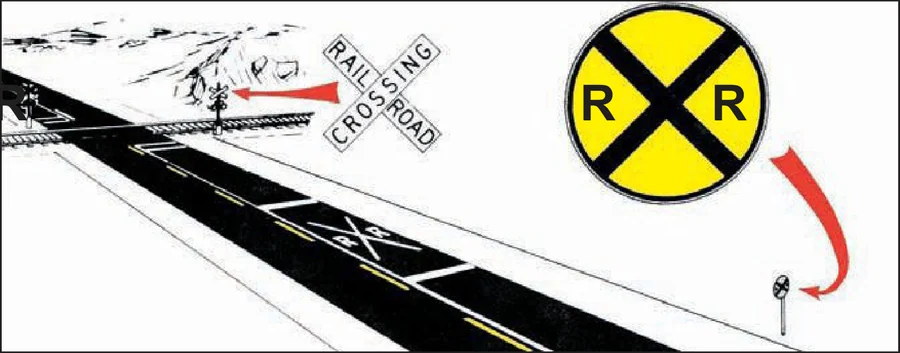
Railroad crossbuck and advance warning sign: be prepared to stop for trains Railroad crossing rules: Never get trapped on a crossing; in heavy traffic, wait on the approach until you're sure you can clear it Watch for a second train: after the last car passes, check that none is coming on another track Never drive around gates; if they're down, stay put until they rise. Going around is illegal Never race a train to the crossing Never shift gears on the crossing; with a manual transmission, shift down before and don't change gears Expect buses and trucks ahead to stop at crossings; pass only where legal, safe, and with a clear view Handbook p. 63 ↗ 1,500 feet Be prepared to stop if a train is within this distance of the crossing
Handbook p. 63 ↗ Know the rule
Always stop when a train is close to the crossing, even if the crossing is unmarked.
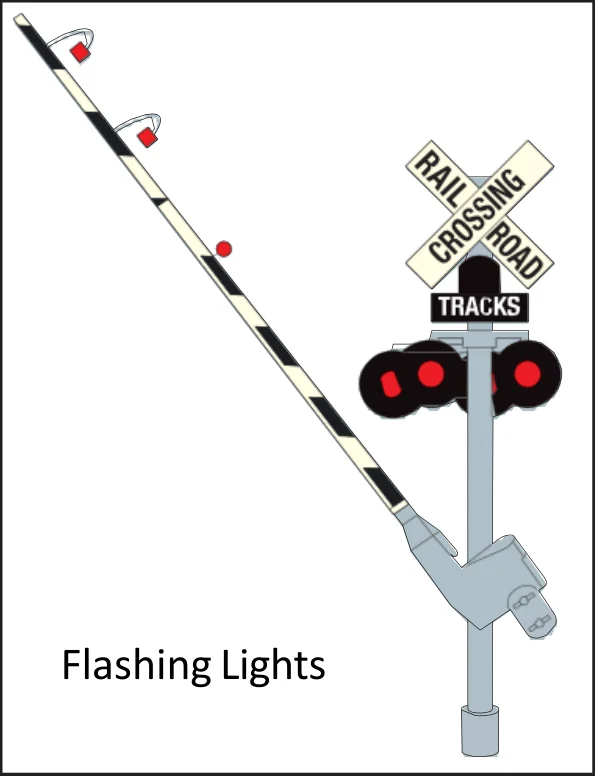
Handbook p. 63 ↗ Crossing gate and flashing lights Know the rule
At a crossing gate or flag person, stop and stay stopped until the gates are raised or the flag person stops signaling.
Handbook p. 41 ↗ Know the rule
Do not pass within 100 feet of, or while crossing, a railroad crossing.
Handbook p. 42 ↗ Know the rule
An "R X R" legend painted on the pavement warns of a railroad crossing ahead. Be prepared to stop.
Handbook p. 61 ↗ Put it into practice
A long freight train finally clears the crossing and the gates start to rise, but the lights keep flashing. Stay stopped and look both ways. A second train may be coming on another track from the other direction.
A useful reminder 1,500 feet is the stop-for-a-train distance. It's the biggest distance number in the rail section.
Check your understanding Read the question, decide on an answer, then open it to check the explanation. These are Roadwise study questions based on the source handbook.
What should you never do at a railroad crossing with the gates down? Wait for the gates to rise Turn off your radio to listen for the train Put your vehicle in park Drive around the gates Answer: Drive around the gates
It is against the law to go around lowered crossing gates.
Handbook p. 63 ↗ You should be prepared to stop if a train is within how many feet of a railroad crossing? 1,500 feet 500 feet 3,000 feet 750 feet Answer: 1,500 feet
Be prepared to stop if a train is within 1,500 feet of the crossing, and always stop when a train is close, even at an unmarked crossing.
Handbook p. 63 ↗ After the last car of a train passes, what should you watch for before crossing? Nothing, you may proceed immediately A second train, possibly from the other direction Only oncoming road traffic A signal from the conductor Answer: A second train, possibly from the other direction
Watch out for a second train before crossing after the first has passed.
Handbook p. 63 ↗ If your vehicle has a manual transmission, what does the handbook say to do at a railroad crossing? Shift to neutral and coast across Shift up to cross as quickly as possible Shift down before it and don't change gears on it Shift gears midway to keep your speed Answer: Shift down before it and don't change gears on it
Shift down before the crossing and do not change gears while crossing the tracks.
Handbook p. 63 ↗ You are following a bus that must stop at railroad crossings. What does the handbook say about passing it at a crossing? You may pass once it has fully stopped Pass only where legal, with a clear view of the tracks You may pass if you signal and sound your horn You may pass it on the right shoulder Answer: Pass only where legal, with a clear view of the tracks
Don't pass where prohibited by law; if passing is legal, make sure there are no unsafe conditions and you have a clear view of the tracks.
Handbook p. 63 ↗ You must stop when a train is close to a railroad crossing, even if the crossing is unmarked. True False Answer: True
Always stop when a train is close to a crossing, even an unmarked one; be prepared to stop if a train is within 1,500 feet.
Handbook p. 63 ↗ Previous lesson Moose & other animals Next lesson Stuck on the tracks & emergency numbers More in Railroads, Night, Weather & Emergencies About the source Roadwise’s Alaska course uses the driver handbook edition supplied with this study pack. This lesson cites source pages 41, 42, 61, 63. The linked PDF is a third-party mirror of the handbook, rather than a government-hosted page.
Open the handbook source PDF · View the source edition
For current application requirements, fees, appointments, and the format that applies to your age or license type, check Alaska’s DMV. Roadwise provides study material and does not issue permits or licenses.