A 3-minute lesson from the Alaska course. Read the rules and examples, follow the handbook page references, and check your understanding before you move on.
Per mile driven, night driving has a higher fatal crash rate than daytime driving, because you can't see as far, as soon, or as much. Alaska's lighting law sets exact times and distances for your headlights.
The time it takes your pupils to readjust after oncoming headlights pass. During it you are virtually driving blind; it varies by person and is worse in older drivers.
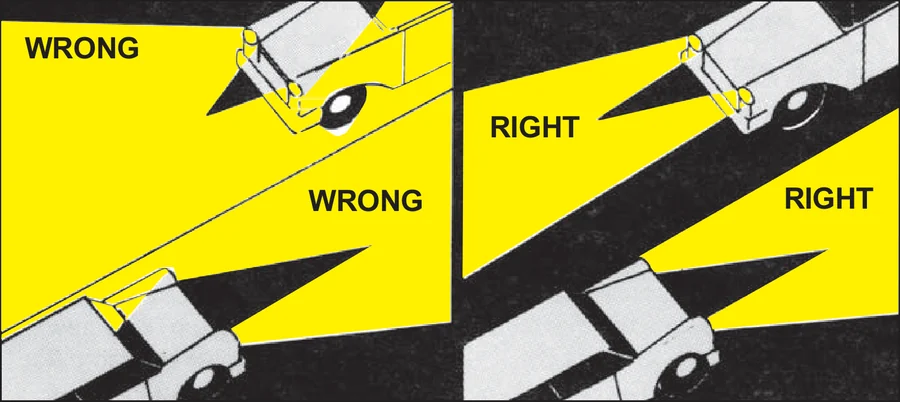
Wrong and right: don't stare into oncoming headlights
Know the rule
When meeting vehicles at night, don't stare at their headlights. Use quick glances to check the oncoming vehicle's lane position, your own position, the right edge of the road, and objects ahead.
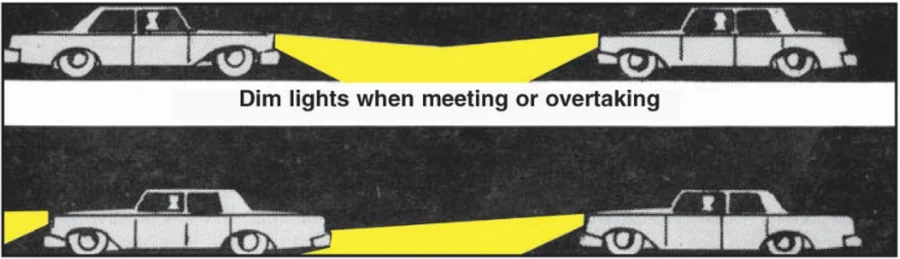
You're on high beams on a dark highway and see a car's taillights ahead. Dim to low beams by the time you're 300 feet behind it. For an oncoming car, dim at 500 feet or more.
Check your understanding
Read the question, decide on an answer, then open it to check the explanation. These are Roadwise study questions based on the source handbook.
When must headlights be turned on in the evening?
1/2 hour after sunset
At sunset exactly
1 hour after sunset
15 minutes after sunset
Answer: 1/2 hour after sunset
Headlights must be on starting a half hour after sunset.