roadwise.Open study app

Alaska driving lesson · Railroads, Night, Weather & Emergencies

Skids & slippery roads

A 3-minute lesson from the Alaska course. Read the rules and examples, follow the handbook page references, and check your understanding before you move on.

Read time
3 minutes
Course unit
Railroads, Night, Weather & Emergencies
Checkpoint questions
6
Source pages
73, 86

Skids happen when your tires lose grip, usually from sudden speed or direction changes on a slippery surface. The best cure is prevention; if you do skid, stay calm and steer where you want to go.

Preventing skids:

  • Be alert to conditions that cause skidding, especially during thawing and freezing weather
  • Avoid abrupt changes in speed or direction
  • Don't over-correct; it only changes the direction of the skid
  • Practice stops and skid recovery at slow speed on private property before driving on ice in traffic
  • When you suspect ice, test the surface cautiously, checking your mirror before the test stop
  • Slow down well before your stopping point on ice or packed snow
Handbook p. 73 ↗

Know the rule

Shaded areas, protected areas and bridges get slippery before the rest of the road and stay slippery longer.

Handbook p. 73 ↗

Know the rule

Don't lock your wheels: "If wheels don't roll you don't have control." Pump the brakes lightly to slow or stop on a slippery surface.

Handbook p. 73 ↗

Know the rule

If your vehicle has ABS, check your owner's manual for how to use it. Never pump the brakes on a vehicle with antilock brakes.

Handbook p. 86 ↗
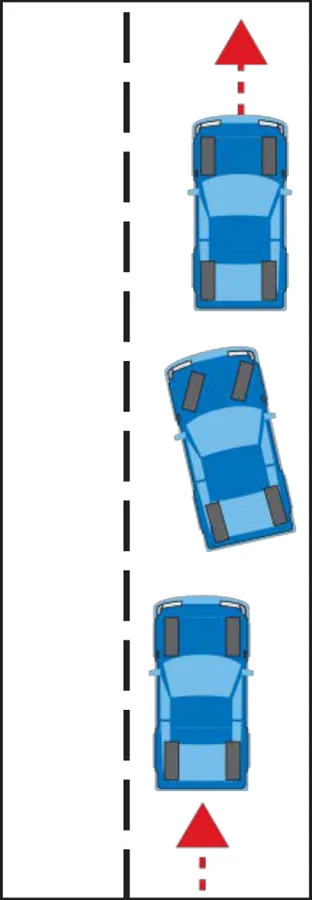
Skid recovery
Recovering from a skid

Recovering from a skid:

  • Control yourself; don't panic
  • Turn the front wheels in the direction of the skid
  • Don't brake suddenly
  • Don't oversteer or overcorrect
  • As control returns, slow down by very gently pressing and releasing the brake
Handbook p. 73 ↗

Know the rule

Front-wheel-drive and four-wheel-drive vehicles need easy acceleration to pull out of a skid.

Handbook p. 73 ↗

Put it into practice

Crossing a shaded bridge on a freezing morning, your rear end slides to the right. Don't slam the brakes. Steer the front wheels in the direction of the skid, avoid overcorrecting, and ease back onto the brakes gently once you're straight.

Check your understanding

Read the question, decide on an answer, then open it to check the explanation. These are Roadwise study questions based on the source handbook.

What should you do first if your vehicle begins to skid?
  1. Brake hard immediately
  2. Stay calm and don't panic
  3. Accelerate to regain traction
  4. Shift into neutral immediately

Answer: Stay calm and don't panic

The first step in skid recovery is to control yourself and not panic.
Handbook p. 73 ↗
Which direction should you turn your front wheels when recovering from a skid?
  1. Opposite the direction of the skid
  2. Straight ahead only
  3. In the direction of the skid
  4. Sharply toward the shoulder

Answer: In the direction of the skid

Turn your front wheels in the direction of the skid to recover.

Handbook p. 73 ↗
What should you avoid doing when braking on a slippery, icy surface without ABS?
  1. Pumping the brakes lightly
  2. Slowing down well before your stopping point
  3. Testing traction cautiously
  4. Locking your wheels

Answer: Locking your wheels

Locking your wheels means you lose control; pump brakes lightly instead.

Handbook p. 73 ↗
If your vehicle has ABS, what should you do differently when braking hard?
  1. Don't pump them; follow your vehicle manual
  2. Pump the brakes rapidly, just like without ABS
  3. Apply the parking brake instead
  4. Shift to neutral before braking

Answer: Don't pump them; follow your vehicle manual

The handbook says never to pump the brakes on a vehicle with antilock brakes, and to check your manual for ABS instructions.

Handbook p. 86 ↗
Which road areas become slippery before the rest of the road and stay that way longer?
  1. Wide open highways in direct sun
  2. Shaded areas and bridges
  3. Areas with heavy traffic
  4. Freshly paved roads only

Answer: Shaded areas and bridges

Shaded areas, protected areas, and bridges become slippery earlier and longer.

Handbook p. 73 ↗
It is safe to pump the brakes rapidly on a vehicle equipped with an anti-lock braking system, just as you would without ABS.
  1. True
  2. False

Answer: False

The handbook says never to pump the brakes if your vehicle has antilock brakes.

Handbook p. 86 ↗
Take the lesson checkpoint in the app

More in Railroads, Night, Weather & Emergencies