roadwise.Open study app

Alaska driving lesson · Signs, Signals & Pavement Markings

Pavement lines

A 3-minute lesson from the Alaska course. Read the rules and examples, follow the handbook page references, and check your understanding before you move on.

Read time
3 minutes
Course unit
Signs, Signals & Pavement Markings
Checkpoint questions
6
Source pages
59, 60, 61

Pavement markings work like signs: they warn, regulate and inform, with the same force of law as signs or signals. Color tells you the direction of traffic; the line style tells you what you may do.

The basic code:

  • Yellow lines (like center lines) separate traffic going in opposite directions
  • White lines (like lane lines) separate traffic going the same direction
  • Dashed lines are permissive
  • Solid white lines are restrictive; solid yellow lines are prohibitive
Handbook p. 59 ↗

Know the rule

Pavement markings have the same force of law as signs or signals. It is illegal to drive on the shoulder of the roadway.

Handbook p. 59 ↗

Yellow lines:

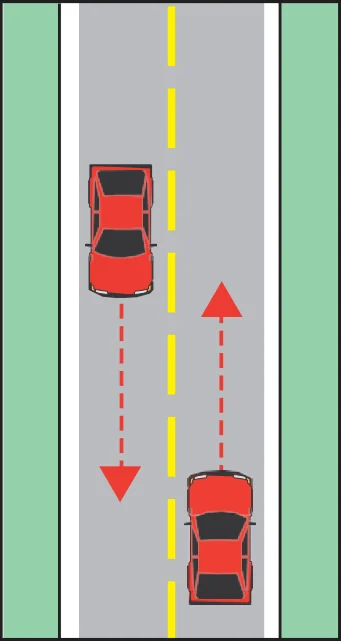
  • Dashed yellow center line: passing permitted on a two-lane, two-way road
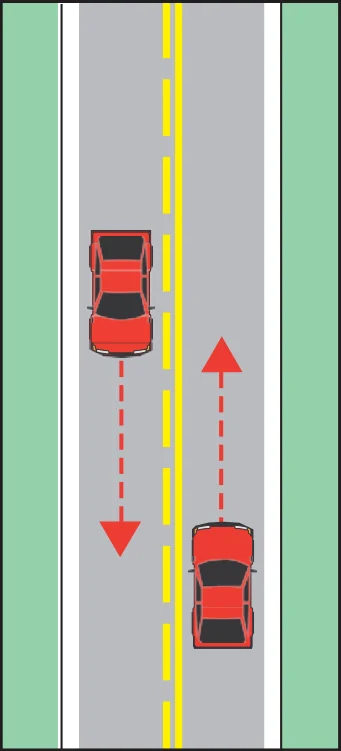
  • Solid yellow center line: no passing, though you may cross it to turn into a driveway
  • Single solid yellow line: the left edge of a divided roadway
Handbook p. 61 ↗

White lines:

  • Dashed white: lanes where changing lanes isn't restricted and lane use isn't specified
  • Solid white: edges of lanes for certain uses, where lane changes are discouraged
  • Solid white: also marks the outside edge of the pavement or the edge of the shoulder
Handbook p. 61 ↗

Know the rule

Drive within a lane and don't move out of it until it's safe to do so.

Handbook p. 61 ↗

Roadway layouts

Roadway layouts
RoadwayWhat the markings mean
Two-lane, passing permittedDashed yellow center line
Two-lane, no passing one directionSolid line on the side where passing is barred
Two-lane, no passing both waysCross center line only to turn left
Multi-lane, two-wayCross center line only to turn left
Restricted laneBuses, carpools, etc.; diamond marks and signs
Divided roadwayYellow left edge lines on all divided/one-way roads
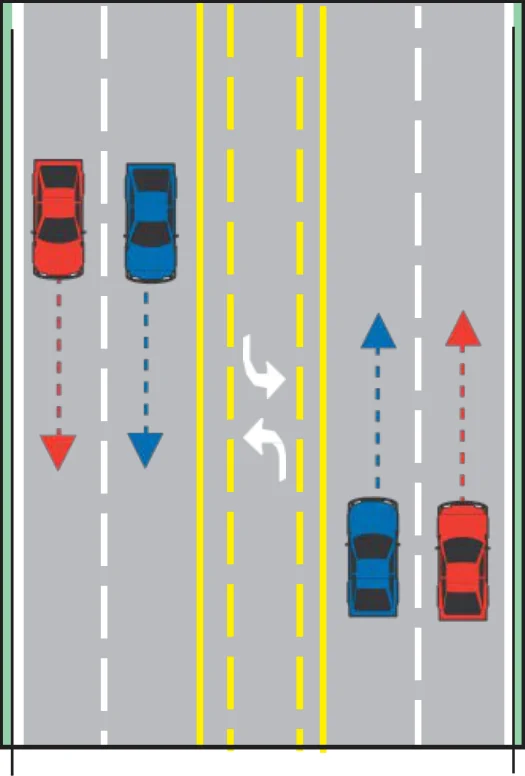
Shared center laneLeft turns only, both directions; no passing
Reversible center laneDirection changes by time; signs/signals
Handbook p. 60 ↗
Two-lane road passing markings
Two-lane road, passing permitted
Two-lane road passing markings
Two-lane road, passing prohibited in one direction
Two-lane road passing markings
Two-lane road, passing prohibited in both directions
Two-way left turn lane markings
Shared center (two-way left turn) lane

Put it into practice

You're on a two-lane road where your side of the center line is solid yellow and the other side is dashed. You may not pass, but you may cross the line to turn left into a driveway.

Check your understanding

Read the question, decide on an answer, then open it to check the explanation. These are Roadwise study questions based on the source handbook.

What do yellow pavement markings, such as center lines, indicate?
  1. They separate lanes going the same direction
  2. They mark pedestrian crossings only
  3. They separate opposite-direction traffic
  4. They indicate a bike lane

Answer: They separate opposite-direction traffic

Yellow markings separate traffic going in opposite directions.
Handbook p. 59 ↗
What do white pavement markings, such as lane lines, indicate?
  1. They separate opposing traffic
  2. They mark no-passing zones
  3. They mark the left edge of divided roads
  4. They separate traffic going in the same direction

Answer: They separate traffic going in the same direction

White markings separate traffic traveling in the same direction.

Handbook p. 59 ↗
What do dashed lane markings generally mean?
  1. They are permissive; you may cross with care
  2. They are always prohibitive
  3. They mean the lane is closed ahead
  4. They indicate a bike-only lane

Answer: They are permissive; you may cross with care

Dashed lines are permissive markings.

Handbook p. 59 ↗
What do solid white lines indicate?
  1. They are prohibitive; crossing is illegal
  2. They are restrictive; changing lanes there is discouraged
  3. They are permissive, like dashed lines
  4. They mark bicycle-only lanes

Answer: They are restrictive; changing lanes there is discouraged

Solid white lines are restrictive, marking lane edges where changing lanes is discouraged.

Handbook p. 59 ↗
What do solid yellow center lines indicate about passing?
  1. Passing is always permitted
  2. They only apply to trucks
  3. Passing is not permitted, though turning into a driveway across them is allowed
  4. They mark reversible lanes only

Answer: Passing is not permitted, though turning into a driveway across them is allowed

Solid yellow center lines prohibit passing but still allow turning into a driveway across them.

Handbook p. 61 ↗
What is a two-way left turn lane, marked with signs and pavement arrows, reserved for?
  1. Passing slower traffic in both directions
  2. Left turns from either direction
  3. Through traffic during rush hour
  4. Parking during off-peak hours

Answer: Left turns from either direction

The shared center lane is reserved exclusively for left-turning vehicles from either direction.

Handbook p. 60 ↗
Take the lesson checkpoint in the app

More in Signs, Signals & Pavement Markings