roadwise.Open study app

Alabama driving lesson · The Driver

Railroad crossings

A 4-minute lesson from the Alabama course. Read the rules and examples, follow the handbook page references, and check your understanding before you move on.

Read time
4 minutes
Course unit
The Driver
Checkpoint questions
6
Source pages
40, 41, 42, 44, 57, 77

Trains can't swerve and can't stop quickly. A motorist is 40 times more likely to die in a crash involving a train, so learn every crossing warning and never gamble on beating a train.

Crossing warning devices:

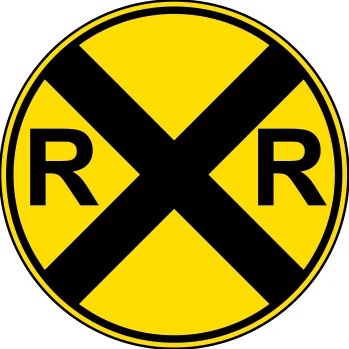
  • Round yellow sign with a black X and RR: a crossing is ahead; placed 750 feet before the track
  • Pavement markings: a large X with two RRs; a yellow line before the crossing means no passing
  • White lines on each side of the track: where to stop when a train is approaching
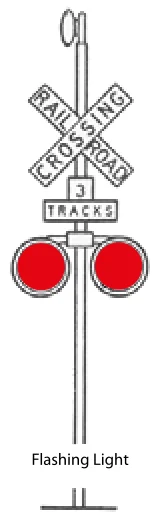
  • Flashing lights: always stop until it is safe to go
  • Gates: stay stopped until the gates are raised and the lights stop flashing
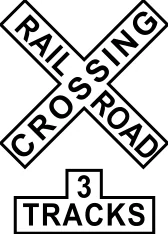
  • Crossbuck: slow down and be ready to stop; a sign below shows the number of tracks
Handbook p. 40 ↗
Railroad crossing ahead
Round railroad advance warning sign, 750 feet before the track
Railroad crossbuck
Railroad crossbuck with the number of tracks below
Railroad crossbuck
Red flashing light signal with crossbuck: always stop when the lights begin to flash

Know the rule

If a crossing has no warning device, slow down, look and listen for trains before going on.

Handbook p. 41 ↗

These vehicles must stop before crossing any railroad crossing:

  • School buses, church buses and any passenger bus
  • Trucks carrying flammables, explosives or other hazardous material
Handbook p. 41 ↗
15 to 50 ft

Where you must stop from the track when required to stop at a crossing

Handbook p. 41 ↗

Know the rule

At a crossing with electric or mechanical signal devices, come to a complete stop when they signal. Also stop when the gate is lowered or a train is approaching. With more than one track, make sure all are clear.

Handbook p. 41 ↗

Safety tips:

  • Expect a train on any track at any time, day or night
  • Never get trapped on a crossing: wait until you're sure you can clear it
  • Watch for a second train on another track once the last car passes
  • Never drive around gates; it's against the law
  • Never race a train to the crossing
  • Never shift gears on the crossing; in a manual, shift down before the tracks
  • Be ready to stop behind buses and trucks that must stop at crossings
Handbook p. 42 ↗

Know the rule

If your vehicle stalls on a crossing, get everyone out and away from the tracks at once, and call local law enforcement.

Handbook p. 42 ↗

Know the rule

If a train is coming and you can't move the car, abandon it and walk quickly alongside the tracks toward the approaching train, so debris won't hit you.

Handbook p. 77 ↗
1 mile+

Distance a freight train at 55 mph needs to stop, the length of 18 football fields

Handbook p. 42 ↗
Nearly 50%

Vehicle/train collisions that happen at crossings with active warning devices

Handbook p. 42 ↗

Put it into practice

The gates are down but you see no train, and cars behind you are honking. Stay put. Going around lowered gates is illegal, and a train may be close. Wait until the gates rise and the lights stop flashing.

Check your understanding

Read the question, decide on an answer, then open it to check the explanation. These are Roadwise study questions based on the source handbook.

How far before a railroad crossing is the round yellow warning sign with a black X and “RR” typically placed?
  1. 1,500 feet before the track
  2. 300 feet before the track
  3. 750 feet before the track
  4. 100 feet before the track

Answer: 750 feet before the track

The round railroad warning sign is placed 750 feet before the track.
Handbook p. 40 ↗
Vehicles required to stop before crossing railroad tracks, such as school buses, must stop within what distance?
  1. 100 to 200 feet of the crossing
  2. 10 to 30 feet of the crossing
  3. 5 to 10 feet of the crossing
  4. 15 to 50 feet of the crossing

Answer: 15 to 50 feet of the crossing

Vehicles required to stop at railroad crossings, like school and church buses, must stop within 15 to 50 feet of the crossing.

Handbook p. 41 ↗
How far does a freight train traveling 55 mph typically need to come to a stop?
  1. About 500 feet
  2. A mile or more
  3. About 100 feet
  4. About a quarter mile

Answer: A mile or more

A freight train at 55 mph takes a mile or more to stop – the length of about 18 football fields.

Handbook p. 42 ↗
What should you do if there is no warning device at all at a railroad crossing?
  1. Stop only if you see a train
  2. Cross at normal speed since there's no signal
  3. Slow down, look, and listen for trains
  4. Speed up to clear the crossing quickly

Answer: Slow down, look, and listen for trains

If a crossing has no warning device, the handbook instructs drivers to slow down, look, and listen before proceeding.

Handbook p. 41 ↗
If your vehicle stalls on the tracks and a train is approaching, what should you do?
  1. Push the vehicle yourself before calling for help
  2. Stay inside and try to restart the engine
  3. Call 911 and wait in the car
  4. Get everyone out and away from the tracks

Answer: Get everyone out and away from the tracks

If a stalled vehicle can't be moved off the tracks and a train is approaching, get everyone out and away from the tracks immediately.

Handbook p. 42 ↗
You should never change gears while crossing railroad tracks.
  1. True
  2. False

Answer: True

The handbook advises against shifting gears while crossing tracks, to avoid stalling.

Handbook p. 42 ↗
Take the lesson checkpoint in the app

More in The Driver