roadwise.Open study app

Wyoming driving lesson · Signs, Signals & Road Markings

Railroad crossings

A 3-minute lesson from the Wyoming course. Read the rules and examples, follow the handbook page references, and check your understanding before you move on.

Read time
3 minutes
Course unit
Signs, Signals & Road Markings
Checkpoint questions
6
Source pages
50, 66, 84, 85, 96

A train can't swerve and takes a very long distance to stop, so the crossing is always your responsibility. Learn the warning devices, never try to beat a train, and know what to do if you stall on the tracks.

Warning devices at crossings:

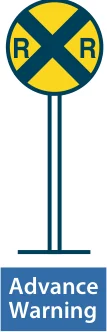
  • Advance warning signs: slow down, look and listen, be ready to stop for a train
  • Pavement markings: an R-X-R followed by a stop line closer to the tracks; stay behind the stop line
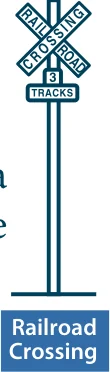
  • Crossbuck signs: yield signs; a sign below shows how many tracks there are
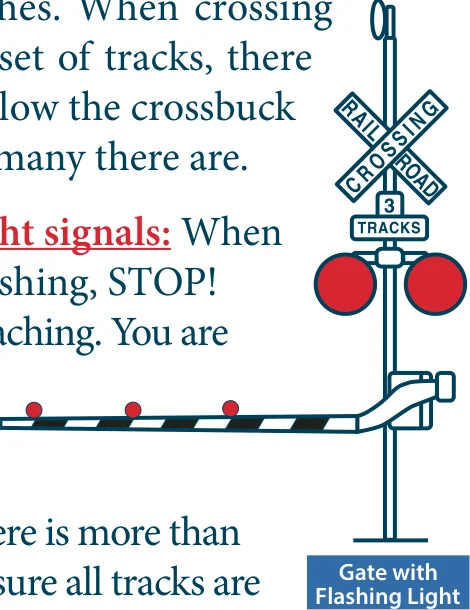
  • Flashing red light signals, alone or with gates
Handbook p. 66 ↗
Railroad crossing ahead
Round advance warning sign
Railroad crossbuck
Crossbuck with number of tracks

Know the rule

You are legally required to yield the right of way to trains. At a crossbuck, slow down, look and listen, and stop if a train approaches.

Handbook p. 66 ↗

Know the rule

Flashing red lights mean STOP: a train is approaching. With more than one track, make sure all tracks are clear before crossing.

Handbook p. 66 ↗

Know the rule

With gates: stop when the lights begin to flash, before the spot where the gate will lower. Stay stopped until the gates go up and the lights stop flashing.

Handbook p. 66 ↗
Railroad crossing gate with flashing lights
Gate with flashing lights

Know the rule

A round sign warns of a railroad crossing ahead. A stop line or an X with the letters RR may be painted on the pavement instead, or any combination may be used.

Handbook p. 96 ↗

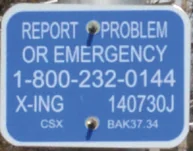
Emergency Notification Sign (ENS)

A sign used for emergencies that would require stopping train traffic, such as an obstruction on the tracks, or lights or gates not working properly.

Handbook p. 96 ↗
Railroad crossing emergency notification sign
Emergency Notification Sign at a railroad crossing

Know the rule

Stop when a flag person signals you at or near a railroad crossing.

Handbook p. 50 ↗

Highway-rail intersection safety:

  • Always expect a train at every crossing
  • Never drive onto the tracks unless you can clear the other side without stopping
  • Gates down means the road is closed: stop and wait; NEVER drive around gates
  • At multiple tracks, look and listen for another train from either direction
  • NEVER race a train to a crossing
  • NEVER pass another vehicle at a highway-rail crossing
Handbook p. 85 ↗

Know the rule

If your vehicle stalls on the tracks, get everyone out and far away immediately. Never try to restart or push it with passengers inside. Call 911.

Handbook p. 85 ↗

Put it into practice

A train clears the crossing and the gates stay down with lights still flashing. Stay stopped: a second train may be coming on another track. Go only after the gates are up, the lights stop, and you've checked every track.

Check your understanding

Read the question, decide on an answer, then open it to check the explanation. These are Roadwise study questions based on the source handbook.

What are crossbuck signs at a railroad crossing legally equivalent to?
  1. Yield signs, requiring you to yield to trains
  2. Stop signs, requiring a complete stop every time
  3. Warning signs with no legal requirement
  4. Stop signs, but only when a train is visible

Answer: Yield signs, requiring you to yield to trains

Crossbuck signs are yield signs; you are legally required to yield the right of way to trains.
Handbook p. 66 ↗
What should you do when flashing red lights begin at a railroad crossing without gates?
  1. Speed up to cross before the train arrives
  2. Stop, since a train is approaching
  3. Proceed with caution at reduced speed
  4. Only slow down if you can see the train

Answer: Stop, since a train is approaching

When the lights are flashing at a railroad crossing, stop; a train is approaching and you are legally required to yield.

Handbook p. 66 ↗
At a railroad crossing with gates, when should you stop?
  1. Only once the gate has fully lowered
  2. Only if you can see an approaching train
  3. When the lights begin to flash
  4. When the train reaches the crossing

Answer: When the lights begin to flash

Stop when the lights begin to flash and before the area where the gate will lower across your lane.

Handbook p. 66 ↗
A sign below a crossbuck indicates multiple sets of tracks. What must you do before crossing?
  1. Only check the nearest track
  2. Cross as soon as the first train passes
  3. Assume only one train can be present at a time
  4. Make sure all tracks are clear before crossing

Answer: Make sure all tracks are clear before crossing

If there is more than one track, make sure all tracks are clear before crossing, since another train could be coming.

Handbook p. 66 ↗
If your vehicle stalls on a highway-rail intersection, what should you do?
  1. Get everyone away from the tracks at once
  2. Try to push the vehicle off the tracks with passengers inside
  3. Wait inside with hazards flashing
  4. Attempt to restart the engine repeatedly before exiting

Answer: Get everyone away from the tracks at once

If your vehicle stalls on a highway-rail intersection, get everyone out and far away from the tracks immediately, then call 911.

Handbook p. 85 ↗
What should you always expect at every highway-rail intersection, according to the handbook?
  1. No trains, unless gates are already down
  2. A train, even if none is immediately visible
  3. Trains only during daytime hours
  4. Trains only if a sign specifically warns of one

Answer: A train, even if none is immediately visible

Always expect a train at every highway-rail intersection, and never assume the tracks are clear.

Handbook p. 85 ↗
Take the lesson checkpoint in the app

More in Signs, Signals & Road Markings