roadwise.Open study app

Wyoming driving lesson · Signs, Signals & Road Markings

Lane use and pavement markings

A 3-minute lesson from the Wyoming course. Read the rules and examples, follow the handbook page references, and check your understanding before you move on.

Read time
3 minutes
Course unit
Signs, Signals & Road Markings
Checkpoint questions
6
Source pages
62, 63, 64, 65, 92

Lines on the road tell you which way traffic flows and whether you may pass or change lanes. Color tells direction; solid or broken tells permission. Lane signs and arrows tell you where a lane must go.

Know the rule

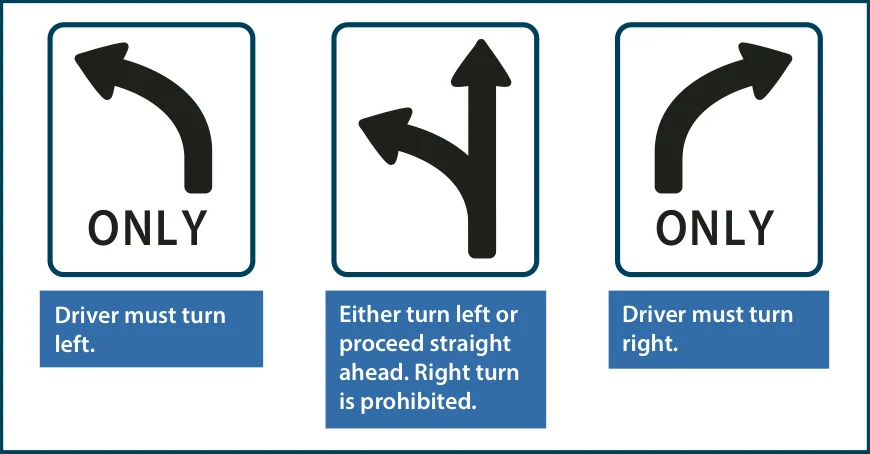
Overhead lane signs tell you which way you must go. If the sign says ONLY, you must go the way the arrow points. Arrows painted on the road mean the same as overhead arrows.

Handbook p. 63 ↗
Lane use control signs
Lane-use signs: must turn left; turn left or go straight (right turn prohibited); must turn right

Lane

A section of roadway for a single line of vehicles.

Handbook p. 92 ↗

Know the rule

On a two-lane road (one lane each way), drive on the right and yield the left half of the roadway to oncoming traffic.

Handbook p. 63 ↗

Choosing a lane on multilane roads:

  • Drive in the lane with the smoothest flow; it keeps a safe space cushion and saves gas
  • With three or more lanes one way, the middle lane or lanes are usually smoothest
  • The left lane is for drivers who want to go faster, pass or turn left
  • Slower drivers and those turning right use the right lane
  • With two lanes one way, the right lane is usually smoothest
  • Where there are special left-turn lanes, the left lane may be smoothest
Handbook p. 63 ↗

Pavement markings

Pavement markings
MarkingMeaning
White linesSeparate traffic going the same direction
Yellow linesSeparate traffic going opposite directions
Broken linesPassing or lane changing allowed if clear
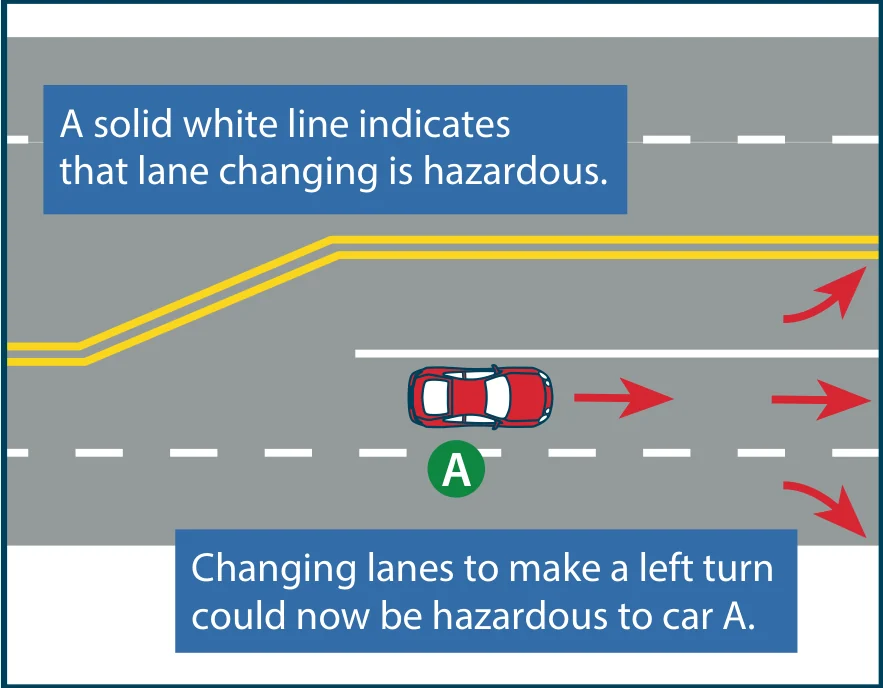
Solid white linePassing or lane changing is hazardous
Solid yellow lineNo passing or lane changing
Handbook p. 63 ↗

Know the rule

You may cross a solid yellow line only to make a left turn into or from an alley, private road or driveway.

Handbook p. 63 ↗
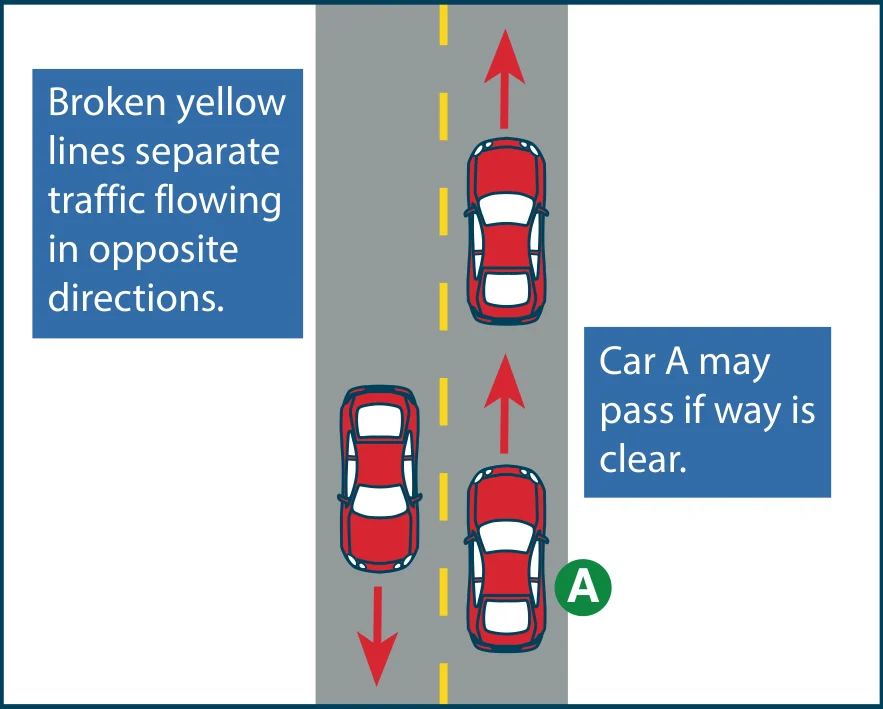
Broken yellow center line
Broken yellow line: car A may pass if the way is clear
Solid white line
Solid white line: lane changing is hazardous
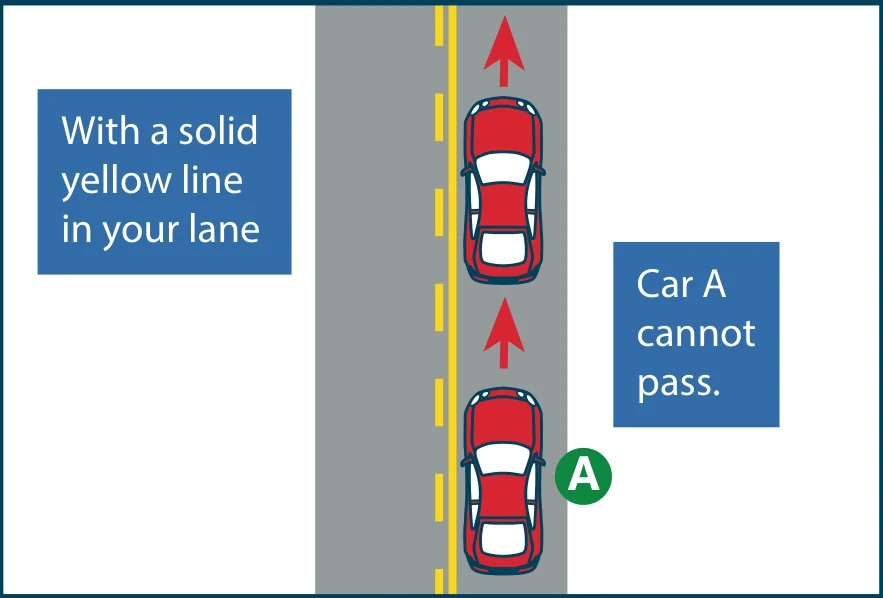
Solid yellow line (no passing)
Solid yellow line in your lane: car A cannot pass
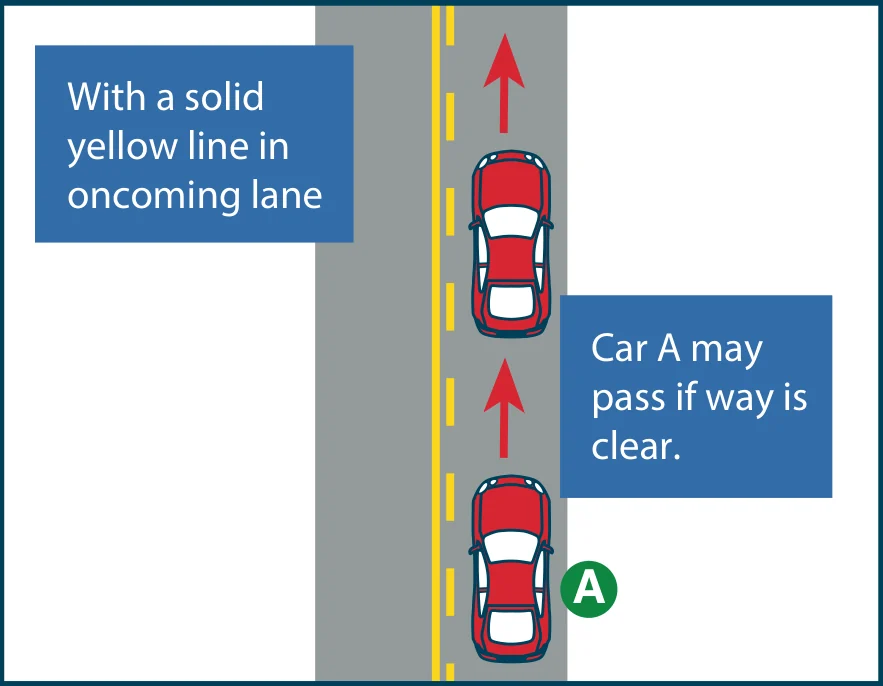
Solid yellow line (oncoming lane, passing allowed)
Solid yellow line in the oncoming lane: car A may pass if clear
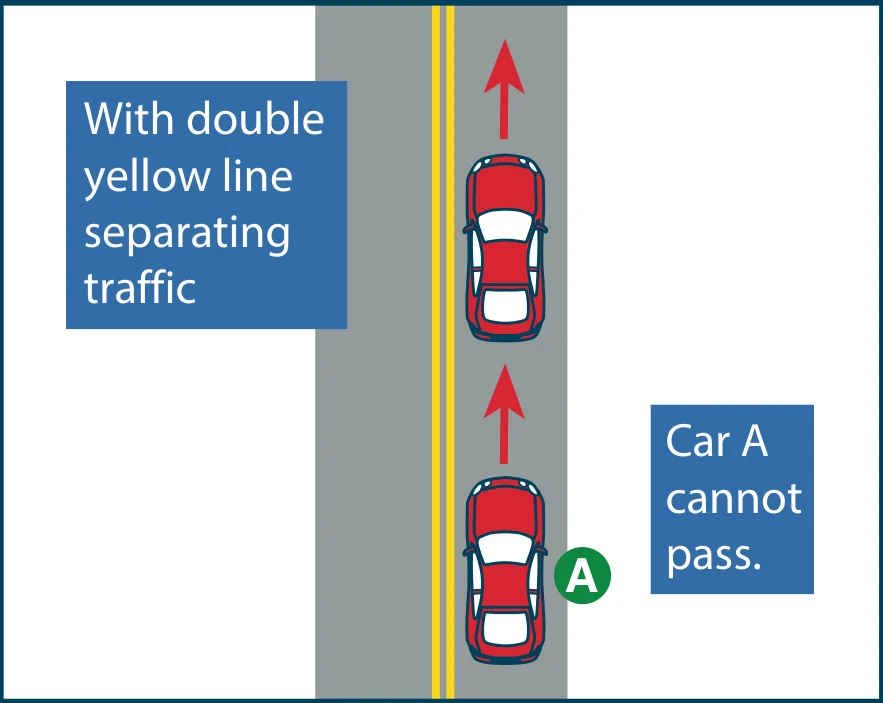
Double solid yellow lines
Double yellow line: car A cannot pass

Put it into practice

On a two-lane highway, your side has a broken yellow line and the oncoming side has a solid yellow line. You may pass when the way is clear. Oncoming drivers, with the solid line on their side, may not.

Check your understanding

Read the question, decide on an answer, then open it to check the explanation. These are Roadwise study questions based on the source handbook.

A solid yellow line on your side with a broken yellow line on the oncoming side means you may pass if the way is clear.
  1. True
  2. False

Answer: False

The p.65 diagrams show that with a solid yellow line in your lane Car A cannot pass; passing is allowed only when the solid line is in the oncoming lane.
Handbook p. 65 ↗
What do white lane lines indicate?
  1. Traffic flowing in opposite directions
  2. A no-passing zone only
  3. Traffic going in the same direction
  4. A pedestrian crossing

Answer: Traffic going in the same direction

White lines separate traffic going in the same direction.

Handbook p. 63 ↗
What do yellow lane lines indicate?
  1. Traffic going in the same direction
  2. A bicycle lane
  3. A parking lane
  4. Traffic flowing in opposite directions

Answer: Traffic flowing in opposite directions

Yellow lines separate traffic flowing in opposite directions.

Handbook p. 63 ↗
What does a solid white line indicate about changing lanes?
  1. That lane changing is permitted if clear
  2. That lane changing is hazardous
  3. That traffic flows in opposite directions
  4. That lane changing is allowed only to turn left

Answer: That lane changing is hazardous

Solid white lines indicate that passing or lane changing is hazardous.

Handbook p. 63 ↗
When is it legal to cross a solid yellow line in your lane?
  1. Whenever traffic is light
  2. Anytime you are passing a bicyclist
  3. When turning left into an alley or driveway
  4. Never, under any circumstance

Answer: When turning left into an alley or driveway

Solid yellow lines indicate no passing or lane changing, unless making a left turn into or from an alley, private road, or driveway.

Handbook p. 63 ↗
With a double yellow line separating traffic, can either driver legally pass?
  1. Yes, both drivers can pass if clear
  2. Only the driver on the left side can pass
  3. Only during daylight hours
  4. No, neither driver can pass

Answer: No, neither driver can pass

With a double yellow line separating traffic, cars in either direction cannot pass.

Handbook p. 65 ↗
Take the lesson checkpoint in the app

More in Signs, Signals & Road Markings