roadwise.Open study app

Wyoming driving lesson · Lanes, Turning, Passing & Parking

Lane changes, signals, turns and backing

A 3-minute lesson from the Wyoming course. Read the rules and examples, follow the handbook page references, and check your understanding before you move on.

Read time
3 minutes
Course unit
Lanes, Turning, Passing & Parking
Checkpoint questions
6
Source pages
51, 52, 53, 54

Other drivers can't read your mind. Check your mirrors and blind spots, signal early, and get into the right lane well before you turn. When you back up, look where you're going instead of trusting your mirrors.

Before changing lanes:

  • Check your rear view and side mirrors
  • Check over your left or right shoulder for anyone in your blind spots
  • Check for other drivers who may also be moving into the same lane
  • Signal, then change lanes
Handbook p. 51 ↗

Know the rule

Don't change lanes before or while in an intersection.
Handbook p. 51 ↗

Know the rule

You must signal when turning or changing lanes.

Handbook p. 51 ↗
100 feet

Minimum distance before an intersection to start your turn signal

Handbook p. 51 ↗
4 to 5 seconds

Better signaling time before a turn at higher speeds

Handbook p. 51 ↗

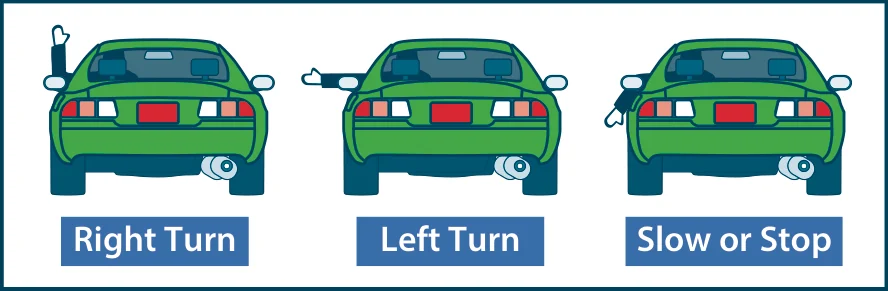
Hand and arm signals (use your left arm):

  • Right turn: hand and arm extended straight up from the elbow
  • Left turn: hand and arm extended straight out to the left
  • Slow or stop: hand and arm extended down from the elbow
Handbook p. 51 ↗
Hand signals (right turn, left turn, slow or stop)
Hand signals: right turn, left turn, slow or stop

Proper turning:

  • Plan ahead
  • Get into the proper lane well before the turn
  • Signal the direction you plan to turn
  • Slow and check for people and vehicles in your turning path
  • Turn into the proper lane
  • Adjust your speed to the flow of traffic
Handbook p. 52 ↗
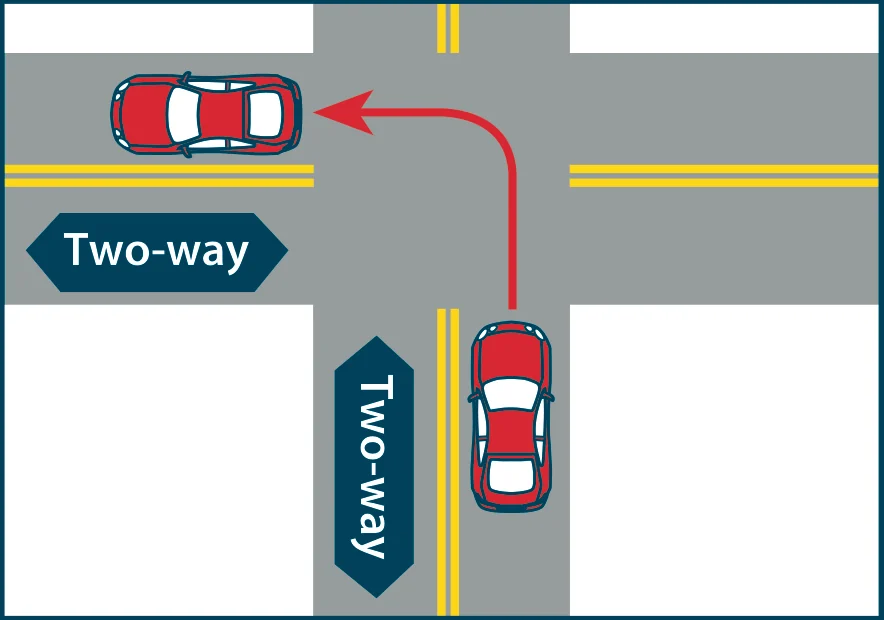
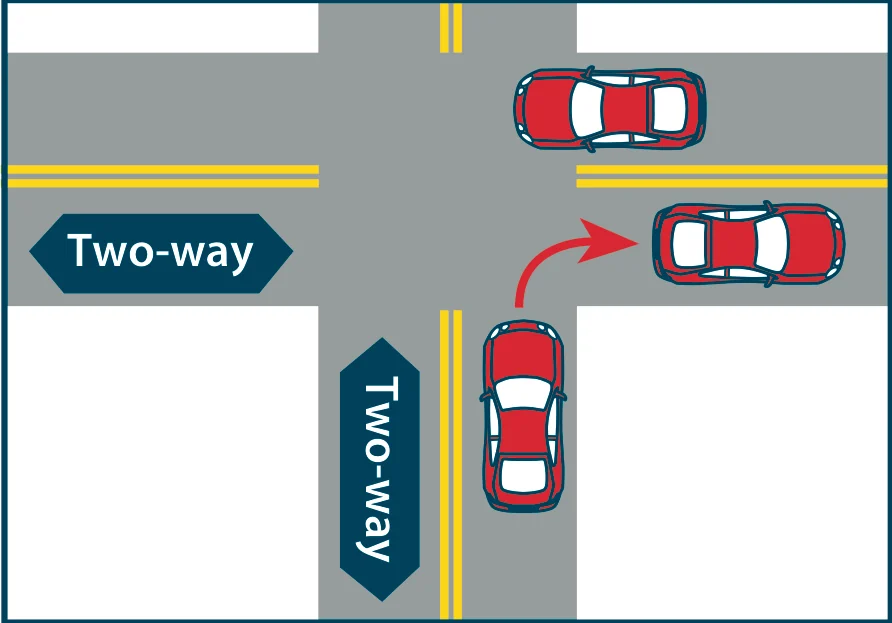
Turning maneuver between two two-way streets
Right turn from a two-way street onto a two-way street
Turning maneuver between two two-way streets (variant)
Left turn from a two-way street onto a two-way street
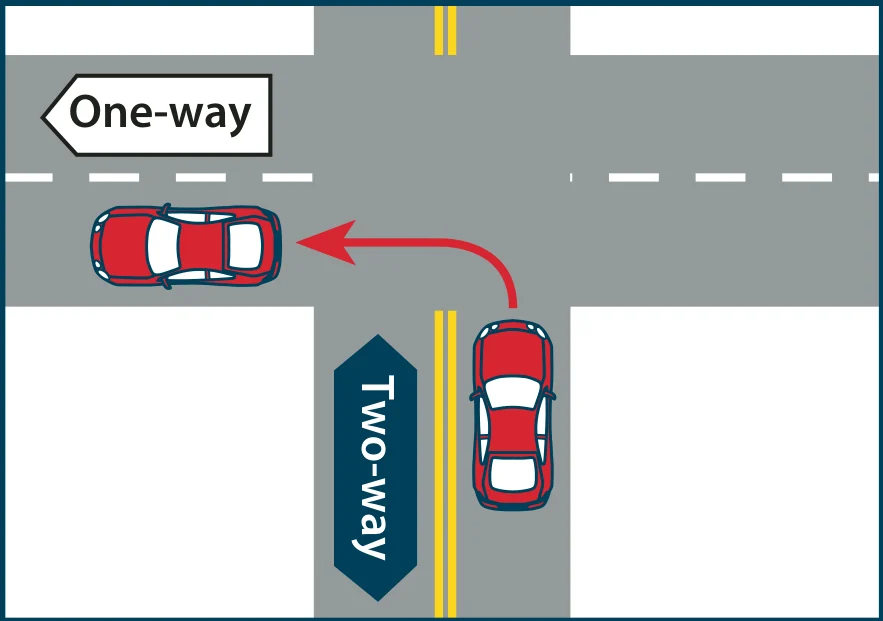
Turning from a one-way street onto a two-way street
Left turn from a two-way street onto a one-way street
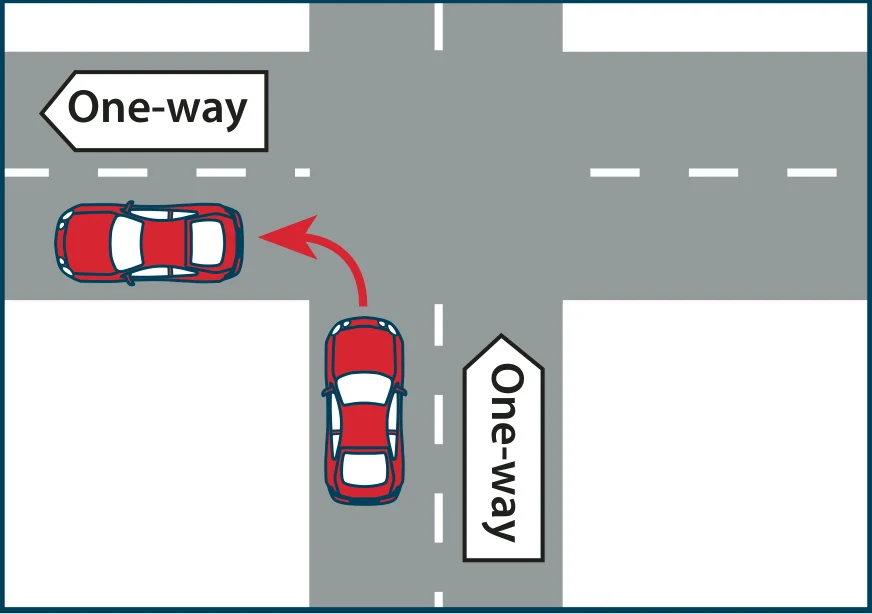
Turning between two one-way streets
Left turn from a one-way street onto a one-way street

Backing safely:

  • Walk behind your vehicle to check before you back up
  • Don't depend on your mirrors; turn your head and body to see where you're going
  • Put your hand at the top of the steering wheel and back up slowly
  • Always be prepared to stop
Handbook p. 54 ↗

Put it into practice

You're doing 50 mph and plan to turn right at the next intersection. The law says signal at least 100 feet before it, but at this speed signal 4 to 5 seconds before the turn, and move into the right lane well ahead.

Check your understanding

Read the question, decide on an answer, then open it to check the explanation. These are Roadwise study questions based on the source handbook.

It is legal to change lanes while inside an intersection.
  1. True
  2. False

Answer: False

Do not change lanes before or while in an intersection.
Handbook p. 51 ↗
Before changing lanes, what must you check in addition to your mirrors?
  1. Only the vehicle directly ahead
  2. Over your shoulder at your blind spots
  3. Your speed compared with the posted limit
  4. The road shoulder for parked cars

Answer: Over your shoulder at your blind spots

Before changing lanes, check your mirrors, check over your shoulder to make sure no one is in your blind spot, then signal.

Handbook p. 51 ↗
How far from an intersection must a driver signal a turn, at minimum?
  1. At least 50 feet
  2. At least 300 feet
  3. At least 100 feet
  4. At least 25 feet

Answer: At least 100 feet

All drivers must signal at least 100 feet from an intersection before turning or changing lanes.

Handbook p. 51 ↗
About how many seconds before turning is it best to signal at higher speeds?
  1. 1 to 2 seconds
  2. 10 to 15 seconds
  3. Immediately before turning
  4. 4 to 5 seconds

Answer: 4 to 5 seconds

Signaling at least 4 to 5 seconds before you wish to turn is better at higher speeds.

Handbook p. 51 ↗
Using a hand and arm signal, how do you indicate a right turn?
  1. Extend your left arm and hand straight up from the elbow
  2. Extend your left arm straight out to the side
  3. Extend your right arm straight up
  4. Extend your left arm straight down

Answer: Extend your left arm and hand straight up from the elbow

For a right turn using hand signals, the hand and arm are extended straight up from the elbow, given with the left arm.

Handbook p. 51 ↗
Using a hand and arm signal, how do you indicate that you are slowing down or stopping?
  1. Extend your left arm straight up
  2. Extend your left arm straight down
  3. Extend your left arm straight out to the side
  4. Extend your right arm straight out

Answer: Extend your left arm straight down

To slow down or stop, the hand and arm are extended down from the elbow.

Handbook p. 52 ↗
Take the lesson checkpoint in the app

More in Lanes, Turning, Passing & Parking