A 4-minute lesson from the Wyoming course. Read the rules and examples, follow the handbook page references, and check your understanding before you move on.
Some things you pass need extra care. Bicyclists may swerve, parked cars may pull out, and trucks can't see you in their huge blind spots. Give each of them room, and don't linger where you can't be seen.
Passing a bicyclist:
Don't try to pass unless you have a clear and empty lane
Without enough space, slow to the cyclist's speed and follow until you have room
Avoid driving next to a bicyclist for long in a shared single lane
Reduce your speed when passing
When space allows, keep at least 3 feet between your vehicle and the bicyclist
When passing a heavy vehicle, keep a consistent speed. Before pulling back in, be sure you can see both headlights and the entire cab in your rearview mirror.
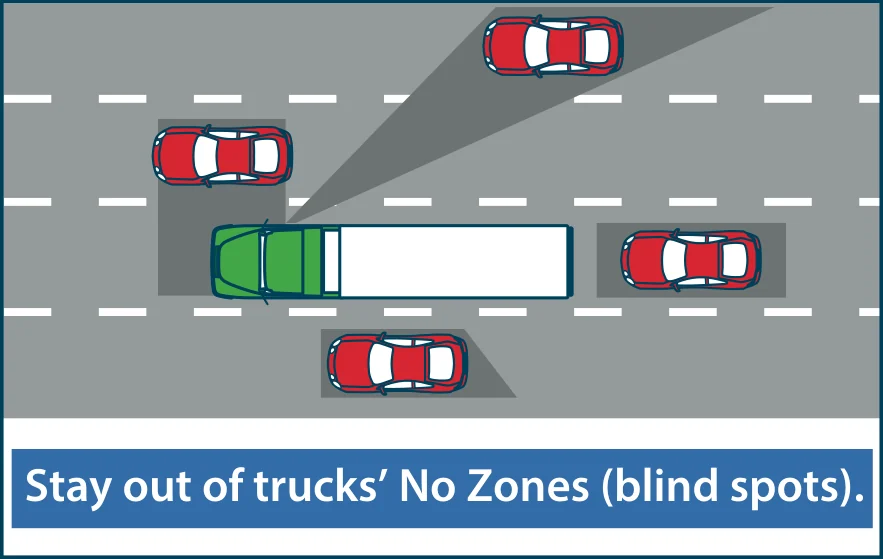
Don't loiter in a truck's blind spot, for example with cruise control set just faster than the truck, or when passing on the right. The driver can't see you or take evasive action.
A truck driver sits twice as high as a car driver and sees farther over traffic, but has large blind spots directly behind and on both sides that cars don't.
Tailgating a truck puts you in its rear No-Zone, cuts your view of traffic ahead and exposes you to debris such as ice, rocks or tire recapping material.
You're passing a tractor-trailer on the interstate. Don't pull back in as soon as you clear its bumper. Keep a steady speed until you see both of its headlights and the whole cab in your rearview mirror, then move over.
Check your understanding
Read the question, decide on an answer, then open it to check the explanation. These are Roadwise study questions based on the source handbook.
When passing a bicyclist and space allows, how much separation should you maintain?
At least 1 foot
At least 10 feet
No specific distance is required
At least 3 feet
Answer: At least 3 feet
When space allows, maintain at least 3 feet of separation between your vehicle and a bicyclist you are passing.