Roadwise States Wisconsin Driving lessons Backing & Parking Wisconsin driving lesson · The Basics
Backing & Parking A 3-minute lesson from the Wisconsin course. Read the rules and examples, follow the handbook page references, and check your understanding before you move on.
Read time 3 minutes
Course unit The Basics
Checkpoint questions 6
Source pages 22, 23, 24 Backing is hard because you can't see well behind you, so do as little as possible. Parking is about leaving your car where it isn't a hazard, and making sure it can't roll.
Know the rule
When backing is necessary, move slowly, no faster than a slow walk. Don't depend only on mirrors and a backup camera.
Handbook p. 22 ↗ Know the rule
Turn your body and look over your right shoulder through the rear window. Use a helper outside the car when possible, and scan left and right before moving back into traffic.
Handbook p. 22 ↗ Know the rule
If you miss your exit or turn, don't back up. Go to the next exit and re-enter the road.
Handbook p. 22 ↗ Know the rule
Park far enough from any travel lane to avoid interfering with traffic, normally on the far-right side of the road, and park at a very low speed.
Handbook p. 22 ↗ Parking is not allowed Where there are yellow markings on the curb In front of fire hydrants Where “No Parking” signs are posted Handbook p. 22 ↗ Know the rule
On a level surface, put the vehicle in Park (or in gear for a manual transmission) and set the parking brake.
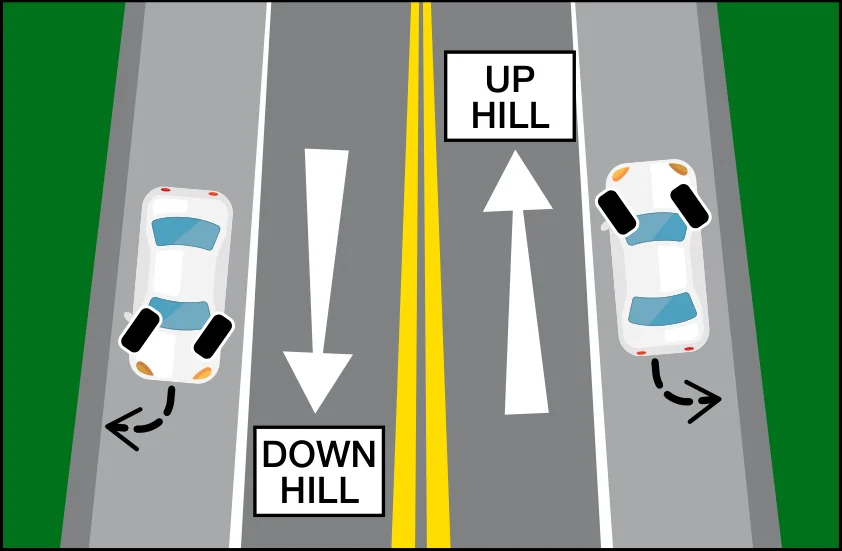
Handbook p. 22 ↗ Hill parking: turn your wheels all the way, then set the emergency brake Handbook p. 23 ↗ Wheel positions for downhill and uphill parking 3–6 feet How much longer than your vehicle a parallel parking space should be
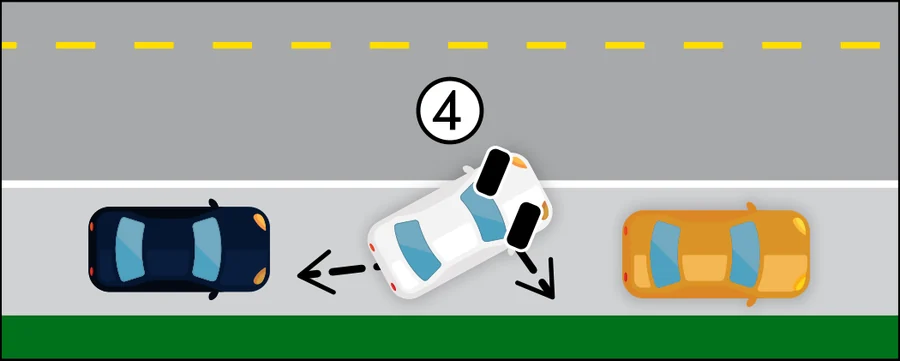
Handbook p. 23 ↗ Parallel parking steps Signal. Stop evenly with the vehicle ahead of the space, about 2 feet away from it Turn the wheel all the way toward the curb side and slowly back up When your front door passes its back bumper, straighten the wheel and keep backing slowly When your bumper clears the vehicle in front, turn sharply the opposite way; back until parallel Straighten your wheels Handbook p. 24 ↗ At least 2 feet From the vehicles in front of and behind you when parallel parked
Handbook p. 24 ↗ Parallel parking: turning sharply the other way to straighten out Put it into practice
You park facing uphill on a street with a curb. Turn your wheels all the way to the left before shifting to Park, then set the emergency brake.
Check your understanding Read the question, decide on an answer, then open it to check the explanation. These are Roadwise study questions based on the source handbook.
How fast should you back up your vehicle? No faster than a slow walk As fast as safely possible Normal driving speed in reverse Speed doesn't matter if mirrors are clear Answer: No faster than a slow walk
Back up no faster than a slow walk.
Handbook p. 22 ↗ Where is parking prohibited, according to the handbook? Only within 100 feet of an intersection In front of fire hydrants and at yellow curb markings Only on streets without sidewalks Anywhere on a residential street Answer: In front of fire hydrants and at yellow curb markings
Parking is not allowed at yellow curb markings or in front of fire hydrants.
Handbook p. 22 ↗ Parked facing uphill on a street with a curb, which way should you turn your front wheels? It doesn't matter Keep them straight All the way to the left All the way to the right Answer: All the way to the left
Parked uphill with a curb, turn your wheels all the way to the left.
Handbook p. 23 ↗ Parked facing downhill, which way should you turn your front wheels? Keep them straight ahead All the way to the left Left, if there is a curb All the way to the right Answer: All the way to the right
Parked downhill, move your wheels all the way to the right and set the parking brake.
Handbook p. 23 ↗ When parallel parking, about how much longer than your vehicle should the parking space be? 1 to 2 feet longer 3 to 6 feet longer Exactly the same length At least 10 feet longer Answer: 3 to 6 feet longer
Find a parking space about 3-6 feet longer than your vehicle.
Handbook p. 23 ↗ When you finish parallel parking, about how far from the curb should your vehicle be? About a foot About 2 feet About 3 feet About 6 feet Answer: About a foot
You should end up about a foot from the curb and at least 2 feet from the vehicles in front and behind.
Handbook p. 24 ↗ Previous lesson Passing & Changing Lanes Next lesson Communication: Horn, Lights & Signals About the source Roadwise’s Wisconsin course uses the driver handbook edition supplied with this study pack. This lesson cites source pages 22, 23, 24. The linked PDF is a third-party mirror of the handbook, rather than a government-hosted page.
Open the handbook source PDF · View the source edition
For current application requirements, fees, appointments, and the format that applies to your age or license type, check Wisconsin’s DMV. Roadwise provides study material and does not issue permits or licenses.