roadwise.Open study app

West Virginia driving lesson · Rules of the Road

Where you may not stop or park

A 3-minute lesson from the West Virginia course. Read the rules and examples, follow the handbook page references, and check your understanding before you move on.

Read time
3 minutes
Course unit
Rules of the Road
Checkpoint questions
6
Source pages
55, 56

Many crashes happen because vehicles weren't parked properly or carefully. West Virginia law (§17C-13-3) lists places you may not stop, stand or park, several with exact distances the test loves to ask about.

Know the rule

Always park in the same direction as traffic on that side of the street, completely off the traveled part of the road. Double parking is illegal.

Handbook p. 55 ↗

Know the rule

Whenever you park and leave the vehicle, turn off the engine and set the parking (emergency) brake. Lock it and take your keys.

Handbook p. 55 ↗

Know the rule

Before getting out on the street side, look for bicycles, motorcycles or larger vehicles that could hit your open door or you.

Handbook p. 55 ↗

Know the rule

The no-stopping rules apply except to avoid a conflict with traffic or to obey a law, police officer, or traffic signal.

Handbook p. 55 ↗

No stopping, standing or parking within

No stopping, standing or parking within
DistanceOf
15 feetA fire hydrant
20 feetA crosswalk at an intersection
30 feetAny stop sign or traffic control signal
50 feetThe nearest rail of a railroad crossing
20 feetA mailbox served by a carrier using a vehicle
Handbook p. 55 ↗

Never stop, stand or park:

  • On a sidewalk or a crosswalk
  • In front of a public or private driveway
  • Within an intersection
  • In front of a wheelchair ramp or curb cut
  • Beside or opposite street work where it would obstruct traffic
Handbook p. 55 ↗

Also never stop, stand or park:

  • On the traffic side of a vehicle stopped or parked at the curb (double parking)
  • On a bridge or other elevated structure, or in a highway tunnel
  • On any controlled-access highway
  • Anywhere the safety and convenience of the traveling public is endangered
  • Where official signs prohibit parking
Handbook p. 56 ↗
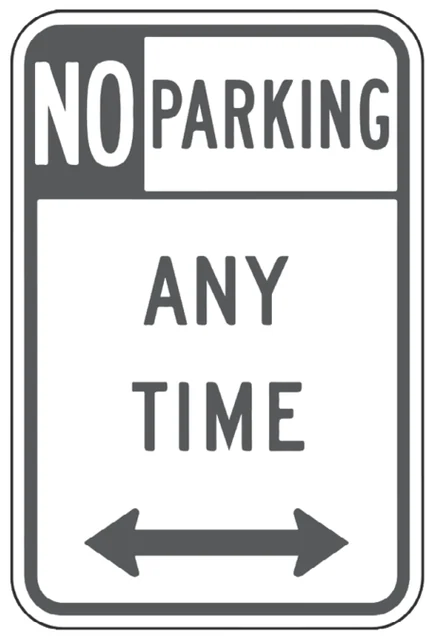
No parking any time
No parking any time sign

Know the rule

A curb in a no-parking zone may be painted yellow.

Handbook p. 56 ↗

Put it into practice

You find a curbside spot 25 feet past a stop sign, 18 feet from a hydrant. Keep looking: you need 30 feet from a stop sign. The hydrant distance (15 feet) is fine, but the stop sign rule makes this spot illegal.

Check your understanding

Read the question, decide on an answer, then open it to check the explanation. These are Roadwise study questions based on the source handbook.

How close to a fire hydrant is it illegal to park?
  1. Within 10 feet
  2. Within 20 feet
  3. Within 30 feet
  4. Within 15 feet

Answer: Within 15 feet

Parking within 15 feet of a fire hydrant is prohibited.
Handbook p. 55 ↗
How close to a crosswalk at an intersection is it illegal to park?
  1. Within 15 feet
  2. Within 30 feet
  3. Within 20 feet
  4. Within 50 feet

Answer: Within 20 feet

Parking within 20 feet of a crosswalk at an intersection is prohibited.

Handbook p. 55 ↗
How close to a stop sign or traffic control signal is it illegal to park?
  1. Within 20 feet
  2. Within 50 feet
  3. Within 15 feet
  4. Within 30 feet

Answer: Within 30 feet

Parking within 30 feet of a stop sign or traffic control signal is prohibited.

Handbook p. 55 ↗
How close to the nearest rail of a railroad crossing is it illegal to park?
  1. Within 30 feet
  2. Within 50 feet
  3. Within 100 feet
  4. Within 20 feet

Answer: Within 50 feet

Parking within 50 feet of the nearest rail of a railroad crossing is prohibited.

Handbook p. 55 ↗
How close to a mailbox served by a carrier's motor vehicle is it illegal to park?
  1. Within 20 feet
  2. Within 15 feet
  3. Within 30 feet
  4. Within 10 feet

Answer: Within 20 feet

Parking within 20 feet of a mailbox served by a motor vehicle carrier is prohibited.

Handbook p. 56 ↗
You may park on any bridge or elevated structure as long as you use your hazard lights.
  1. True
  2. False

Answer: False

Parking on any bridge, viaduct, or elevated structure is prohibited outright.

Handbook p. 56 ↗
Take the lesson checkpoint in the app

More in Rules of the Road