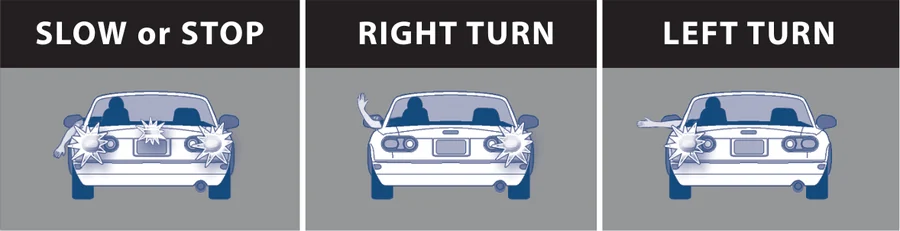
A 3-minute lesson from the West Virginia course. Read the rules and examples, follow the handbook page references, and check your understanding before you move on.
Improper turns cause many crashes, and pedestrians and bicyclists are often the victims. Signal early, turn from and into the right lane, and never back or turn around where others can't see you.
Switch off your signal after the turn. If you're turning just beyond an intersection, don't signal so early that others think you're turning at it, or so late that drivers behind can't react.
Hold the wheel with both hands, left at about 8 o'clock and right at about 4 o'clock, for maximum control and less chance an air bag knocks your hands off.
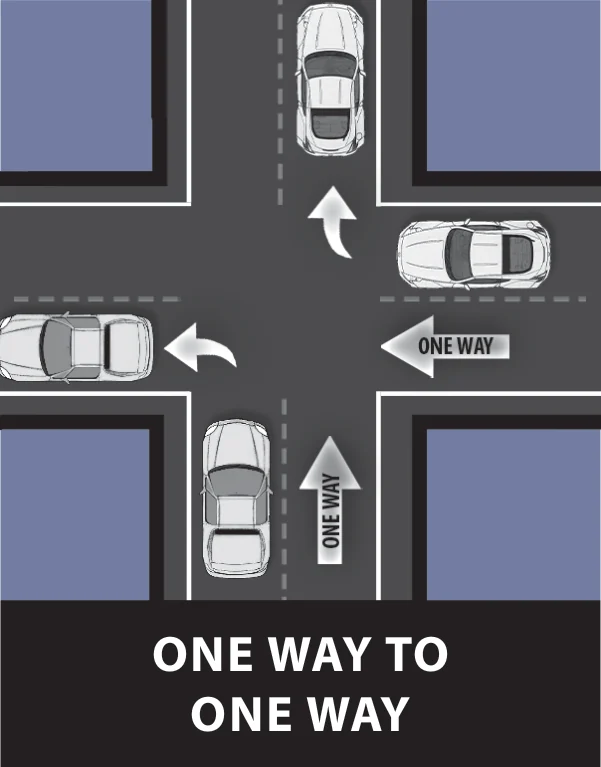
With no sign forbidding it, you may turn right on red after a complete stop and yielding to pedestrians and traffic; the same applies to left turns from one one-way street onto another.
Turning from a one-way street onto a one-way street
Know the rule
It is illegal to turn around near a curve, near the crest of a hill where vehicles within 500 feet either way can't see you, or where signs prohibit it.
You're waiting in the intersection to turn left while oncoming cars pass. Keep your wheels pointed straight ahead until the gap comes. If someone rear-ends you, you'll roll forward instead of into oncoming traffic.
Check your understanding
Read the question, decide on an answer, then open it to check the explanation. These are Roadwise study questions based on the source handbook.
How far before turning should you activate your turn signal?
At least 500 feet
At least 25 feet
At least 300 feet
At least 100 feet
Answer: At least 100 feet
You should signal at least 100 feet before turning to give other drivers time to react.