roadwise.Open study app

Washington driving lesson · Conditions and Emergencies

Night driving and curves

A 3-minute lesson from the Washington course. Read the rules and examples, follow the handbook page references, and check your understanding before you move on.

Read time
3 minutes
Course unit
Conditions and Emergencies
Checkpoint questions
6
Source pages
166, 167, 168, 169

Darkness shrinks what you can see, and curves change how your car wants to move. At night, drive so you can stop inside your headlights. In curves, do your slowing before you turn, then steer and accelerate gently.

Know the rule

Slow down before a sharp curve, when the roadway is slippery, or when there's water on the road.

Handbook p. 166 ↗
400 feet

Usual reach of your headlights' glow; drive at a speed that lets you stop within it

Handbook p. 166 ↗

At night:

  • Use high beams whenever there are no oncoming vehicles; switch to regular headlights for approaching traffic
  • Use regular headlights when following another vehicle
  • Don't look directly into oncoming headlights
  • Search beyond your headlights for dark shapes or shadows
  • Glance to the sides for the pavement edge and hazards
  • Increase following distance, especially on unfamiliar roads
Handbook p. 166 ↗

Know the rule

Don't wear sunglasses or colored lenses at night or on overcast days. Tinted or colored lenses reduce your vision.

Handbook p. 167 ↗

Know the rule

If a vehicle comes toward you with its high beams on, look toward the right side of the road.

Handbook p. 167 ↗

Driving a curve

Driving a curve
PhaseWhat to do
ApproachingSlow first, look ahead, stay slightly to the outside
In the curveSteady speed, gentle steering, be ready to adjust
ExitingAccelerate gradually and check your mirrors
Handbook p. 168 ↗

Know the rule

Uphill curves could require more acceleration; downhill curves might require more braking. Avoid braking or accelerating suddenly in the curve; it can upset your balance.

Handbook p. 168 ↗
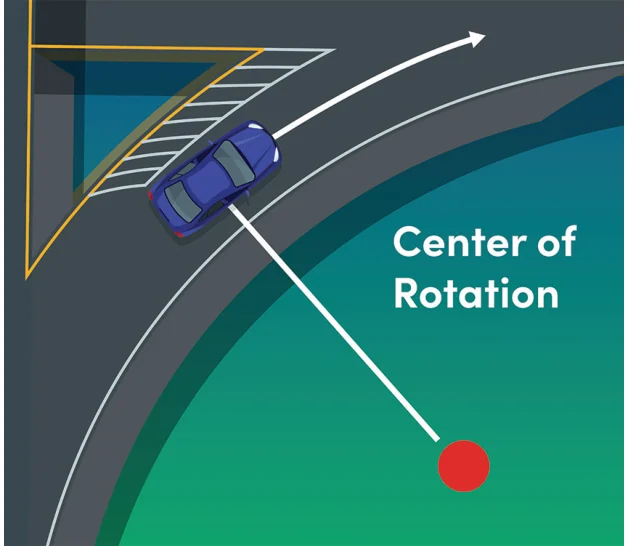
Center of rotation in a turn
Vehicle rotating through a curve

Laws of motion in a curve:

  • Roll (tilt) and yaw (side-to-side) affect control; balance them with speed and steering
  • Momentum carries you straight; the curve changes your direction
  • Inertia keeps the car moving straight if you turn suddenly, so steer smoothly
  • Kinetic energy grows with speed, needing more time and space
  • Friction between tires and road is your grip; rain, snow, or ice reduce it
Handbook p. 169 ↗

Know the rule

On slippery roads, friction in curves drops sharply. Slow down even more and avoid sudden movements.

Handbook p. 169 ↗

Put it into practice

On a dark rural highway you round a bend and see an oncoming car. Switch from high beams to regular headlights and shift your eyes to the right edge of the road instead of the glare. Keep your speed low enough to stop within your lights.

Check your understanding

Read the question, decide on an answer, then open it to check the explanation. These are Roadwise study questions based on the source handbook.

At night, you should drive at a speed that lets you stop within about how many feet?
  1. 200 feet
  2. 400 feet
  3. 100 feet
  4. 800 feet

Answer: 400 feet

Drive at a speed that lets you stop within the glow of your headlights, usually 400 feet.
Handbook p. 166 ↗
When should you use your high beams at night?
  1. When there's no oncoming traffic
  2. Only in fog
  3. Anytime you're on a two-lane road
  4. Only when following another vehicle

Answer: When there's no oncoming traffic

Use your high beams whenever there are no oncoming vehicles, switching back to regular headlights when traffic approaches.

Handbook p. 166 ↗
Approaching a curve, where should you position your vehicle within the lane?
  1. Slightly to the inside of the lane
  2. Dead center of the lane
  3. As close to the shoulder as possible
  4. Slightly to the outside of the lane

Answer: Slightly to the outside of the lane

Position slightly to the outside of the lane approaching a curve for more room and visibility.

Handbook p. 168 ↗
A vehicle with high beams is coming toward you at night. Where should you look to avoid the glare?
  1. Toward the center line
  2. At your own dashboard
  3. Toward the right edge of the road
  4. Directly at the oncoming headlights

Answer: Toward the right edge of the road

Look toward the right side of the road to avoid being distracted or blinded by oncoming high beams.

Handbook p. 167 ↗
Tinted lenses are fine for night driving as long as they're prescription corrective lenses.
  1. True
  2. False

Answer: False

Do not wear sunglasses or colored lenses when driving at night; tinted or colored lenses reduce your vision.

Handbook p. 167 ↗
At night, which headlights should you use when following another vehicle closely?
  1. Your regular headlights
  2. Your high beams
  3. Your parking lights only
  4. Your hazard lights

Answer: Your regular headlights

Use your regular headlights when following another vehicle so you don't blind the driver ahead.

Handbook p. 167 ↗
Take the lesson checkpoint in the app

More in Conditions and Emergencies