roadwise.Open study app

Washington driving lesson · Managing Risk

Focus, field of vision, and line of sight

A 3-minute lesson from the Washington course. Read the rules and examples, follow the handbook page references, and check your understanding before you move on.

Read time
3 minutes
Course unit
Managing Risk
Checkpoint questions
6
Source pages
163, 164, 165, 166

Your brain can only focus on one thing at a time, so where you put your attention matters. Good drivers keep their mind and eyes on the task, use all three kinds of vision, and keep shifting focus between where they are and where they want to be.

Be mindful:

  • Be mentally present: turn off distractions like your phone and in-car entertainment
  • Be prepared: anticipate hazards by scanning ahead
  • Be proactive: adjust speed and behavior for road, weather, and traffic
Handbook p. 163 ↗

Know the rule

Distractions, even for a few seconds, can have devastating consequences. Align your mental attention and visual focus; your attention is your most valuable asset on the road.

Handbook p. 163 ↗

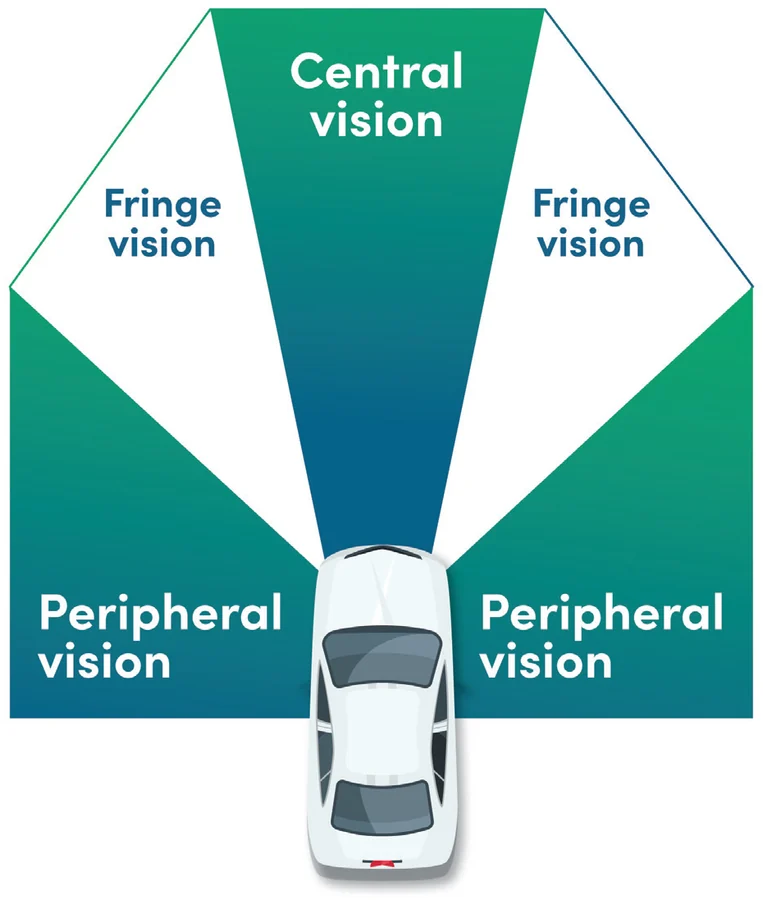
Three types of vision

Three types of vision
TypeWhat it sees
CentralDetail straight ahead, like reading these words
FringeThe edges around your focus; seen but not sharp
PeripheralTo the side, without losing focus on what's ahead
Handbook p. 164 ↗
Field of vision (central, fringe, peripheral)
Central, fringe, and peripheral vision

Know the rule

Higher speeds reduce the quality of all three types of vision.

Handbook p. 164 ↗

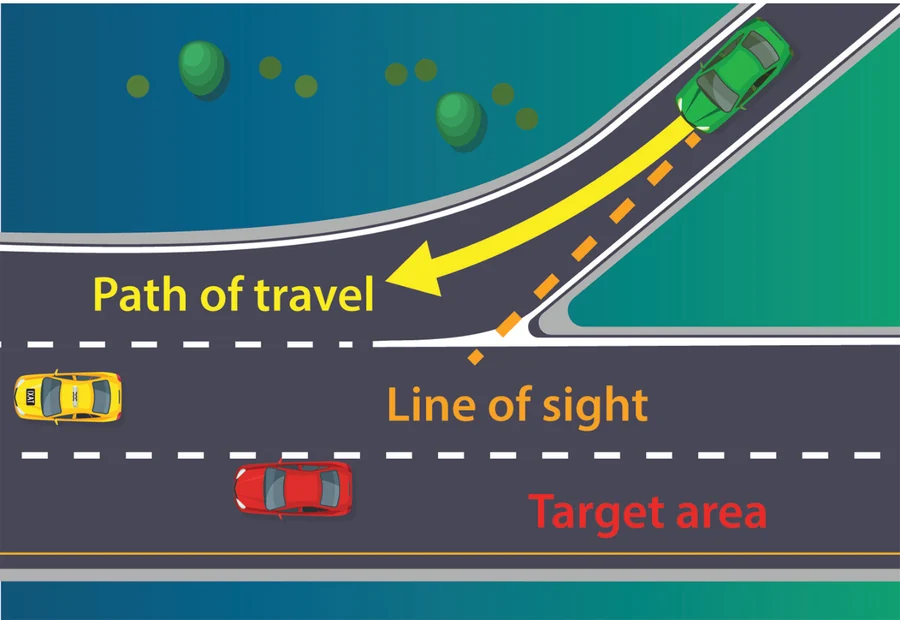
Path of travel

The route or course you drive to get from one place to another. You'll often need to change it for a hazard, weather, or a new direction.

Handbook p. 165 ↗

Line of sight

What's between you and the target area where you want to be.

Handbook p. 165 ↗
Line of sight and target area
Path of travel, line of sight, and target area

Divide your visual focus and attention among:

  • Your path of travel
  • Your line of sight
  • Your intended target area
  • Present and potential hazards
  • Your vehicle, inside and out
  • Other road users
  • Yourself
Handbook p. 166 ↗

Know the rule

Scanning your path of travel and line of sight is continuous. Form habits of constant vigilance and minimal distractions.

Handbook p. 166 ↗

Put it into practice

You plan to move into the left lane to pass a bus. Your target area is the open space beside the bus. Glance along your line of sight to that spot, back to your current path, then to your mirror, switching quickly until the move is safe.

Check your understanding

Read the question, decide on an answer, then open it to check the explanation. These are Roadwise study questions based on the source handbook.

Which type of vision lets you see fine detail straight ahead, like reading a sign?
  1. Fringe vision
  2. Peripheral vision
  3. Night vision
  4. Central vision

Answer: Central vision

Central vision allows you to see detail straight in front of you.
Handbook p. 164 ↗
Which type of vision covers the edges of your view, visible but not sharply focused?
  1. Peripheral vision
  2. Tunnel vision
  3. Fringe vision
  4. Central vision

Answer: Fringe vision

Fringe vision covers the edges of your view, which you can see but isn't very focused.

Handbook p. 164 ↗
How does higher speed affect your three types of vision?
  1. It only affects night vision
  2. It degrades all three types
  3. It has no effect on vision quality
  4. It improves peripheral vision only

Answer: It degrades all three types

Higher speeds reduce the quality of central, fringe, and peripheral vision alike.

Handbook p. 164 ↗
What is your 'line of sight' while driving?
  1. What's between you and your target area
  2. The distance your headlights reach at night
  3. Your rearview mirror's field of view
  4. The width of the lane you're in

Answer: What's between you and your target area

Once you pick a target area, your line of sight is what's between you and that target.

Handbook p. 165 ↗
Your brain can really only focus on one thing at a time, so eliminating distractions matters.
  1. True
  2. False

Answer: True

The handbook notes your brain can only focus on one thing at a time, making distraction elimination essential.

Handbook p. 163 ↗
What does your 'path of travel' refer to while driving?
  1. Your vehicle's current speed
  2. The route or course you drive to get from one place to another
  3. Only the lane markings on the road
  4. The distance your headlights illuminate

Answer: The route or course you drive to get from one place to another

Your path of travel is the route or course you take to get from one place to another.

Handbook p. 165 ↗
Take the lesson checkpoint in the app

More in Managing Risk