roadwise.Open study app

Tennessee driving lesson · Sharing the Road

Sharing the road with trains

A 4-minute lesson from the Tennessee course. Read the rules and examples, follow the handbook page references, and check your understanding before you move on.

Read time
4 minutes
Course unit
Sharing the Road
Checkpoint questions
6
Source pages
127, 128

You don't really share the road with trains — you stop and let them have it. A train can't stop quickly or swerve, so if you're on a collision course, only you can prevent the crash. Drivers must ALWAYS yield to trains; it's the law.

Train facts

  • Average car: 3,000 pounds. Average loaded train: 12 million pounds
  • A train at 55 mph needs a full mile to stop
  • You're 30 times more likely to die hitting a train than a car or truck
  • Over half of crashes happen at crossings with lights, bells or gates
  • Two-thirds happen in full daylight, most within 25 miles of home
  • A train takes 30 seconds to 2 minutes to pass — impatience kills
Handbook p. 127 ↗

Know the rule

Crossing warnings include the round yellow advance sign, the crossbuck, pavement markings, and at busy crossings red flashing lights and gates. Expect a train on any track at any time — don't trust a schedule.

Handbook p. 127 ↗

Know the rule

At a crossing with a stop sign, stop completely and look both ways before crossing.

Handbook p. 127 ↗

Know the rule

Never drive around a lowered gate — it's illegal. Wait until the gates are fully up and the lights stop flashing.

Handbook p. 127 ↗

Know the rule

At crossings with electric or mechanical signals, stop within 50 feet but no closer than 15 feet from the nearest rail, and go only when safe.

Handbook p. 127 ↗

Know the rule

If the lights start flashing or the gates begin to drop while you're on the tracks, keep moving — you have time, and the far gate won't block you in. Never try to back up.

Handbook p. 128 ↗

If your car stalls on the tracks

  • Get everyone out immediately and away from the tracks, even if no train is in sight
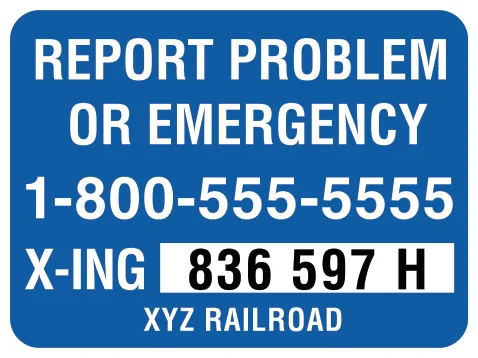
  • Find the blue Emergency Notification System (ENS) sign on the crossbuck or signal post
  • Call its number and give the DOT crossing number
  • No ENS sign? Call 911
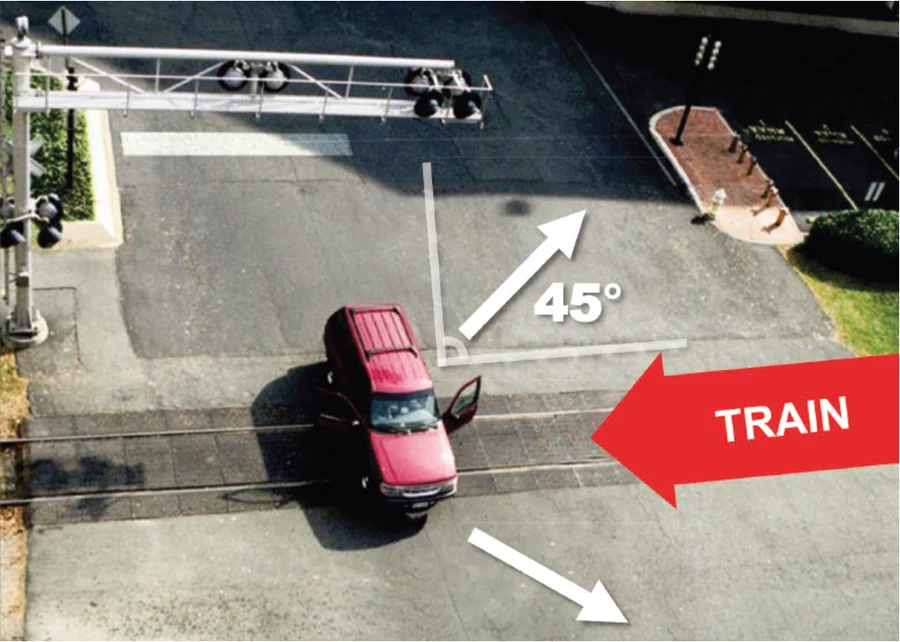
  • If a train is coming, run toward it at a 45-degree angle, away from the tracks
Handbook p. 128 ↗
Railroad crossing approach angle
Run toward the train at a 45-degree angle
Railroad emergency notification sign
Emergency Notification System sign

Know the rule

At multi-track crossings, after one train passes, make sure no other train is coming on another track before you cross.

Handbook p. 128 ↗

Know the rule

School buses, passenger buses and hazmat trucks stop at every crossing. Never pass them on a two-way road; on a multi-lane road pass only if the crossing's lights or gates are clearly not activated.

Handbook p. 128 ↗
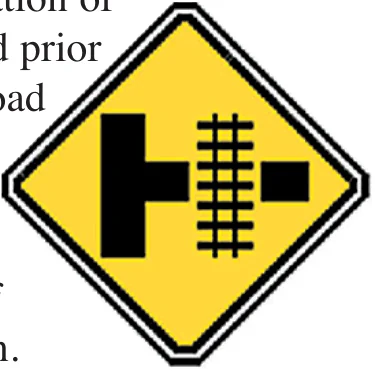
Intersection with railroad crossing ahead
Railroad crossing near an intersection warning sign

Put it into practice

Your car dies on the tracks. Don't keep cranking the engine. Get everyone out and well away, call the number on the blue ENS sign with the crossing number — and if a train appears, move toward it at an angle so debris flies past you.

Check your understanding

Read the question, decide on an answer, then open it to check the explanation. These are Roadwise study questions based on the source handbook.

If your vehicle stalls on railroad tracks and a train is not visible, you should:
  1. Stay in the vehicle and try to restart it
  2. Attempt to push the vehicle off the tracks alone
  3. Get out and move away from the tracks
  4. Wait inside the vehicle for police to arrive

Answer: Get out and move away from the tracks

If your vehicle stalls on the tracks, all occupants should exit immediately and get away from the tracks, even without seeing a train.
Handbook p. 128 ↗
If a train is approaching a vehicle stalled on the tracks, which way should occupants run?
  1. Away from the train, straight down the tracks
  2. In the same direction the train is traveling
  3. Directly across to the opposite side of the tracks
  4. Toward the train at a 45-degree angle

Answer: Toward the train at a 45-degree angle

Running toward the train at a 45-degree angle moves you away from and behind the point of impact and flying debris.

Handbook p. 128 ↗
A train traveling at 55 miles per hour needs approximately how far to come to a complete stop?
  1. 500 feet
  2. A full mile
  3. 100 yards
  4. A quarter mile

Answer: A full mile

A train traveling at 55 m.p.h. takes a full mile to stop, far longer than a car or even a large truck.

Handbook p. 127 ↗
You are how many times more likely to die in a collision with a train compared to a car or large truck?
  1. 3 times more likely
  2. 300 times more likely
  3. 30 times more likely
  4. Equally likely

Answer: 30 times more likely

The handbook states you are 30 times more likely to die in a collision with a train than with a car or large truck.

Handbook p. 127 ↗
About what fraction of train-vehicle collisions in America happen at crossings with lights, bells, or gates?
  1. Less than 5 percent
  2. About 10 percent
  3. About one-quarter
  4. Over half

Answer: Over half

Over half of train collisions with cars happen at crossings that already had lights, bells, or gates.

Handbook p. 127 ↗
If warning lights and gates activate while you are crossing railroad tracks, you should keep moving rather than stop on the tracks.
  1. True
  2. False

Answer: True

If lights or gates activate while you're already crossing, keep moving; the system allows enough time to clear the crossing.

Handbook p. 128 ↗
Take the lesson checkpoint in the app

More in Sharing the Road