roadwise.Open study app

Tennessee driving lesson · Sharing the Road

Sharing the road with trucks & buses

A 4-minute lesson from the Tennessee course. Read the rules and examples, follow the handbook page references, and check your understanding before you move on.

Read time
4 minutes
Course unit
Sharing the Road
Checkpoint questions
6
Source pages
122, 123, 124

Big trucks aren't just big cars. A loaded tractor-trailer can weigh 80,000 pounds and stretch over 70 feet. In truck-car crashes, the car's occupants suffer 78 percent of the deaths. Knowing a truck's limits keeps you out of harm's way.

The bigger the vehicle:

  • The bigger its blind spots
  • The longer it takes to stop
  • The more room it needs to turn
  • The longer it takes you to pass
  • The more likely you are to lose in a crash
Handbook p. 123 ↗

Stopping from 55 mph

Stopping from 55 mph
VehicleDistance to stop
CarAbout 240 feet
TruckAbout 450+ feet
Handbook p. 123 ↗

No-Zones

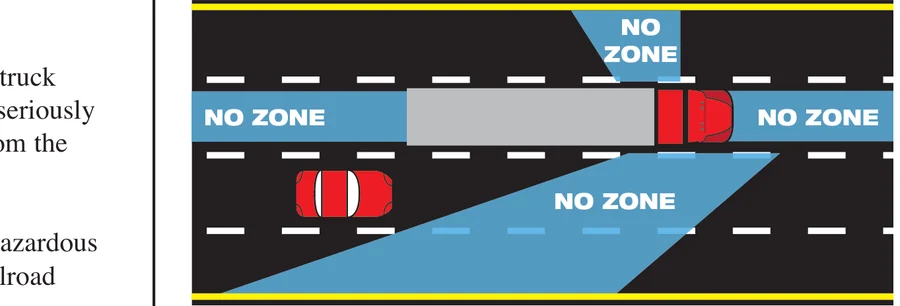
A truck's blind spots: up to about 20 feet in front, up to 200 feet behind, and large areas on both sides. If you can't see the truck's mirrors, the driver can't see you.

Handbook p. 124 ↗
Truck/bus blind spots (No-Zones)
Truck No-Zones: front, rear and both sides

Do NOT:

  • Pull out onto a road in front of a large vehicle
  • Drive directly behind a truck or bus
  • Cut abruptly in front of one, or slow down once you're in front
  • Pull back in until you see the whole front of the truck in your rearview mirror
  • Linger beside a large vehicle
  • Drive in the right lane near a weigh station, where trucks merge back
Handbook p. 123 ↗

Know the rule

Stopped behind a truck on an uphill grade? Stay to the left in your lane so the driver can see you, and leave extra space in case it rolls back.

Handbook p. 123 ↗

Right turn squeeze

Trucks swing wide left to turn right and may leave space on their right. Never move into that space or pass a truck that might be turning right.

Handbook p. 124 ↗

Know the rule

If a truck driver blinks the headlights after you pass, it's a signal you're clear to pull in. When a truck passes you, keep to the far side of your lane and slow slightly — never speed up.

Handbook p. 123 ↗

Know the rule

Meeting a truck from the other direction, keep well to the right. The wind turbulence pushes vehicles apart; it doesn't suck them together.

Handbook p. 124 ↗

Know the rule

Never cross behind a truck preparing to back up, and don't follow trucks hauling hazardous materials closely — they stop often, as at railroad crossings.

Handbook p. 124 ↗

Know the rule

On steep grades, smoking wheels or a high speed can mean a truck has lost its brakes — fall back and don't pass. Never stop or park on a runaway truck ramp.

Handbook p. 124 ↗

Know the rule

Trucks often look slower than they are because of their size. Dim your lights behind one at night — bright lights in its mirrors blind the driver.

Handbook p. 123 ↗

Put it into practice

On the interstate you're about to pass a tractor-trailer before your exit. Rather than cutting in front of it and braking for the ramp, slow down a few seconds and exit behind it.

Check your understanding

Read the question, decide on an answer, then open it to check the explanation. These are Roadwise study questions based on the source handbook.

If you cannot see a truck driver's side mirrors, this generally means:
  1. You are safely out of the No-Zone
  2. You are following at a safe distance
  3. The truck driver cannot see you either
  4. The truck's mirrors need adjusting

Answer: The truck driver cannot see you either

If you can't see the truck's side mirrors, the truck driver cannot see you — you are likely in a No-Zone.
Handbook p. 122 ↗
A car traveling at 55 m.p.h. can stop in about 240 feet. About how far does a truck traveling the same speed need to stop?
  1. 100 feet
  2. 240 feet, the same as a car
  3. 1,000 feet
  4. 450+ feet

Answer: 450+ feet

A truck traveling 55 m.p.h. needs about 450 or more feet to stop, nearly double a car's stopping distance.

Handbook p. 123 ↗
The 'Right Turn Squeeze' danger with trucks occurs because trucks:
  1. Swing wide left before turning right
  2. Always turn right without any warning
  3. Brake hard before every right turn
  4. Cut the corner over the curb

Answer: Swing wide left before turning right

Trucks must swing wide, sometimes to the left, before safely completing a right turn, creating a 'squeeze' risk for vehicles beside them.

Handbook p. 124 ↗
The No-Zone directly in front of a large truck extends approximately how far?
  1. Up to 2 feet
  2. Up to 20 feet
  3. Up to 200 feet
  4. There is no front No-Zone

Answer: Up to 20 feet

The area up to about 20 feet directly in front of a large vehicle is considered a No-Zone.

Handbook p. 124 ↗
The rear No-Zone (blind spot) behind a truck or bus can extend back as far as:
  1. 20 feet
  2. 2 feet
  3. 200 feet
  4. It does not exist for rear visibility

Answer: 200 feet

A truck's blind spots can extend up to 200 feet behind the vehicle, making tailgating a truck especially dangerous.

Handbook p. 124 ↗
When passing a large truck, you should return to your lane only when:
  1. You've passed its front bumper
  2. Ten seconds have passed
  3. You are one car length ahead
  4. You see its whole front in your mirror

Answer: You see its whole front in your mirror

You should not pull back in front of a truck until you can see its entire front end in your rearview mirror.

Handbook p. 123 ↗
Take the lesson checkpoint in the app

More in Sharing the Road