Tennessee driving lesson · Speed, Space & Stopping
Following distance: the two-second rule
A 3-minute lesson from the Tennessee course. Read the rules and examples, follow the handbook page references, and check your understanding before you move on.
When the driver ahead makes a mistake, you need time to react. A 'space cushion' gives you that time and a better view of the road. Tailgating blocks your view and causes most rear-end crashes, one of the most common kinds.
Know the rule
Tennessee law: you may not follow another vehicle more closely than is 'reasonable and prudent,' considering speed, traffic and road conditions.
On high-speed interstates, behind large trucks or buses, and in bad weather or low visibility, increase your following distance to at least 3 to 4 seconds.
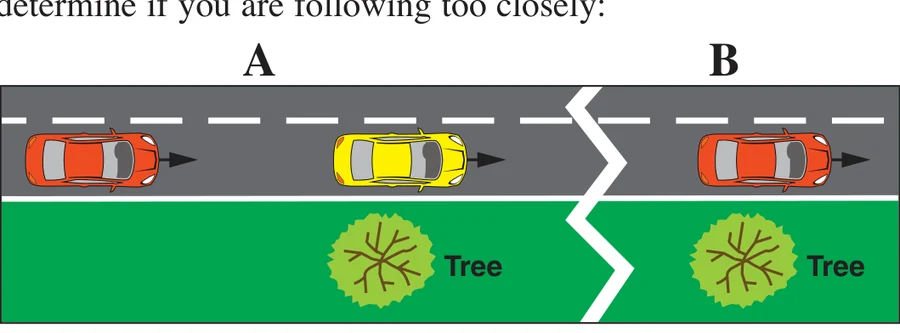
On I-40 at night in the rain, the pickup ahead passes an overpass pillar. You count 'one-thousand-one, one-thousand-two' and reach it. That's two seconds — fine on a dry day, but tonight you need at least four. Ease off the gas.
Check your understanding
Read the question, decide on an answer, then open it to check the explanation. These are Roadwise study questions based on the source handbook.
What is the minimum following distance recommended by the two-second rule under normal conditions?
Two seconds
One second
Five seconds
Ten seconds
Answer: Two seconds
The two-second rule recommends a minimum following distance of two seconds under normal conditions.
To use the two-second rule, you should count how long it takes you to reach a stationary point the car ahead just passed. If you reach it before finishing '1,001, 1,002', you are:
Following at a safe distance
Driving too slowly
Following too closely
Exceeding the speed limit
Answer: Following too closely
If you reach the marker before counting to at least 'one-thousand-two', you are following too closely and should slow down.