roadwise.Open study app

South Carolina driving lesson · Sharing the Road

Trucks & buses: the No Zones

A 3-minute lesson from the South Carolina course. Read the rules and examples, follow the handbook page references, and check your understanding before you move on.

Read time
3 minutes
Course unit
Sharing the Road
Checkpoint questions
4
Source pages
116, 117, 118

Commercial vehicles are bigger, slower to stop and far less maneuverable than cars. Many car-truck collisions could be avoided by knowing where the truck driver can't see you.

250,000+

Collisions between cars and commercial vehicles each year

Handbook p. 116 ↗

Compared to cars, commercial vehicles:

  • Are generally larger and less easily maneuverable
  • Have much larger blind spots
  • Need longer distances to stop and to accelerate
  • Need more room to turn
Handbook p. 116 ↗

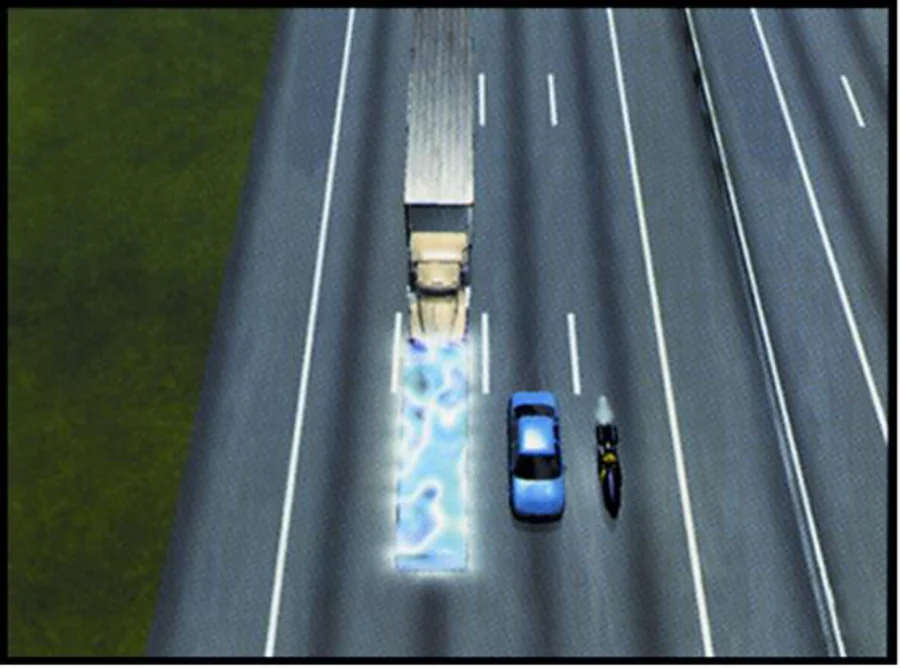
No zone

The areas around a large truck or bus (sides, rear and front) where vehicles disappear into the driver's blind spots.

Handbook p. 117 ↗

Know the rule

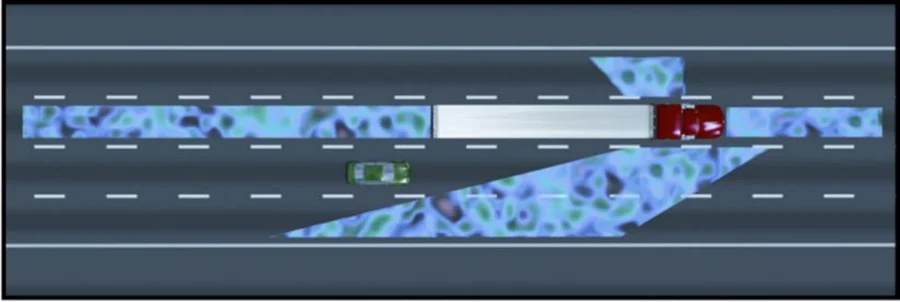
Side no zones are big on both sides. The right-side blind spot is larger, starting behind the cab and extending up to the truck's length.

Handbook p. 117 ↗

Know the rule

If you can't see the driver's face in the side mirror, the driver can't see you. Don't drive alongside a large vehicle any longer than you must.

Handbook p. 117 ↗
Truck no-zone blind spot
Side no zones of a tractor trailer
335 feet

Minimum stopping distance for a loaded truck at 55 mph in ideal conditions

Handbook p. 118 ↗

Know the rule

That's more than 1½ times a car's stopping distance, so never pull onto the road or change lanes right in front of a large vehicle.

Handbook p. 118 ↗

Know the rule

When passing a large vehicle, see its whole front in your rearview mirror before pulling in front, and keep your speed.

Handbook p. 118 ↗
Truck no-zone blind spot
Rear and front no zones

Put it into practice

You pass a tractor trailer on the interstate and want to exit just ahead of it. Don't cut in. Wait until you can see the truck's entire front in your rearview mirror, keep your speed, and move over only then.

Check your understanding

Read the question, decide on an answer, then open it to check the explanation. These are Roadwise study questions based on the source handbook.

About how many collisions occur between cars and commercial vehicles each year?
  1. About 1,000
  2. About 10,000
  3. More than 1 million
  4. More than 250,000

Answer: More than 250,000

More than 250,000 collisions occur between cars and commercial vehicles each year.
Handbook p. 116 ↗
Commercial vehicles have blind spots that are:
  1. Much larger than a car's
  2. Smaller than a car's blind spots
  3. Nonexistent due to extra mirrors
  4. Only located at the front

Answer: Much larger than a car's

Large trucks and buses have much larger blind spots, or No Zones, than regular vehicles.

Handbook p. 117 ↗
If you cannot see a truck driver's face in their side mirror, this means:
  1. The driver can always see you
  2. The driver cannot see you
  3. You are safely out of the No Zone
  4. The driver sees you on camera

Answer: The driver cannot see you

If you cannot see the driver's face in the side view mirror, he or she cannot see you.

Handbook p. 117 ↗
A loaded truck traveling at 55 mph under ideal conditions needs a minimum stopping distance of about:
  1. 100 feet
  2. 600 feet
  3. 335 feet
  4. 158 feet

Answer: 335 feet

A loaded truck traveling at 55 mph requires a minimum of 335 feet to come to a complete stop.

Handbook p. 118 ↗
Take the lesson checkpoint in the app

More in Sharing the Road